How to Define Your Brand’s Core Values
Core values are critical to establishing a strong culture at your organization.
Why are they so important?
Core values communicate what you believe as a company and how you are working together toward a shared vision.
This concept is powerful. By articulating what you stand for as a brand, you can attract better employees and customers who share your beliefs.
In fact, one study shows that organizations with employees who have shared values are nine times more likely to have high customer satisfaction.
And another study found that differentiated values that were listed on a company website led to better financial performance.
Core values matter.
Without them, your organization will create a culture by default instead of one that is powerfully working to reach your goals as a company every day.
Characteristics of Strong Core Values Statements
However, simply having core values will not make your company stronger. You must have strong values that your company believes in and stands behind for them to stick.
Before you dive in to create a list of platitudes to post in your company break room, it will help to understand what core values statements should look like.
Your organization’s core values should be…
- Memorable. Core values mean very little if your team can’t remember them. They should be words or phrases that your entire team can easily commit to memory. Short, snappy phrases seem to work best. And although there’s not a perfect number of values, your list of core values shouldn’t be so long that your team couldn’t remember them. For us, five felt like the perfect number. I would suggest you likely don’t want more than 10.
- Meaningful. Empty words or phrases will do little good for your business. For core values to be a powerful tool for your brand, they should have deep meaning for your business. In other words, these should be things that you are willing to stand behind and fight for as a business. Your core values should be something you and your team are passionate about. In fact, the strongest values statements are ones that employees would be willing to adopt personally because they believe them so strongly.
- Actionable. Because core values should guide how your team works every day, each value statement should be an action word or phrase. For instance, using a word like “integrity” doesn’t mean much because it’s vague and doesn’t articulate well how someone should act. But, phrases such as “do the right thing” or “choose honesty” are actions that show integrity. Actionable statements give much better guidance on how your team can implement the values on a daily basis.
- Well-Defined. In addition to the values statement itself, it can also help to have anecdotes, explanations or bullet points that underscore each point. If you look at our values, each one has an additional sentence or two that brings the point home. For Buffer, they have bullet points to go along with each value to articulate how to apply the statement every day. Netflix created an entire Slidedeck that explains in full detail what each value means. In other words, your values statements shouldn’t be vague. Make sure they are clearly defined so people know what they mean.
- Unique. This might go without saying, but your core values statements should reflect your culture and be unique to your business. Although there might be other businesses with similar words or statements, the entirety of the list should be unique to your brand. Don’t copy. Your core values should have your brand’s DNA.
- Timeless. Your core values should not change. And if they do, they should only change with a great deal of consideration. The idea of core values is that they are the guideposts for everything you do. That means that sometimes, it can be painful to stick to your core values because it means you will have to make tough decisions to adhere to them.
“But coming up with strong values—and sticking to them—requires real guts. Indeed, an organization considering a values initiative must first come to terms with the fact that, when properly practiced, values inflict pain. “ – Patrick M. Lencioni, Harvard Business Review
The Process for Determining Your Core Values
So, how do you determine the core values for your brand?
There are a number of ways to go about this process. Much of it will depend on the size and personality of your company.
For instance, if you’re a large corporation, the process will look much different than if you’re a startup with just a couple of employees.
But, to give you an idea of how to go through this process, I’ll share what worked for our team along with some ideas about how you can apply these ideas to your team.
1. Brainstorm ideas and combine into themes.
Since we are a small team, we started with a sticky note brainstorm session. We each had a stack of sticky notes, we set a timer and we wrote down answers to these questions:
- What do we stand for?
- What do we value most?
- What do we believe as a company?
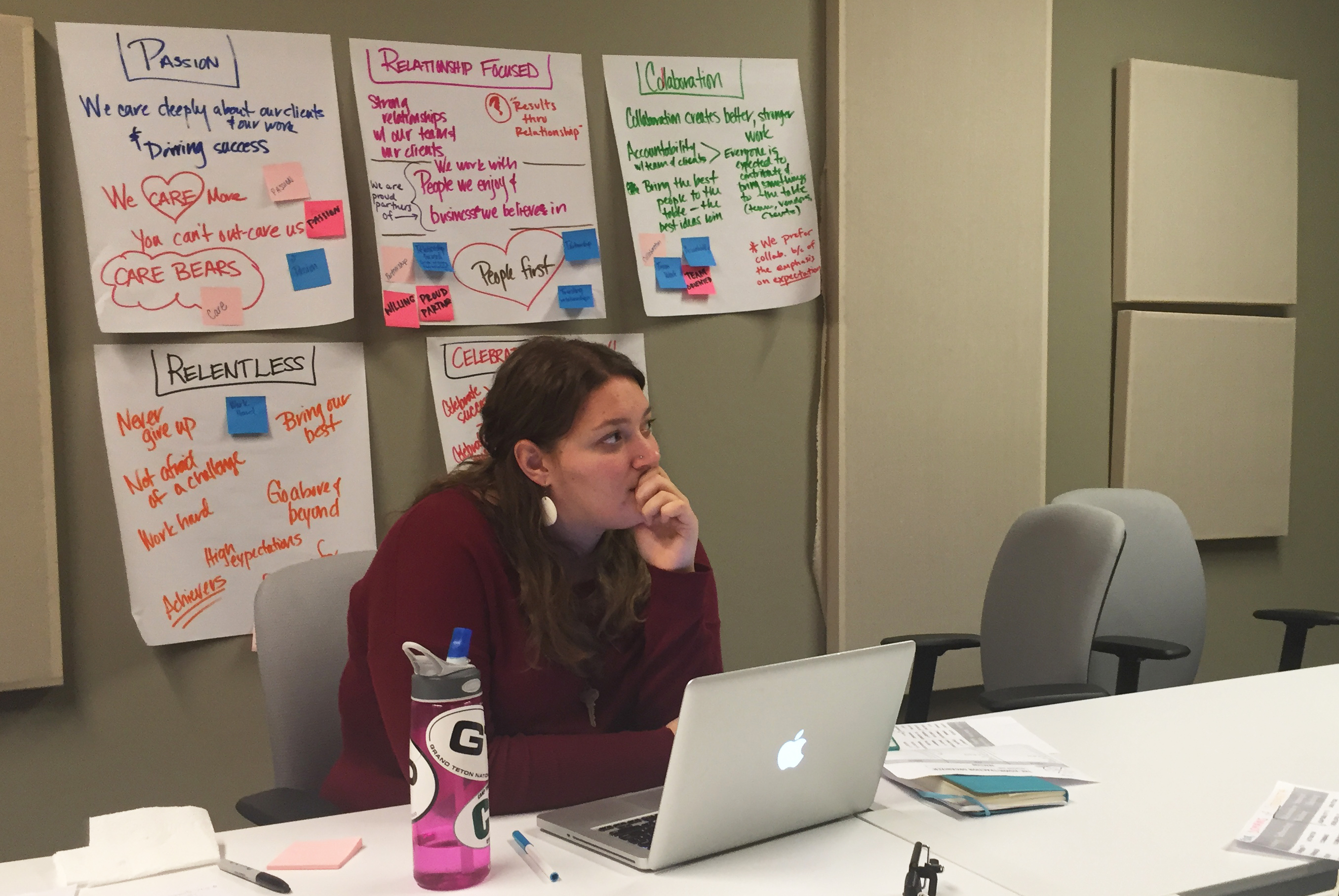
Once we spent several minutes jotting down our answers to these questions, we placed our sticky notes on a white board so we can see what each of us wrote. From there, we began organizing the ideas into themes.
At the end of our brainstorming session, we had agreed on five key words or themes with supporting points for each. You can see Abby with our wall of sticky notes below.
If you’re a larger company, this exercise could still work really well. However, instead of involving your entire team, you could conduct this exercise with your leadership team.
And, if you want to ensure you get input from employees, you can ask these questions through a survey to get their input and use that to combine the values into themes.
2. Let the ideas sit and get feedback.
After our brainstorming session, we moved all of our thoughts into a shared Google Doc and we let the ideas marinate for a few weeks.
What we found is that some of the words we chose weren’t really ringing true. Instead, we paid closer attention to things we said as we were working with each other and with our clients.
We began jotting down new ideas to consider. Most of them were consistent with our original themes and ideas, but the language was stronger and better conveyed how we want to act.
If you’re a larger company, I would suggest finding ways to get feedback on the initial list of themes to see if it resonates with your team.
3. Refine the list.
When we went on our retreat, we brought all of our notes and ideas. We spent a couple of hours discussing each of our points, pruning our list and refining the language.
Once we had decided on each of the five values, we created definitions for each value to give our team further guidance how to live out the value on a daily basis.
Create Your Core Values NOW
There’s not a one-size-fits all process for defining your core values, but this approach worked well for our team.
The main priority is to ACT. If you don’t have core values for your organization, now is as good time as any to start.
We’ve already found that having core values makes our work more focused. And, when we hire new team members, we will do so based on these values.
Core values are meaningful for your business. They certainly have been for us. Don’t wait to do this exercise. You’ll find that it’s incredibly valuable for your brand.
Do you have core values for your company? If so, share them in the comment section! We’d love to hear from you!
Related Post

Author: admincontent
in the week Active Speakers
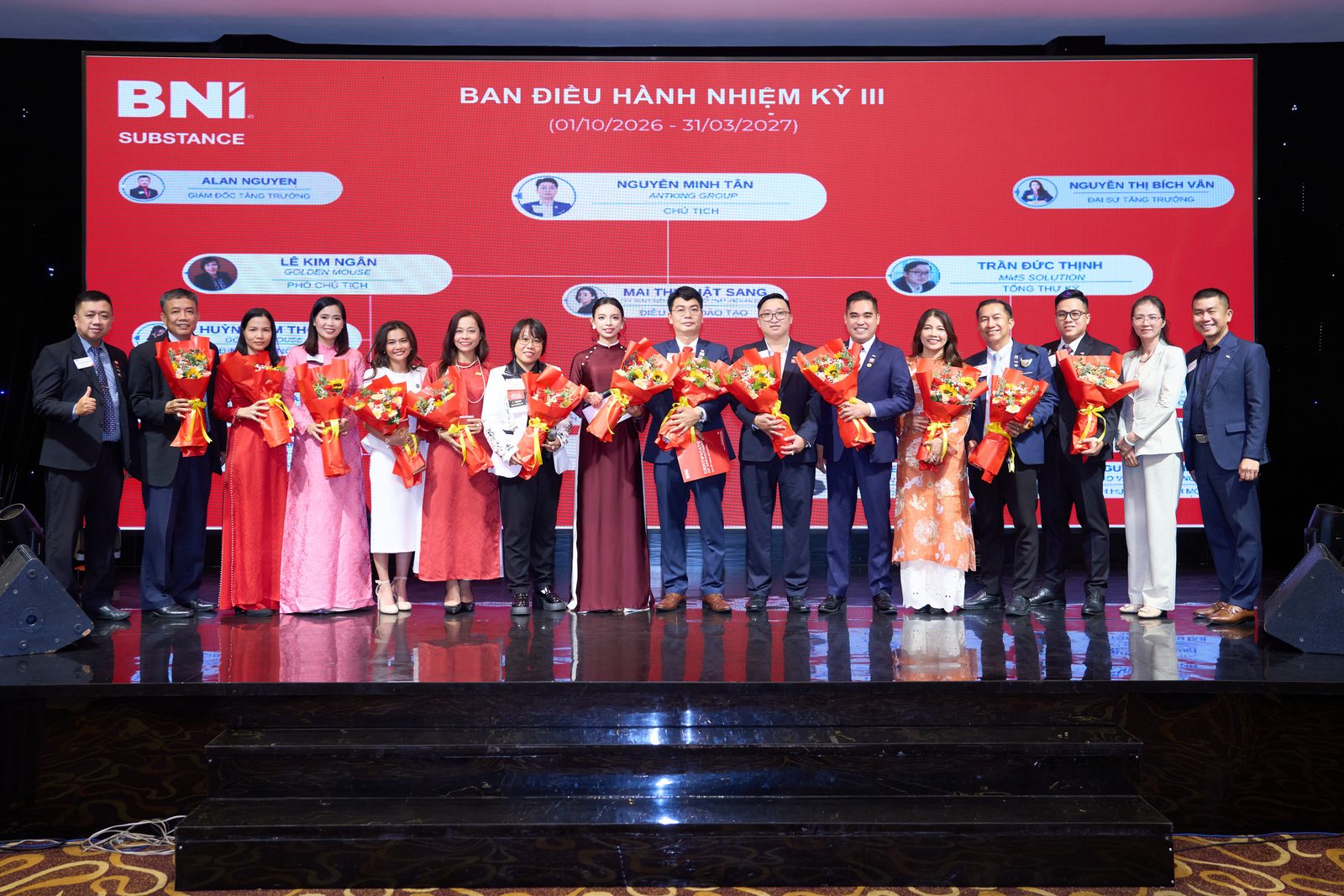
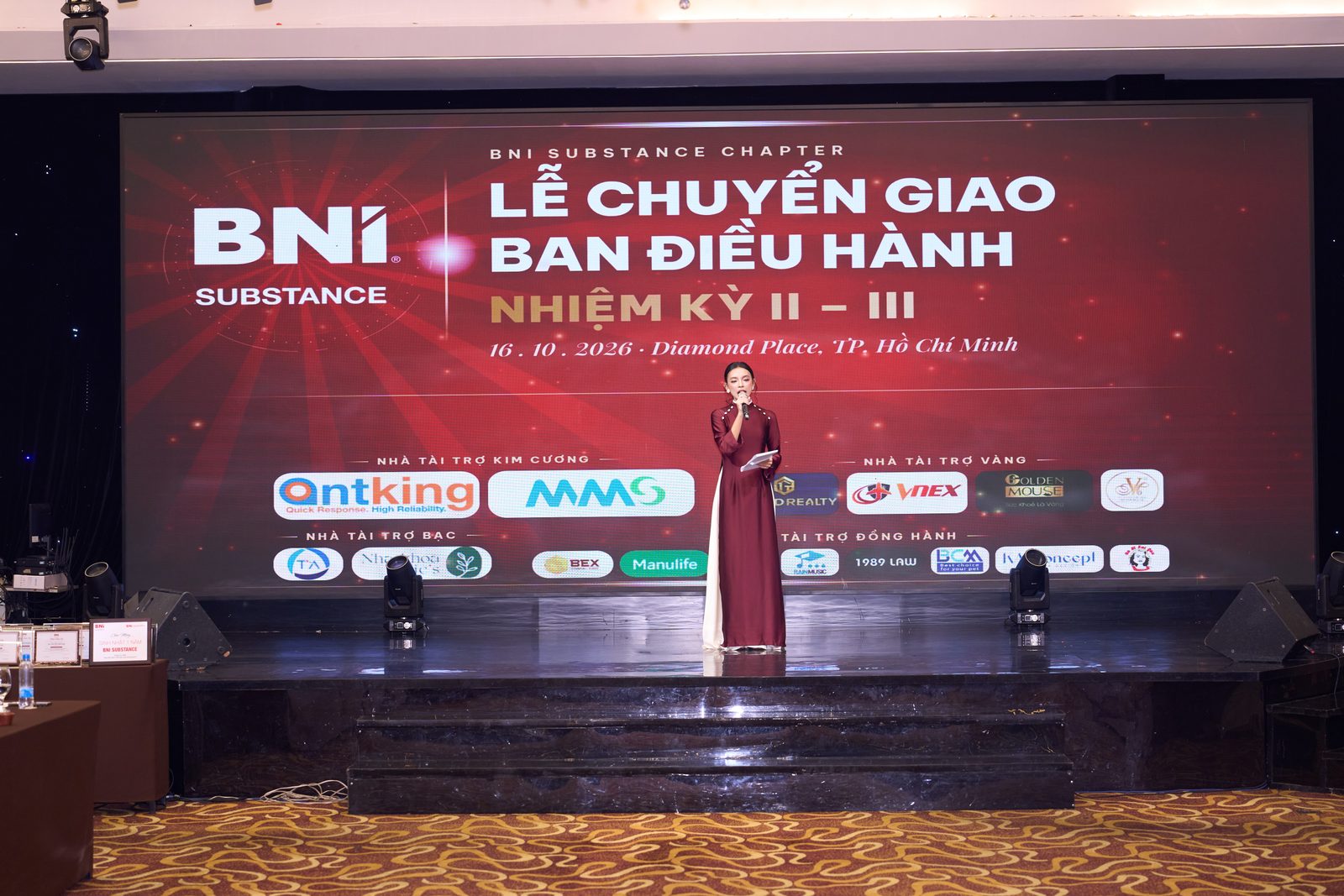
On the afternoon of Friday, 16 October 2026, at Diamond Place (15A Ho Van Hue, Duc Nhuan Ward, Ho Chi Minh City), BNI Substance Chapter (BNI HCM West) held its Leadership Team Handover Ceremony for Term II – III and 1st Anniversary celebration under the theme “Elevating Connections – Accelerating Growth”. Around 150 members and guests, BNI directors, and presidents and representatives of many partner chapters came together to witness the Substance family’s first milestone.
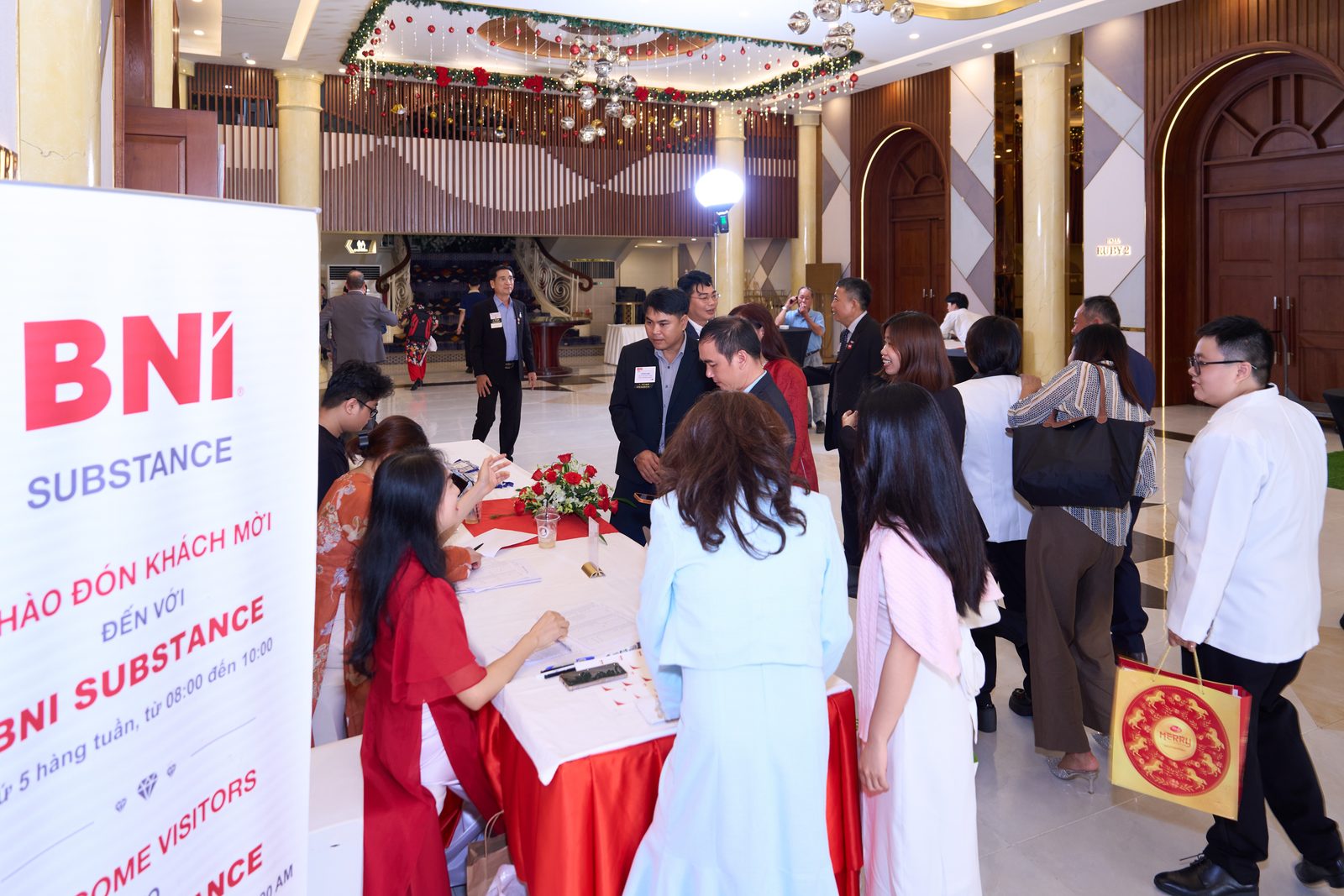
Open networking and exhibition booths
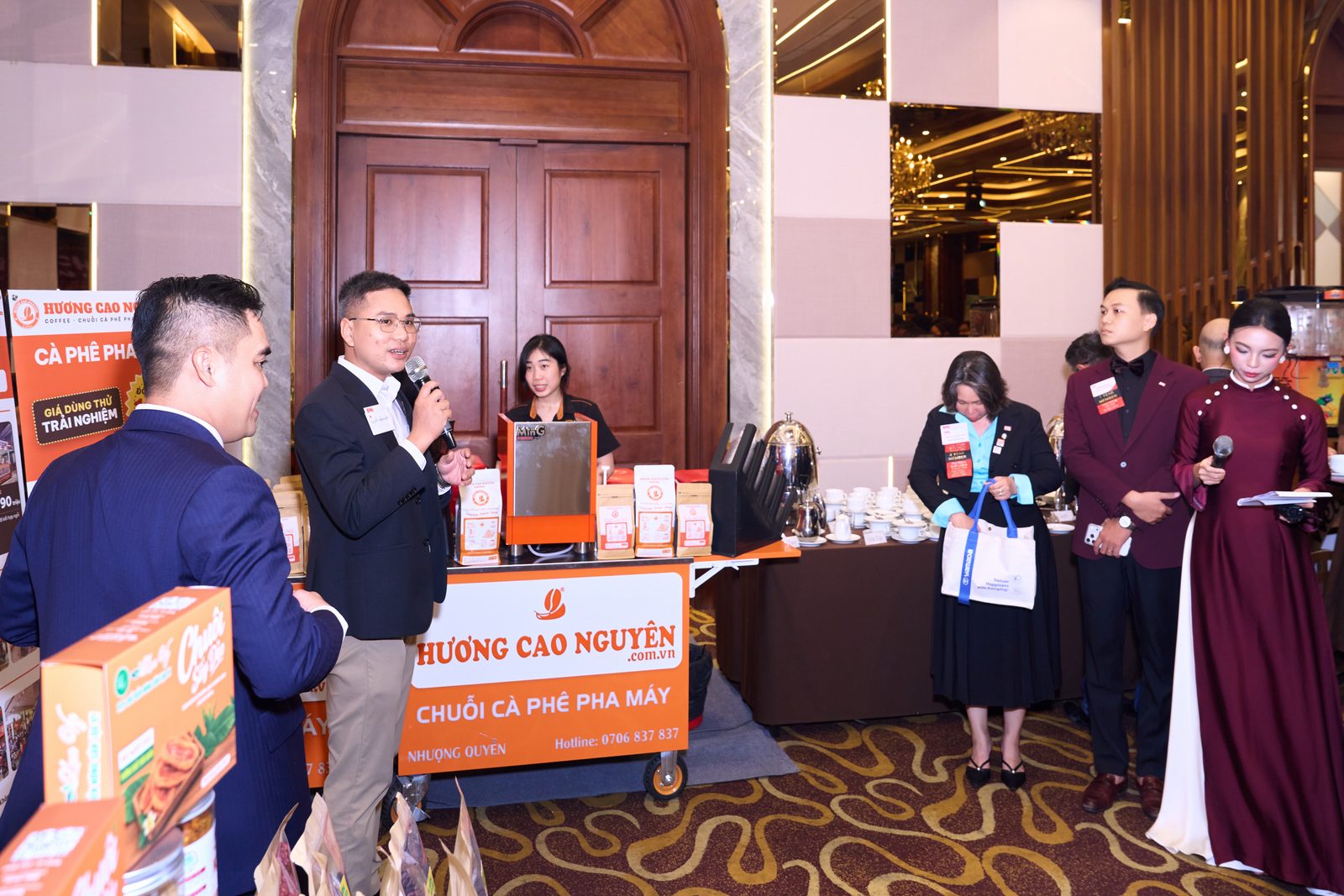
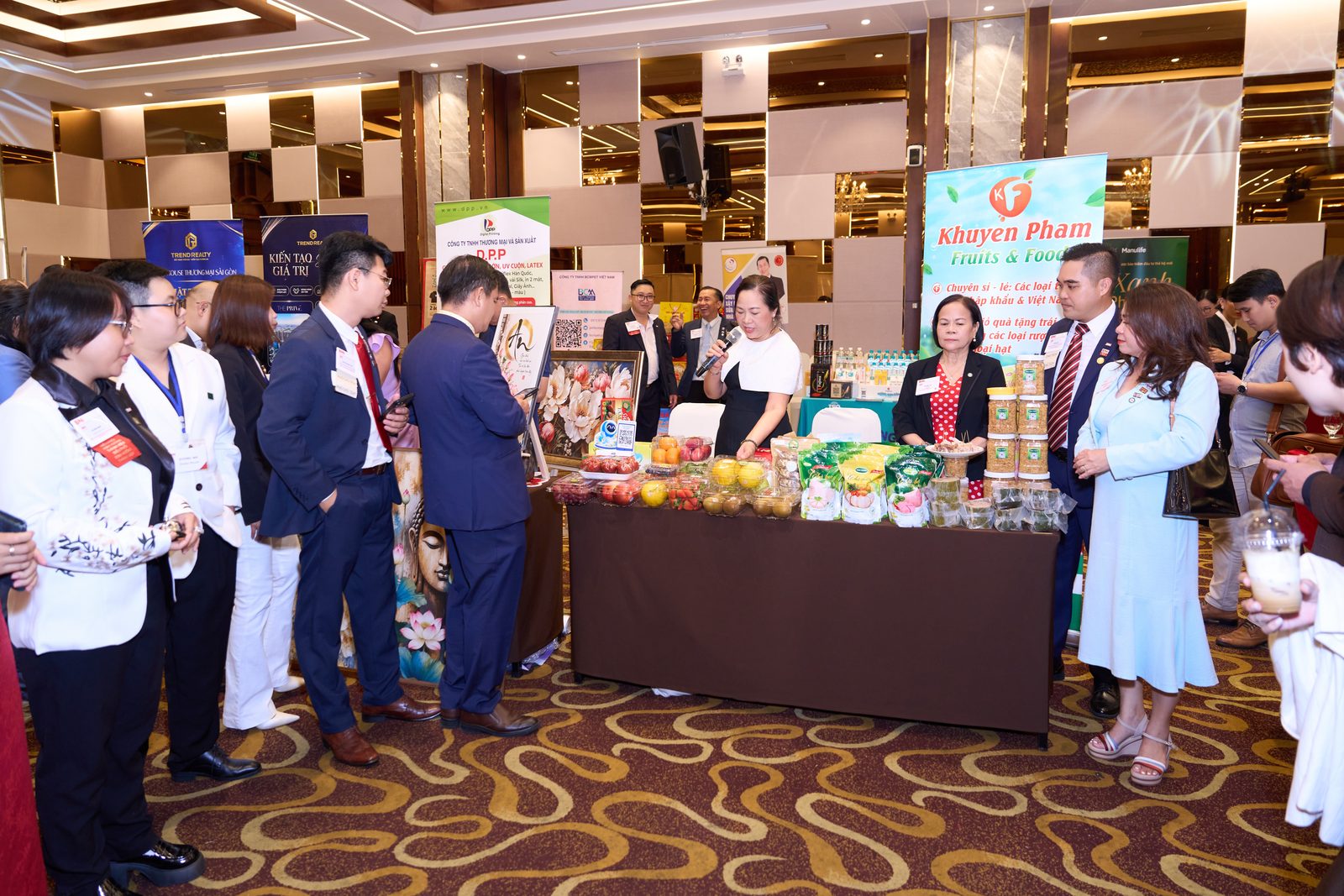
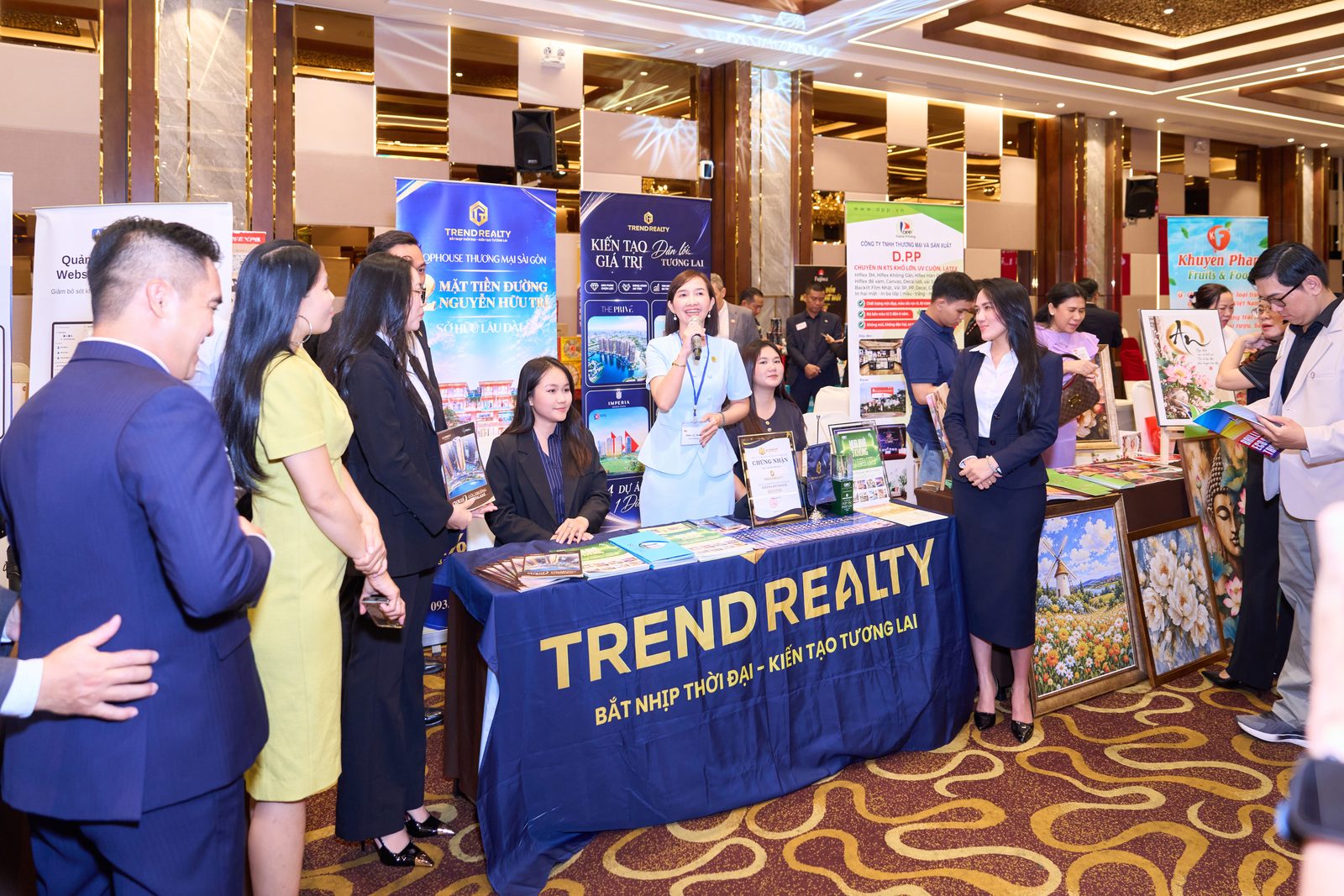
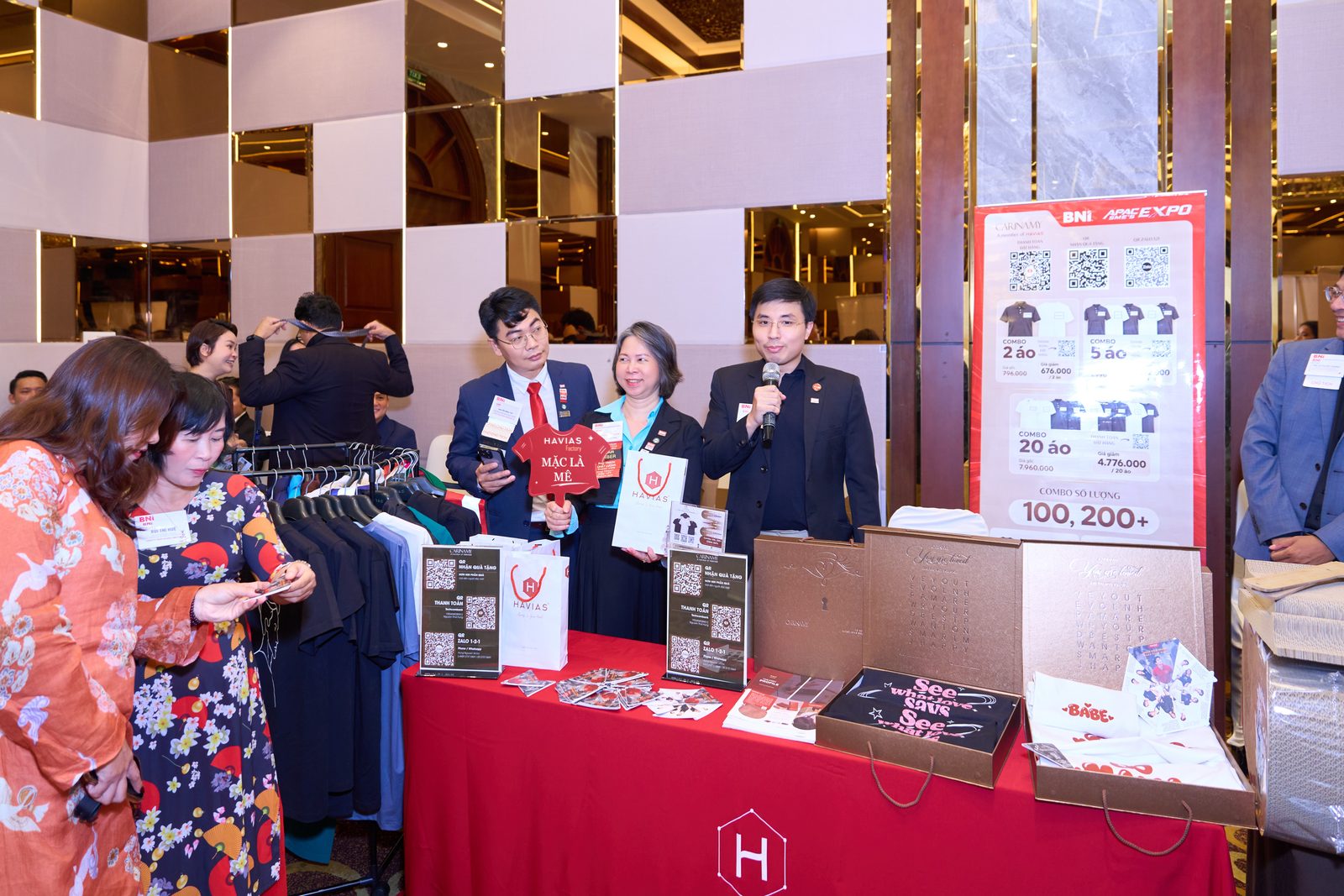
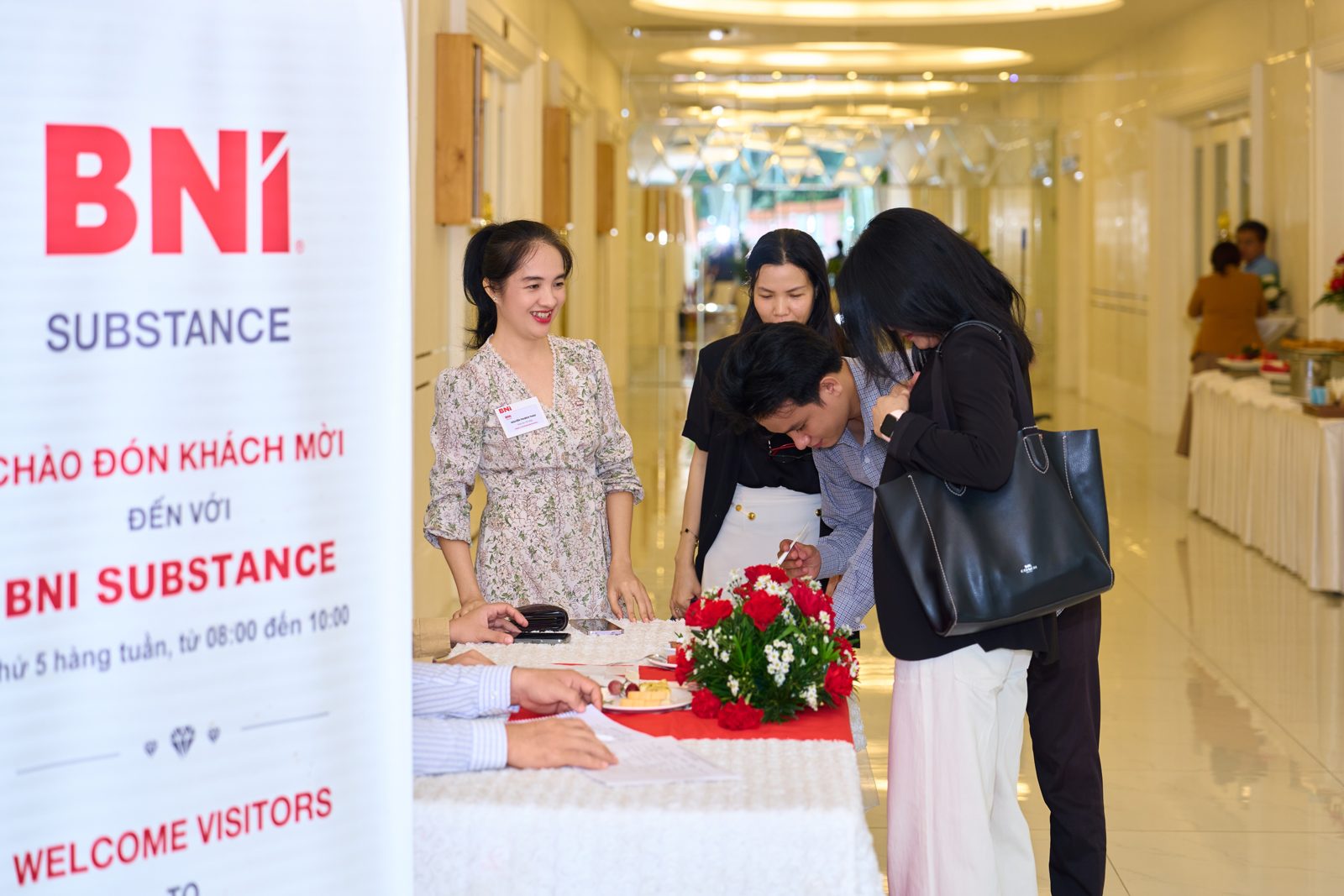
From 3:00 PM, guests checked in, picked up their name badges and networked over tea. A special feature of the day was the exhibition area: the whole group toured the booths, each with a 30-second introduction, so guests could see first-hand the products and services these businesses create every day. Real connection starts with real understanding.
15 booths took part, in the order of the tour:
- Huong Cao Nguyen (Windland Coffee Co., Ltd.): machine-brewed coffee chain, roasted coffee, beverage ingredients and turnkey coffee-shop franchising
- Trung Nam Mart: Northwest Vietnam specialities and healthy foods
- Leo Handmade: handmade products, fabric bags and accessories
- Golden Mouse: pharmacy chain, a no-starvation weight-loss programme
- T.A Future (TA Nature): natural foods and farm produce
- VN Express: international express delivery
- Minh Thanh Pork Rolls: clean food and Hue-style grilled chicken rolls
- ANTKING Group: a digital operating system for businesses with ADO ERP, AOMNICHAT and Knexis
- Trend Realty: real estate
- D.P.P Digital Printing: large-format digital, UV roll and latex printing, canvas prints
- Khuyen Pham Fruits & Food: fruit and food gifts
- Fujiwa: Japanese-technology pH9 alkaline ionised water
- Loi Hoa Bird’s Nest: edible bird’s nest products
- BCM Pet: pet products
- HAVIAS: custom uniforms and corporate gifts
Opening: looking back on a term, welcoming a new journey
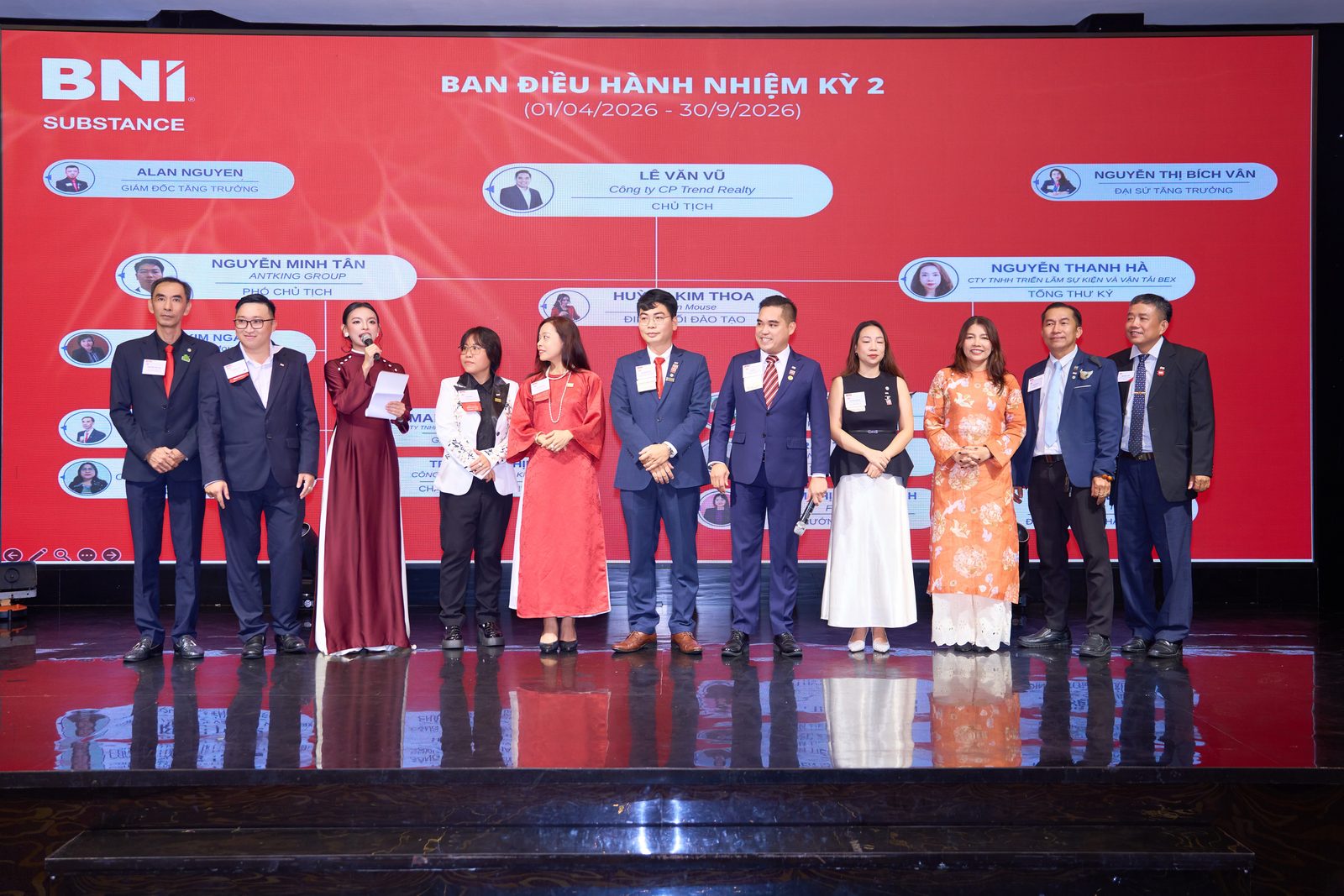
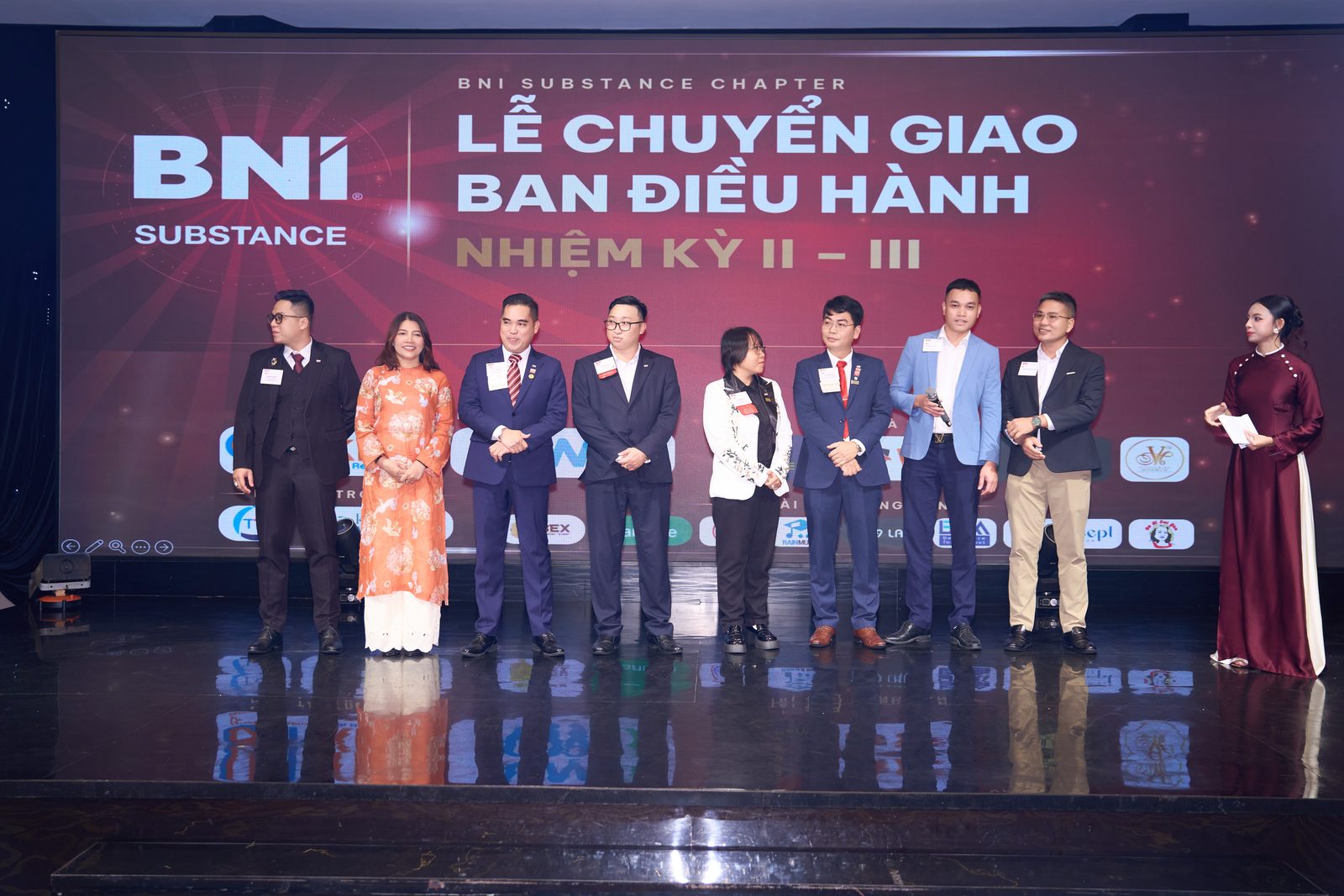
The programme opened with a warm welcome to the leadership of BNI HCM West and partner regions, chapter presidents and representatives, and all guests. The Term II Top 4 Leadership Team, President Le Van Vu, Vice President Nguyen Minh Tan, Secretary-Treasurer Nguyen Thanh Ha and Education Coordinator Huynh Kim Thoa, took the stage with the full Leadership Team. President Le Van Vu then gave an overview of the global BNI network and the 7 Core Values that shape every chapter’s culture.
Education: relationships, the last advantage no one can take away
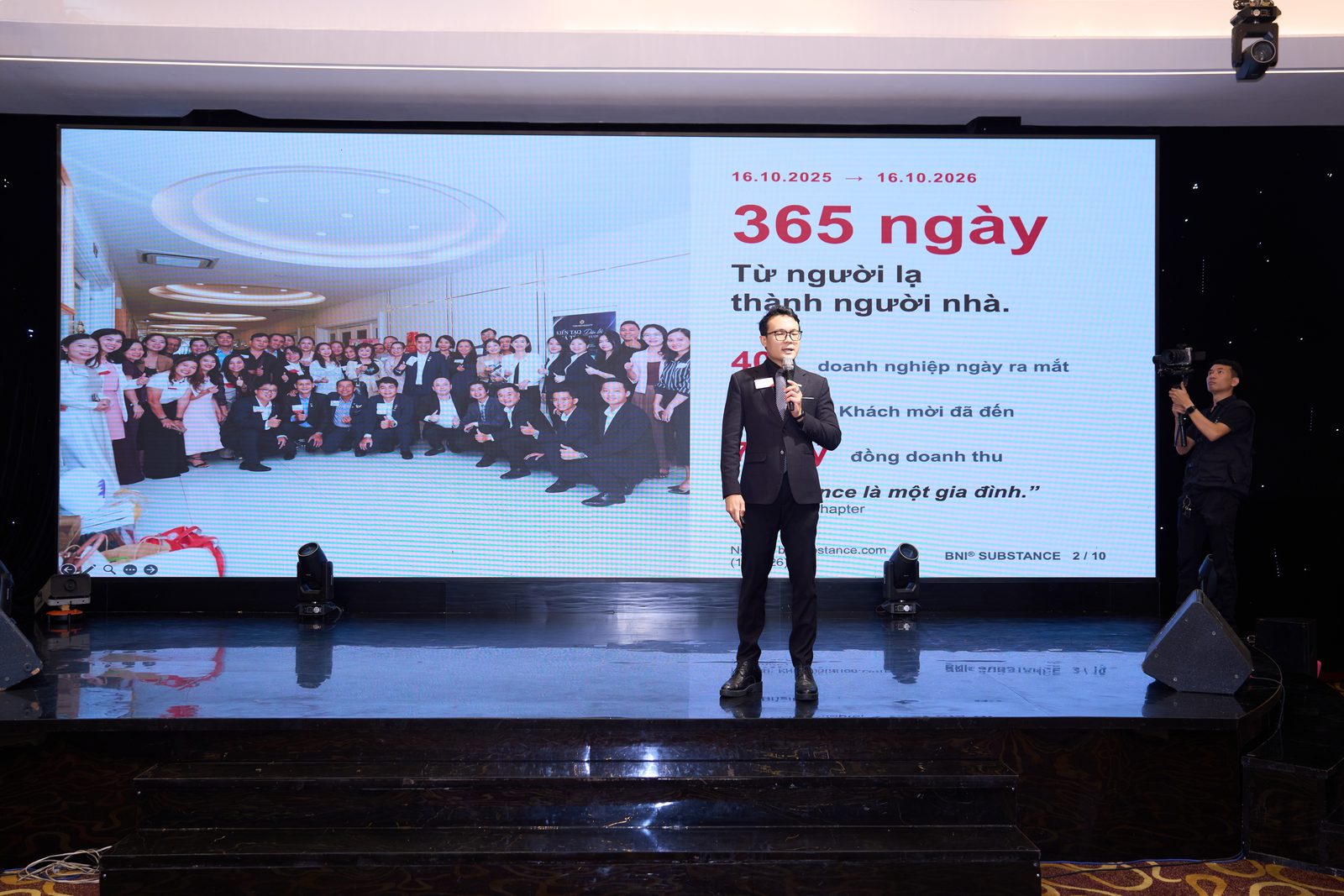
The education segment was delivered by Kendrick Tran Anh Khang, PhD candidate, Growth Director of BNI HCM West and CEO of EngoNow Education, on “Relationships: Your Last Unfair Advantage”. He opened with Substance’s 365-day journey (16.10.2025 → 16.10.2026): from strangers to family, with 40+ businesses at launch, 154+ visitors and VND 7.2 billion in business passed between members.
In the age of AI, products, prices, ads, content and technology are all easy to copy. The one thing that cannot be copied is trusted relationships: valuable, rare, hard to imitate and irreplaceable. Relationships follow the path Know → Trust → Refer, and the Substance way is “farming, not hunting”.
For the second year he proposed three concrete habits: within 24 hours, send a personal, sincere note after every meeting; every week, one deep 1-2-1 prepared with GAINS; every month, give a business opportunity first. His closing line: “AI can write messages. Only people can be trusted.”
New member induction and renewal ceremony
BNI Substance welcomed two new members: Mr. Nguyen Thanh Luan – Windland Coffee Co., Ltd. (Huong Cao Nguyen brand), supplying roasted coffee, beverage ingredients and turnkey coffee-shop franchise solutions; and Mr. Truong Minh Tinh – TMT Equipment Engineering Co., Ltd., which supplies and installs automotive equipment such as car lifts, tyre equipment and automatic car-wash systems, and manufactures paint booths.
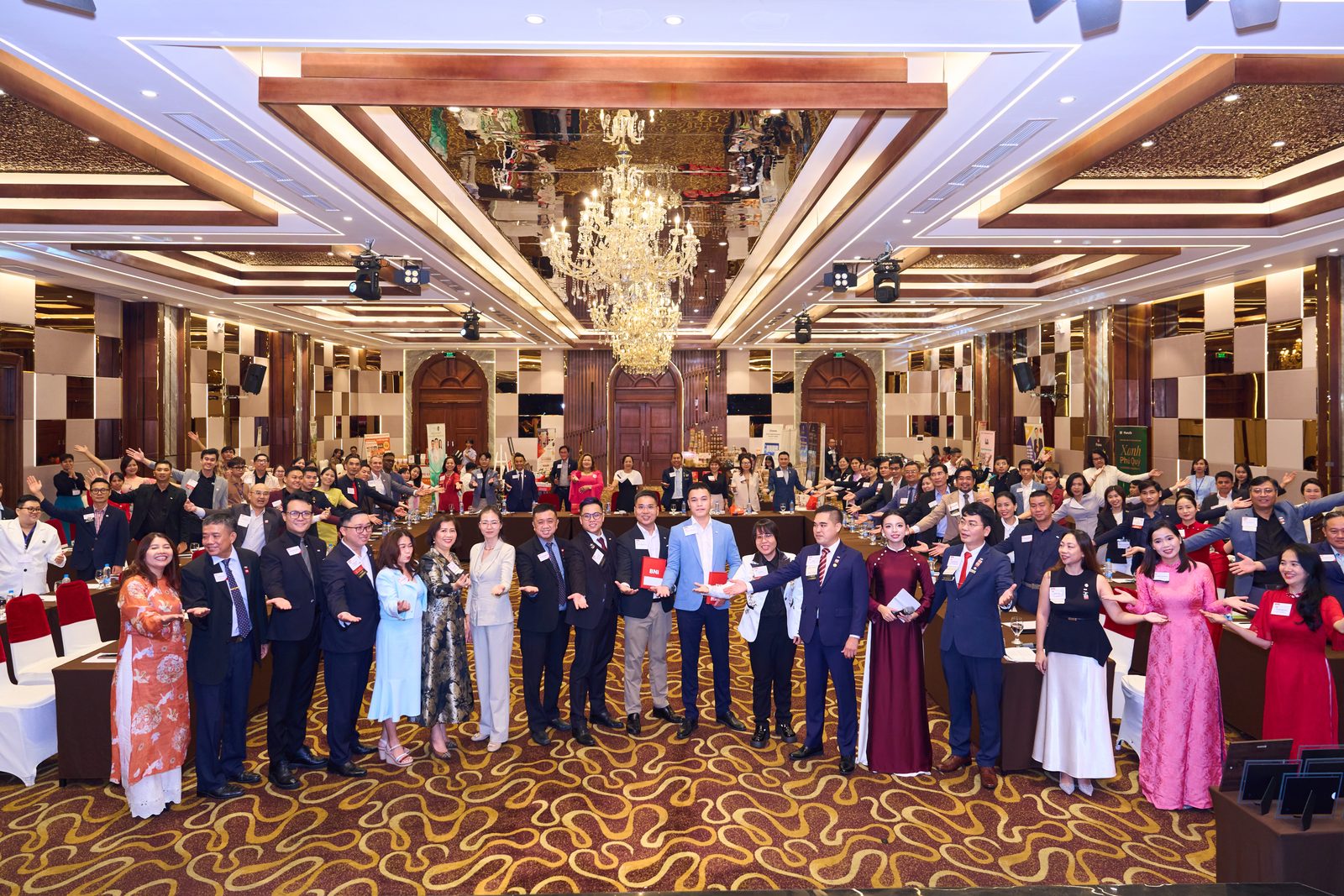
The celebration continued with 7 renewing members recommitting to the Chapter: Mr. Nguyen Minh Tan (ANTKING Group), Ms. Le Kim Ngan (Golden Mouse), Mr. Tran Duc Thinh (MMS Group), Ms. Nguyen Thi Cong (Cong Anna Brow & Tattoo), Mr. Le Van Vu (Trend Realty), Ms. Nguyen Thi Minh Thu (Manulife Vietnam) and Mr. Vincent Nguyen (VN Express). Mr. Alan Nguyen, Mr. Nguyen Le Anh and Ms. Nguyen Thi Bich Van presented the new-member kits and renewal ribbons. The whole room recited the BNI Code of Ethics, went round shaking hands and took a group photo in the spirit of One BNI.
20-second introductions: members and guests
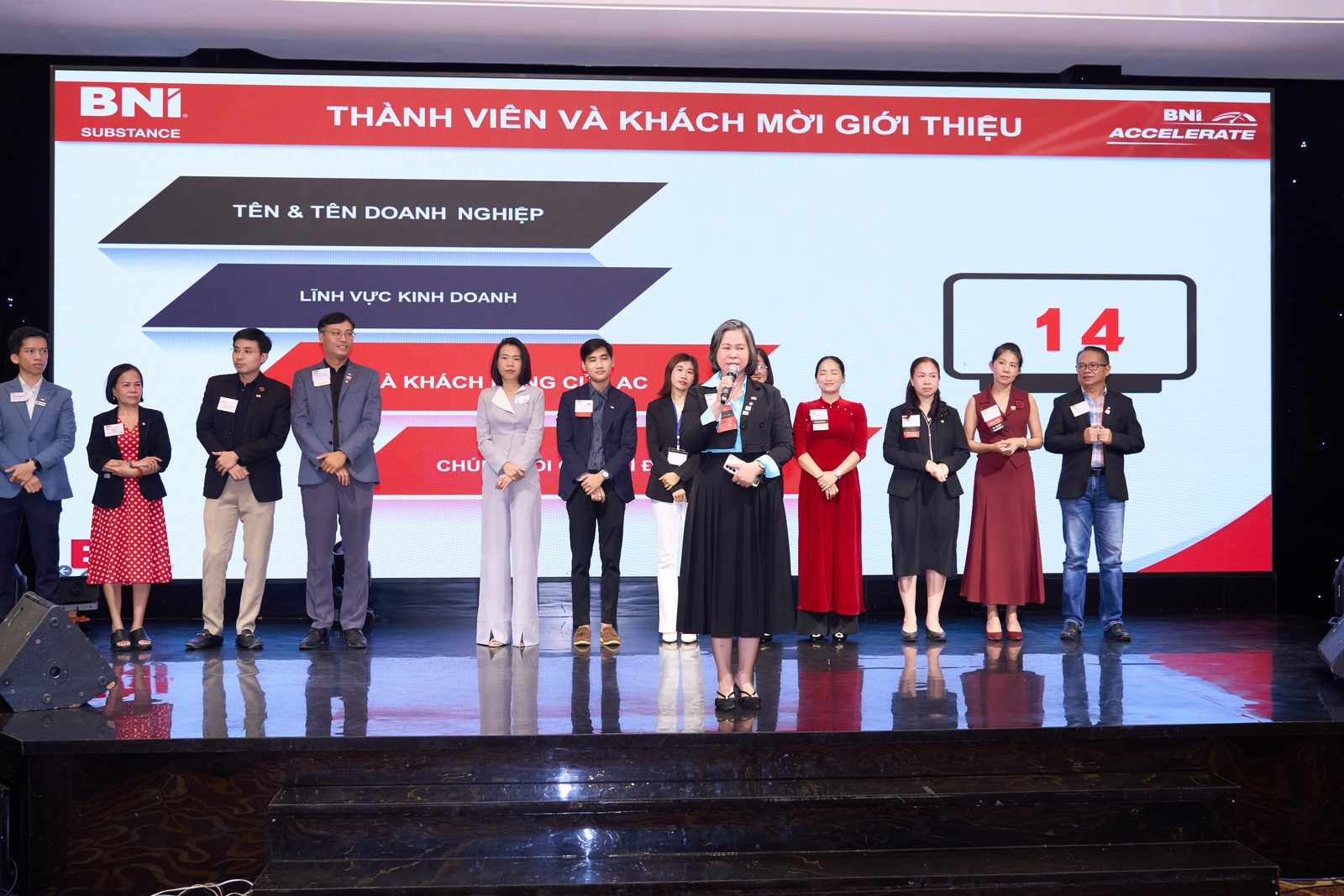
Members and guests came on stage group by group, each with 20 seconds to share their name, business, industry and what they are looking for in business connections. Only 20 seconds, but enough to open the door to 1-2-1 meetings after the ceremony.
Diamond Sponsor showcase: From Growth Marketing to a Digital Operating System
The professional highlight was the joint showcase of the two Diamond Sponsors, “From Growth Marketing to a Digital Operating System – Attract customers, Convert opportunities, Operate for growth”.
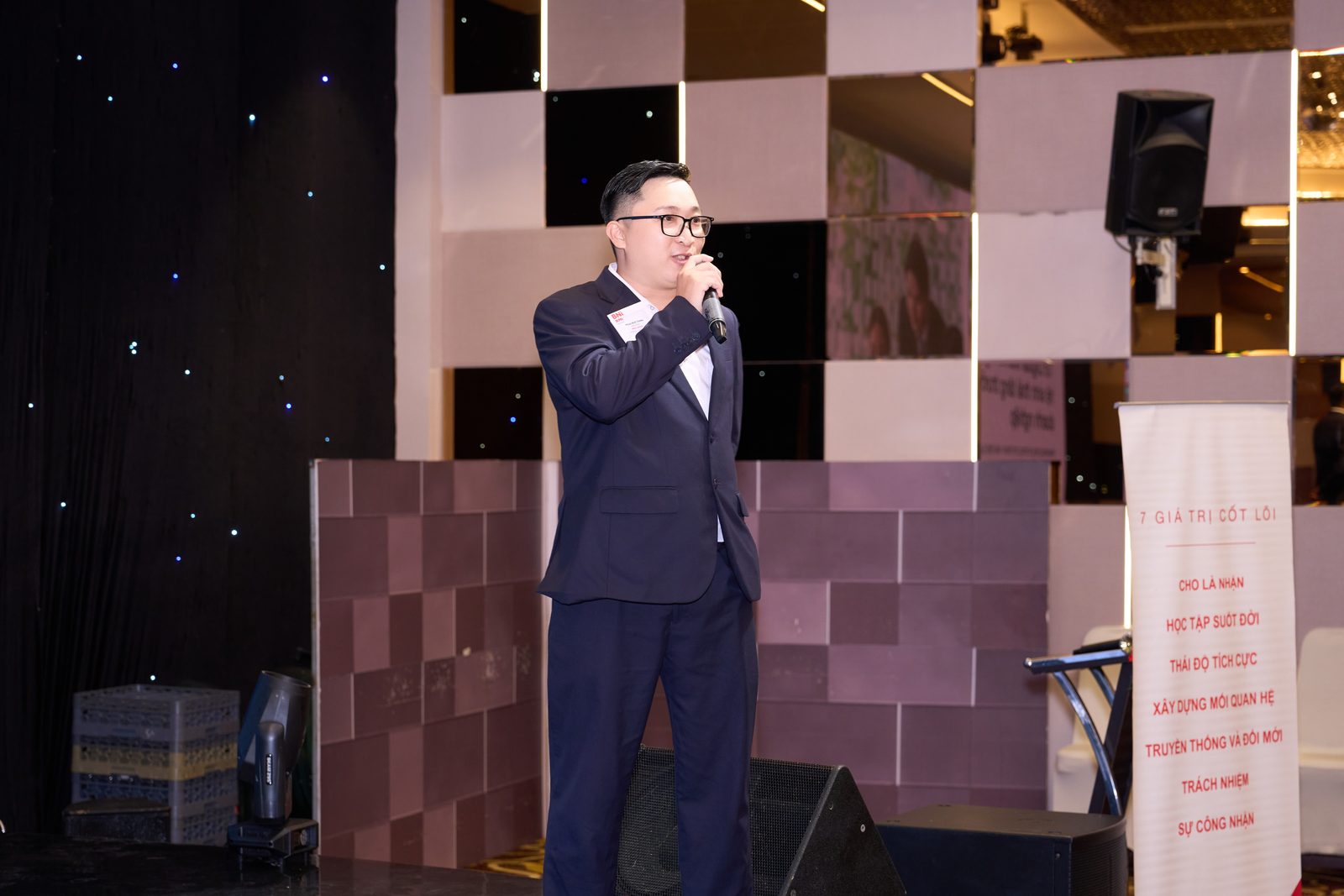
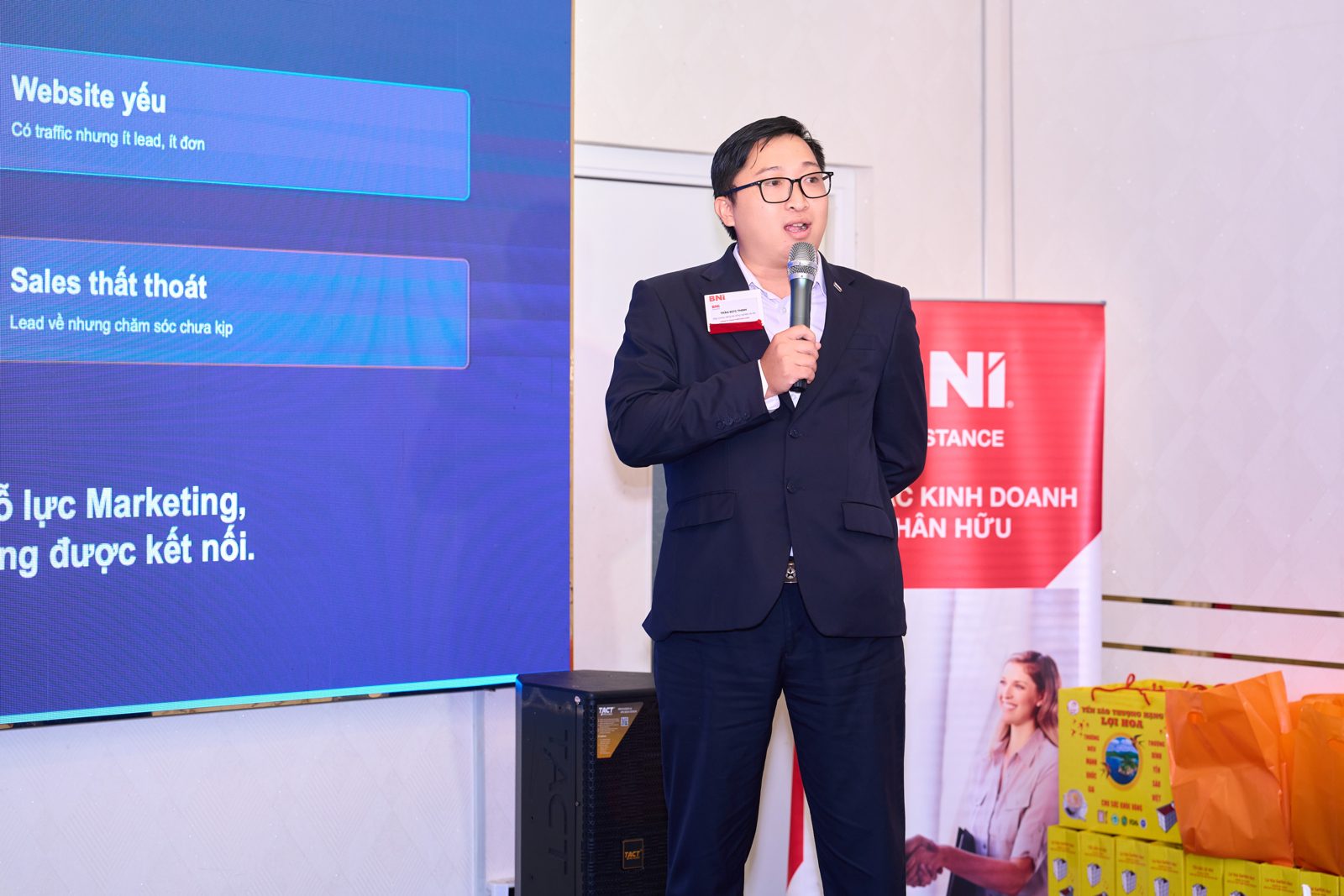
Mr. Tran Duc Thinh – Chairman of MMS Group asked where businesses are losing money: ads that cost money without guaranteeing real customers, websites with traffic but few orders, scattered data that hides which channel drives revenue, and leads that arrive faster than sales can follow up. Businesses, he said, do not lack marketing effort; they lack a connected system from search to revenue. He illustrated this with an SEO case for Huong Cao Nguyen, with 24,000+ impressions and 1,160+ clicks, and Google Ads campaigns optimised for conversions.
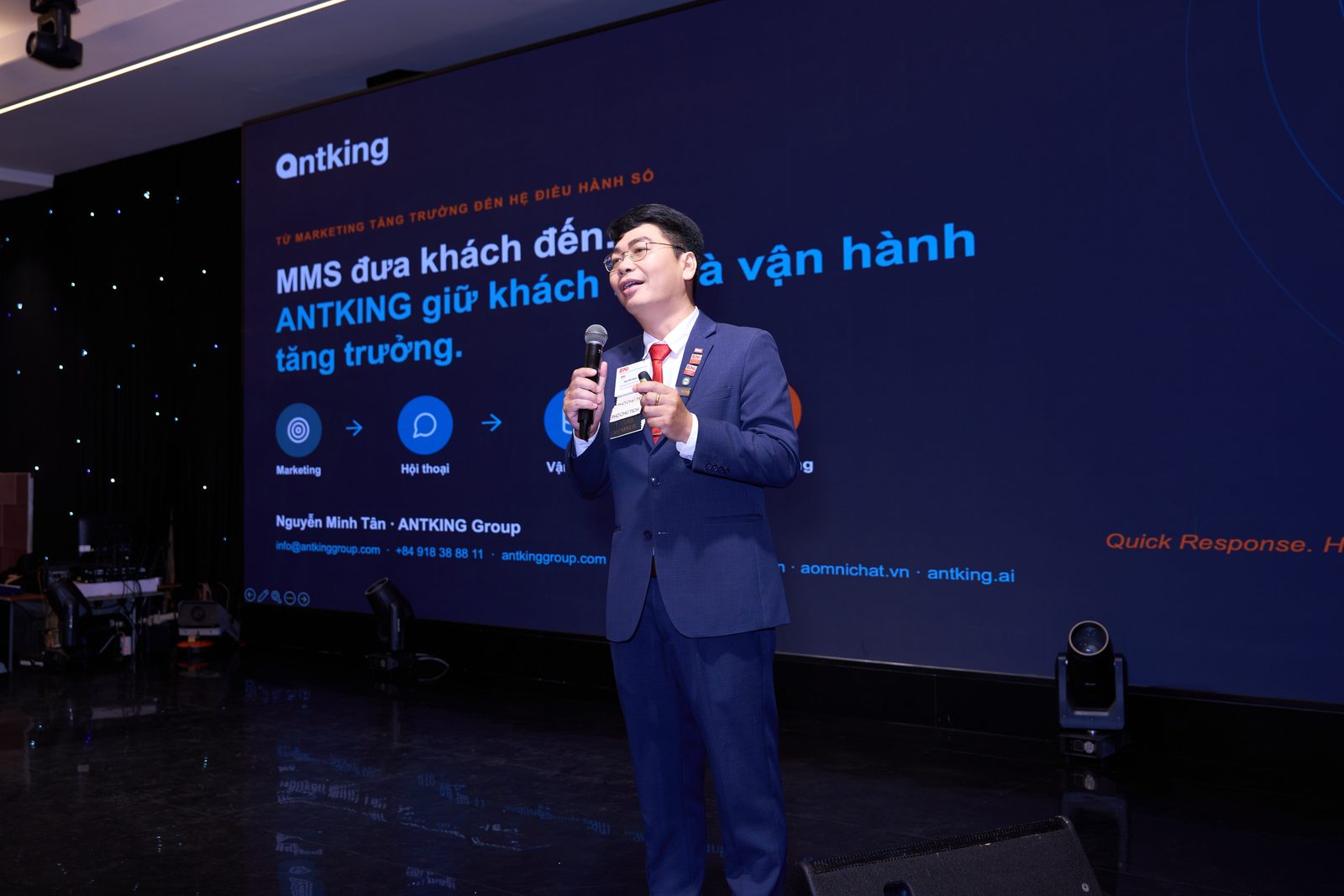
Mr. Nguyen Minh Tan – Chairman of ANTKING Group then answered the question “Marketing brings customers in. What next?”. Once leads arrive, businesses typically lose customers and money in four places: conversations scattered across staff members’ personal Zalo and Facebook accounts, sales run on Excel, inventory and accounting that do not reconcile, and owners without real-time figures. The answer is a digital operating system: one data set, one process, one management dashboard, built on the ANTKING ecosystem of AOMNICHAT (Zalo, Facebook and website messages in one place), ADO ERP (sales, inventory and accounting in sync, with 30+ modules already running in production), a digital workplace with domain email, and AI and automation for the team.
The two talks closed with a shared message: “MMS brings customers in. ANTKING keeps them and runs the growth.”
When to refer customers to the two sponsors?
- MMS Group: when you hear “I spend a lot on ads but customers aren’t steady”, “We have a website but it brings no customers”, “We do a lot of marketing but don’t know what drives revenue”.
- ANTKING Group: when you hear “Customer messages are scattered across my staff’s Zalo accounts”, “When staff leave, they take customers with them”, “We only know profit or loss at month-end, and stock never matches”, “We run the company on Excel, Zalo and notebooks”.
The handover: Term II in numbers
The handover opened with a video looking back on the Substance family’s first year. Vice President Nguyen Minh Tan then presented the Term II results (1 April – 30 September 2026):
- 457 referrals
- 808 1-2-1 meetings
- 1,044 CEUs
- 115 visitors
- VND 3,512,710,600 in total TYFCB
- 84% attendance rate
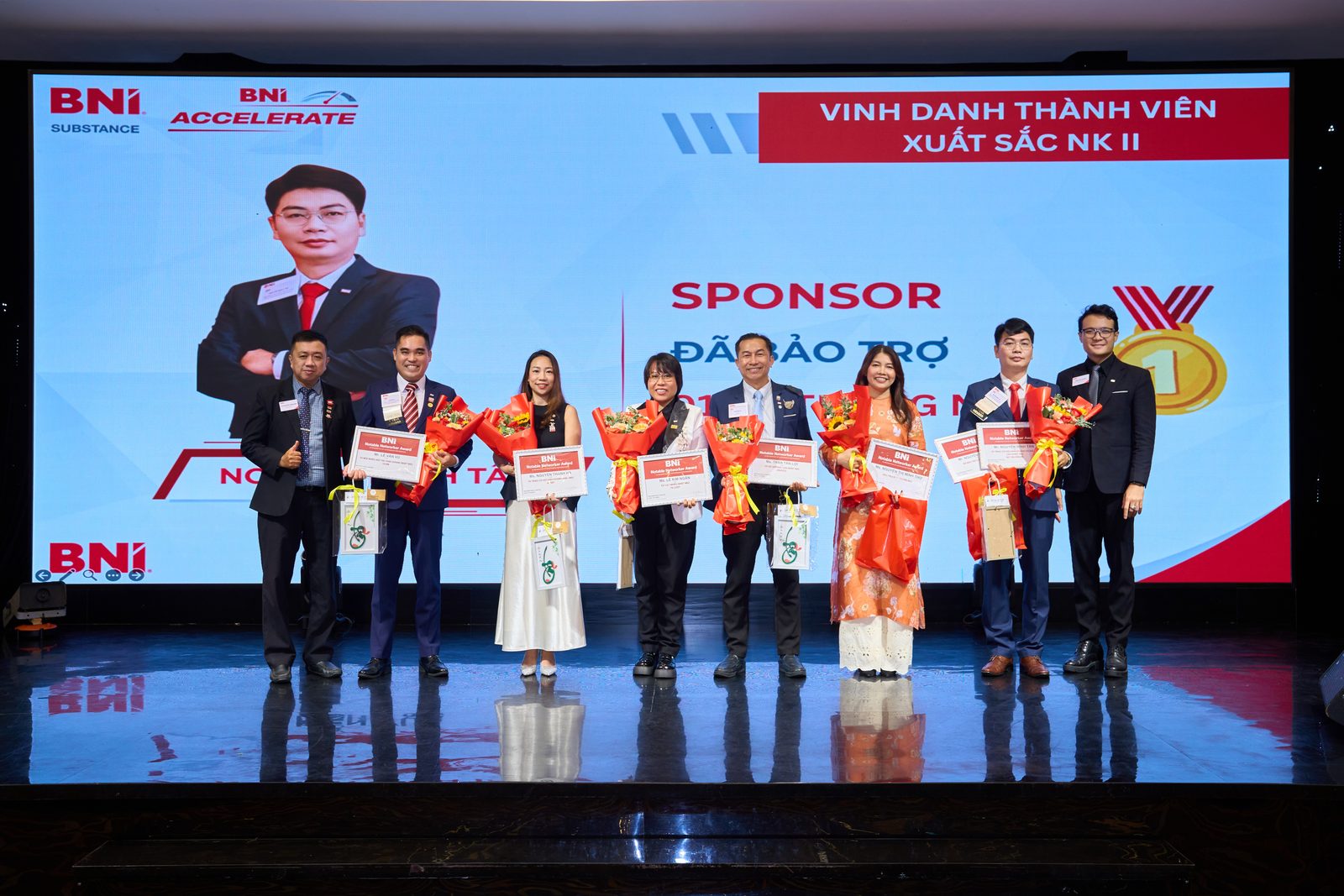
Outstanding members of Term II
- Most 1-2-1s (74): Ms. Le Kim Ngan – Golden Mouse
- Most CEUs (259): Mr. Tran Tan Loi – Loi Hoa Bird’s Nest
- Most referrals (41): Ms. Nguyen Thanh Ha – Bex
- Most visitors (15): Mr. Le Van Vu – Trend Realty
- Highest TYFCB (VND 421,186,000): Mr. Nguyen Minh Tan – ANTKING Group
- Sponsor – bringing in new members: Ms. Nguyen Thi Minh Thu – Manulife Vietnam and Mr. Nguyen Minh Tan
BNI HCM West Growth Director Kendrick Tran Anh Khang presented the certificates to the honourees.
Thanking those who led the Chapter
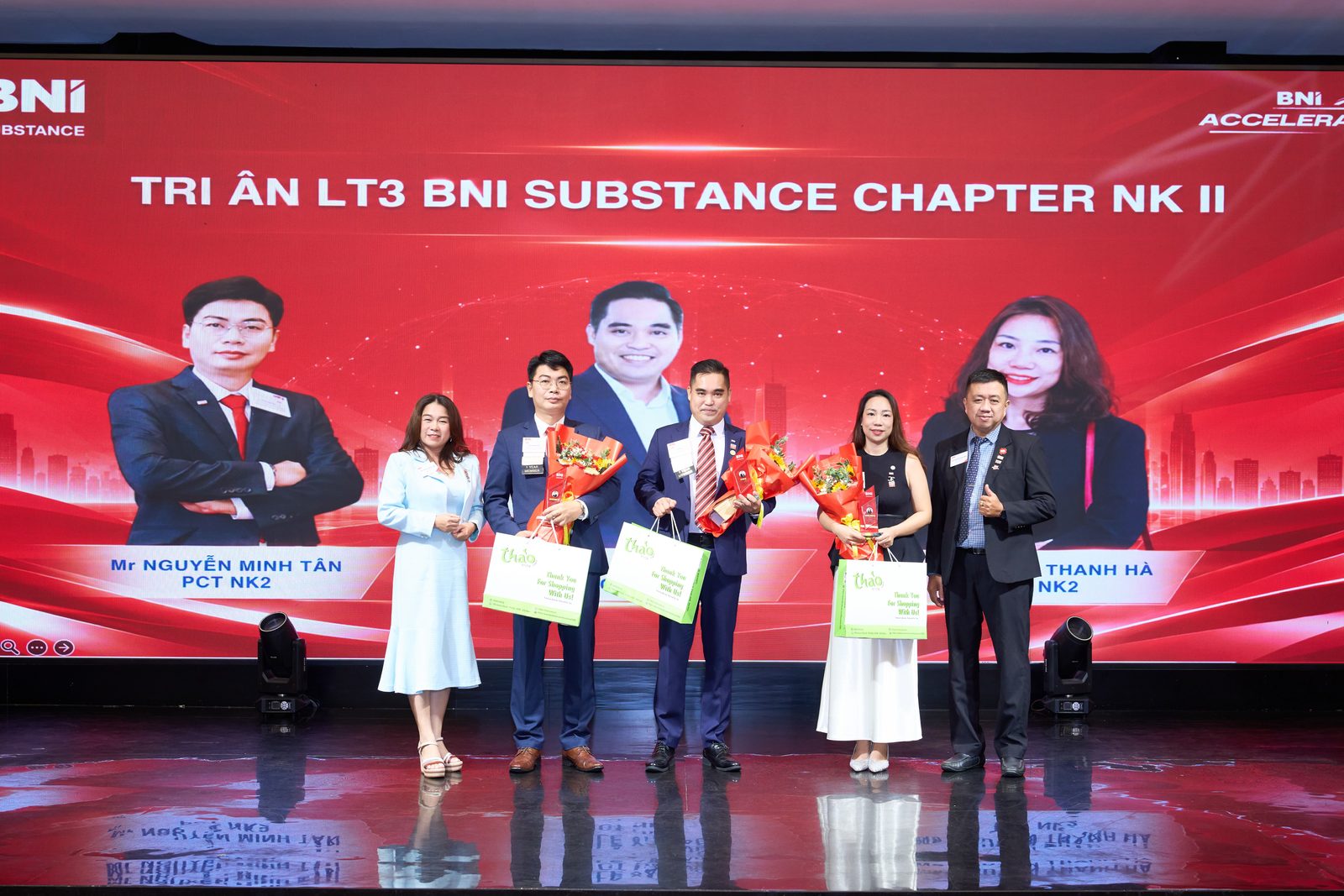
The Chapter thanked the Term II LT3 (President Le Van Vu, Vice President Nguyen Minh Tan, Secretary-Treasurer Nguyen Thanh Ha), the full Term II Leadership Team, three Power Team leaders (Nguyen Thi Minh Thu – Health & Beauty, Vincent Nguyen – Business Support, Mai Thi Nhat Sang – Construction & Manufacturing) and the support team: Ms. Kara Hang Le, Mr. Alan Nguyen and Ms. Nguyen Thi Bich Van.
Introducing the Term III Leadership Team
Chapter Growth Director Alan Nguyen read the decision appointing the Term III Leadership Team (1 October 2026 – 31 March 2027): President Nguyen Minh Tan (ANTKING Group), Vice President Le Kim Ngan (Golden Mouse) and Secretary-Treasurer Tran Duc Thinh (MMS Group).
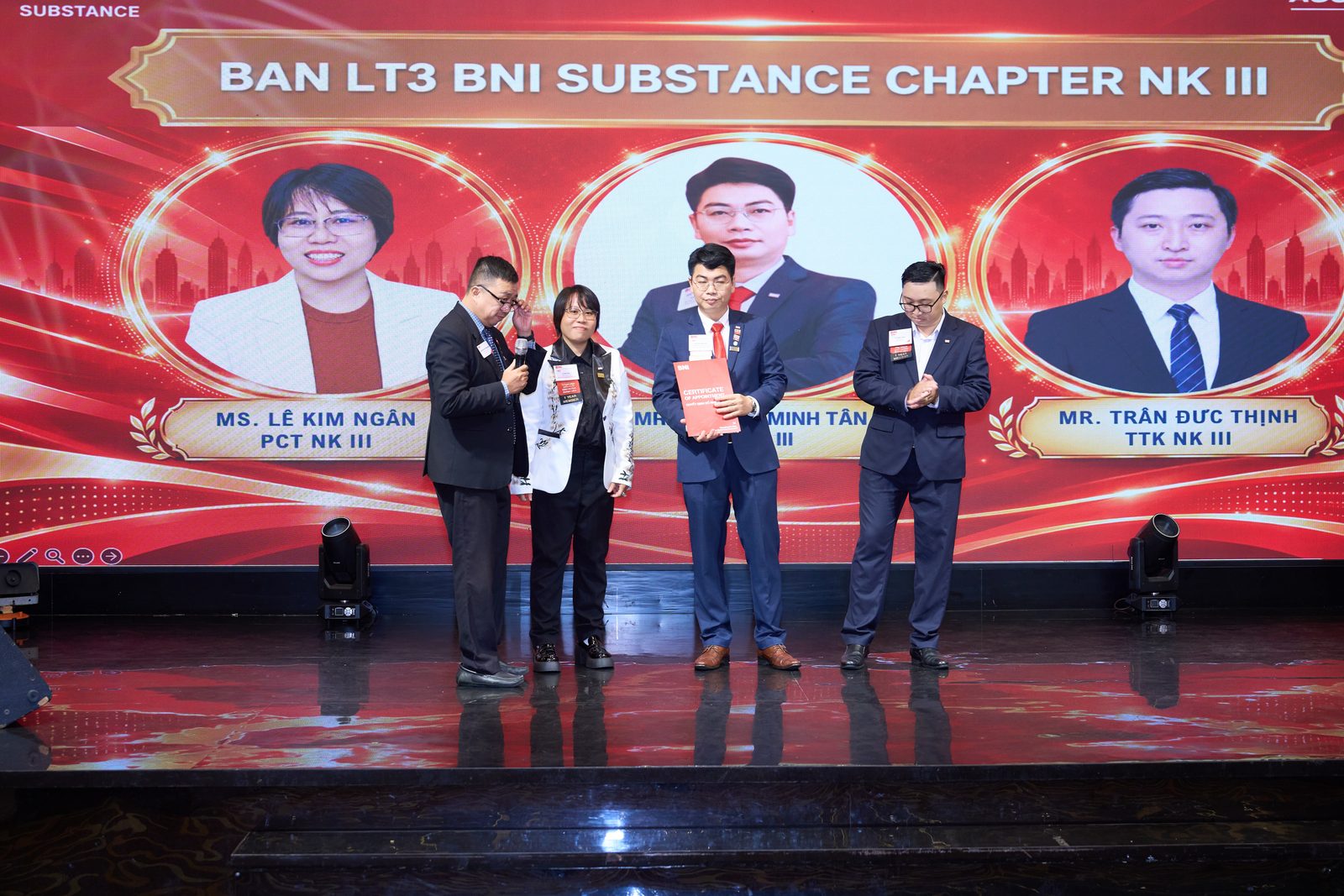
The new President introduced the other Term III Leadership Team roles:
- Education Coordinator: Mai Thi Nhat Sang
- Member Orientation: Huynh Kim Thoa
- Chapter Growth: Nguyen Le Anh
- Membership Quality: Nguyen Nhat Thanh Nguyen
- Member Relations: Nguyen Thi Bich Chung
- Member Engagement: Nguyen Thi Diep
- Visitor Coordinator: Le Van Vu
- Visitor Support: Nguyen Thi Cong
- Visitor Hosts: Tran Tan Loi, Nguyen Thi Minh Thu, Vincent Nguyen
- Visitor Orientation: Nguyen Le Anh
- Growth Director: Alan Nguyen · Growth Ambassador: Nguyen Thi Bich Van
The new President’s acceptance speech
Accepting the role, President Nguyen Minh Tan thanked BNI’s leadership and all Substance members for their trust. After two terms as Vice President, he said: “The strength of a Chapter does not lie in one person, but in unity, trust and a shared commitment to grow together.”
For Term III, he hopes to work with the Leadership Team and all members to build Substance into a Chapter of:
- DISCIPLINE in action
- CONNECTION in relationships
- RESULTS in business
“I believe that when every member succeeds, Substance succeeds!”
Official Term III goals
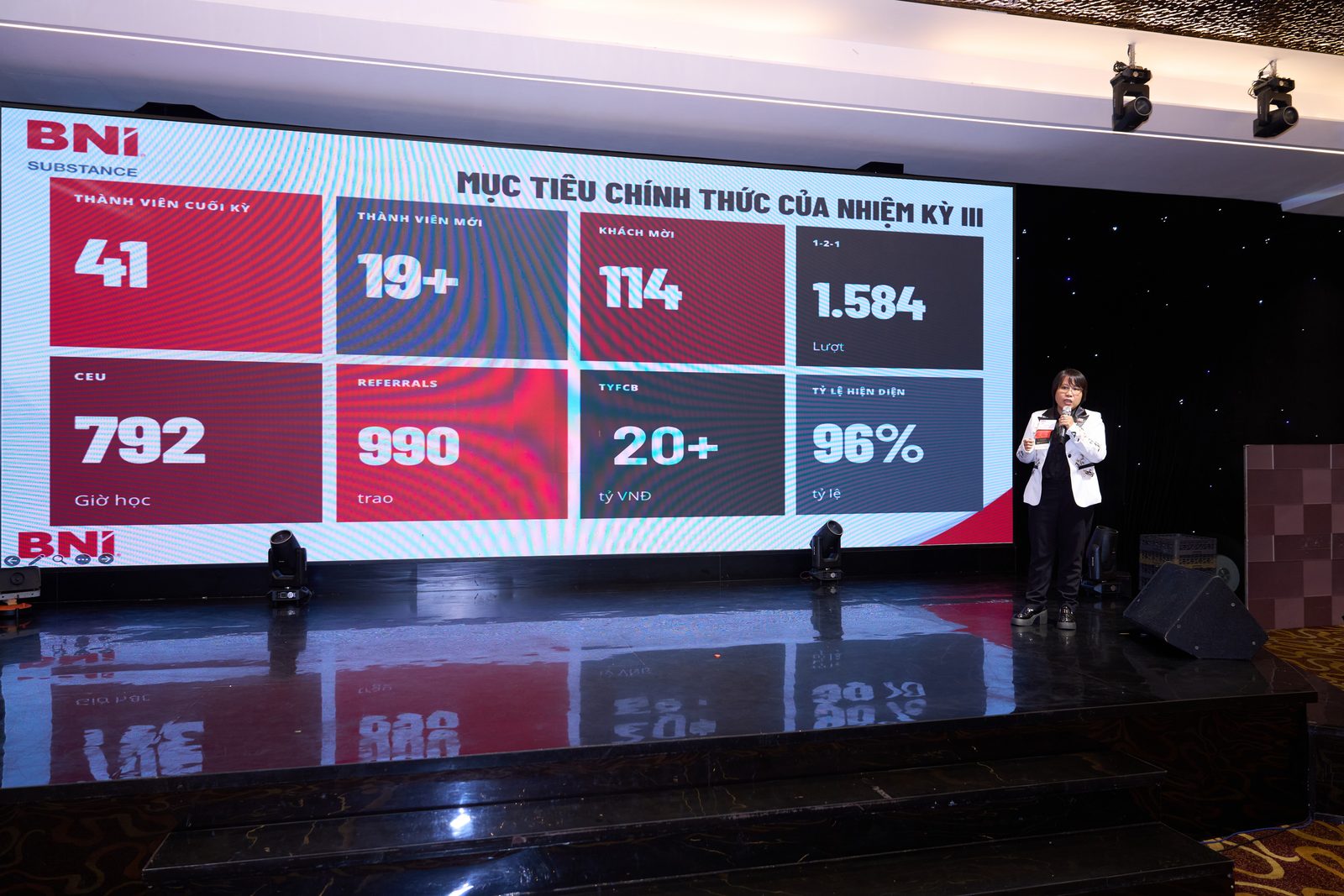
Vice President Le Kim Ngan announced the Term III goals:
- 41 members at term end, 19+ new members
- 114 visitors
- 1,584 1-2-1 meetings
- 792 CEU hours
- 990 referrals
- VND 20+ billion in TYFCB
- 96% attendance rate
Thank you to our sponsors
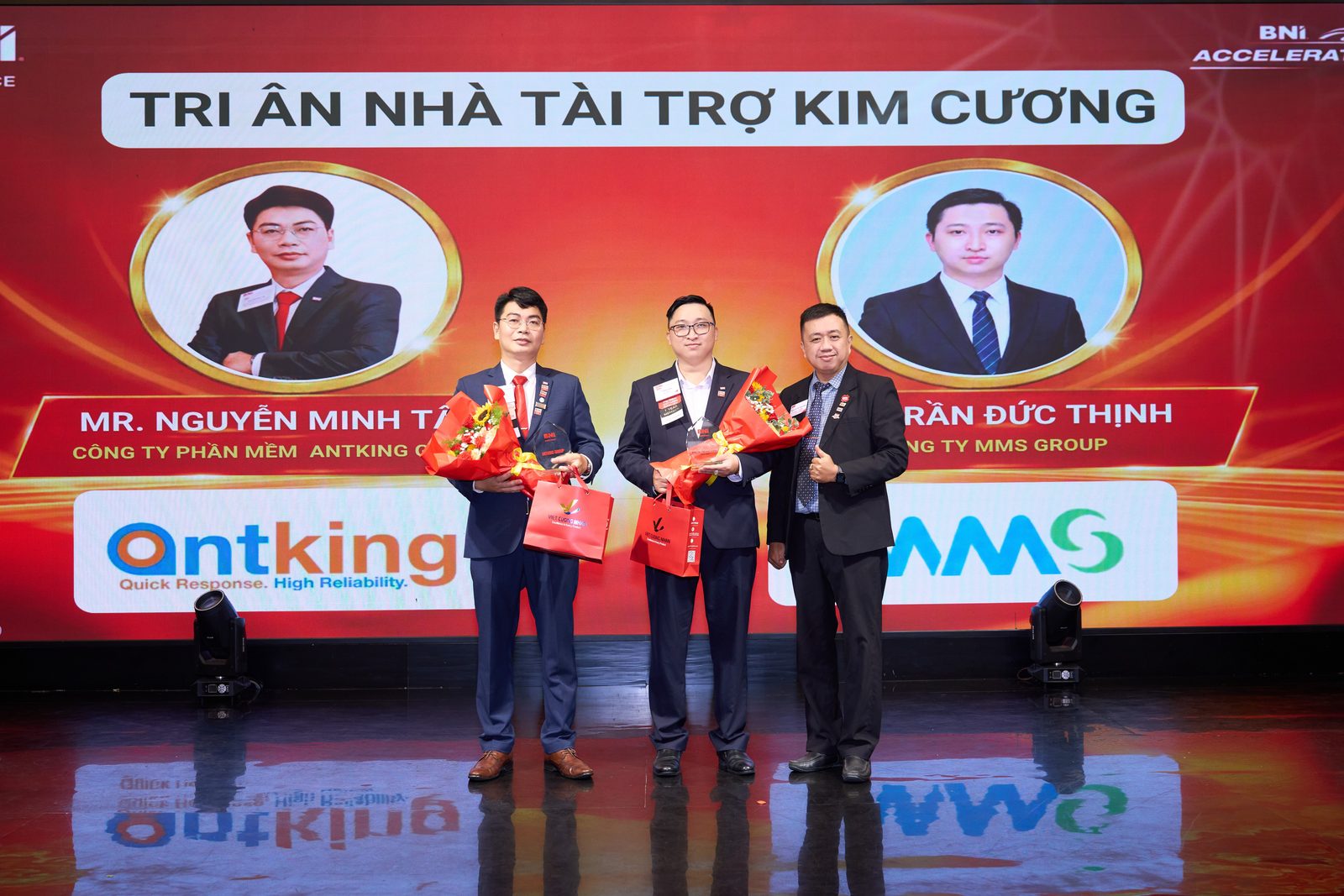
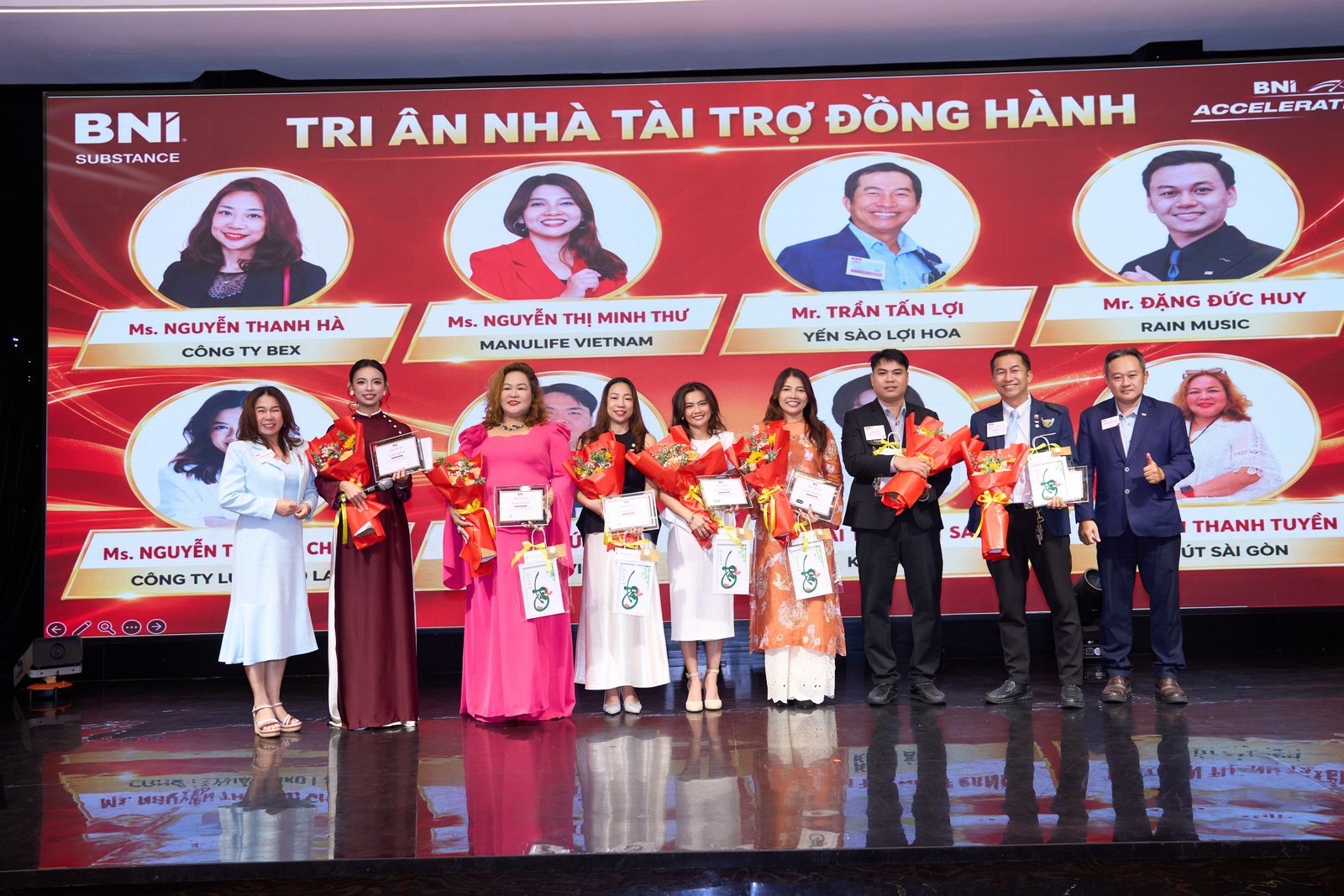
BNI Substance Chapter sincerely thanks the businesses that supported the event:
- Diamond sponsors: ANTKING Group, MMS Group
- Gold sponsors: Trend Realty, VN Express, Golden Mouse, Vu Man Quilling
- Silver sponsors: Vic’s Dental Clinic, T.A Company
- Companion sponsors: Bex, Manulife Vietnam, Loi Hoa Bird’s Nest, Rain Music, 1989 Law Firm, BCM Pet, KA Concept and Ms. Tran Thanh Tuyen
1st anniversary: from strangers to family
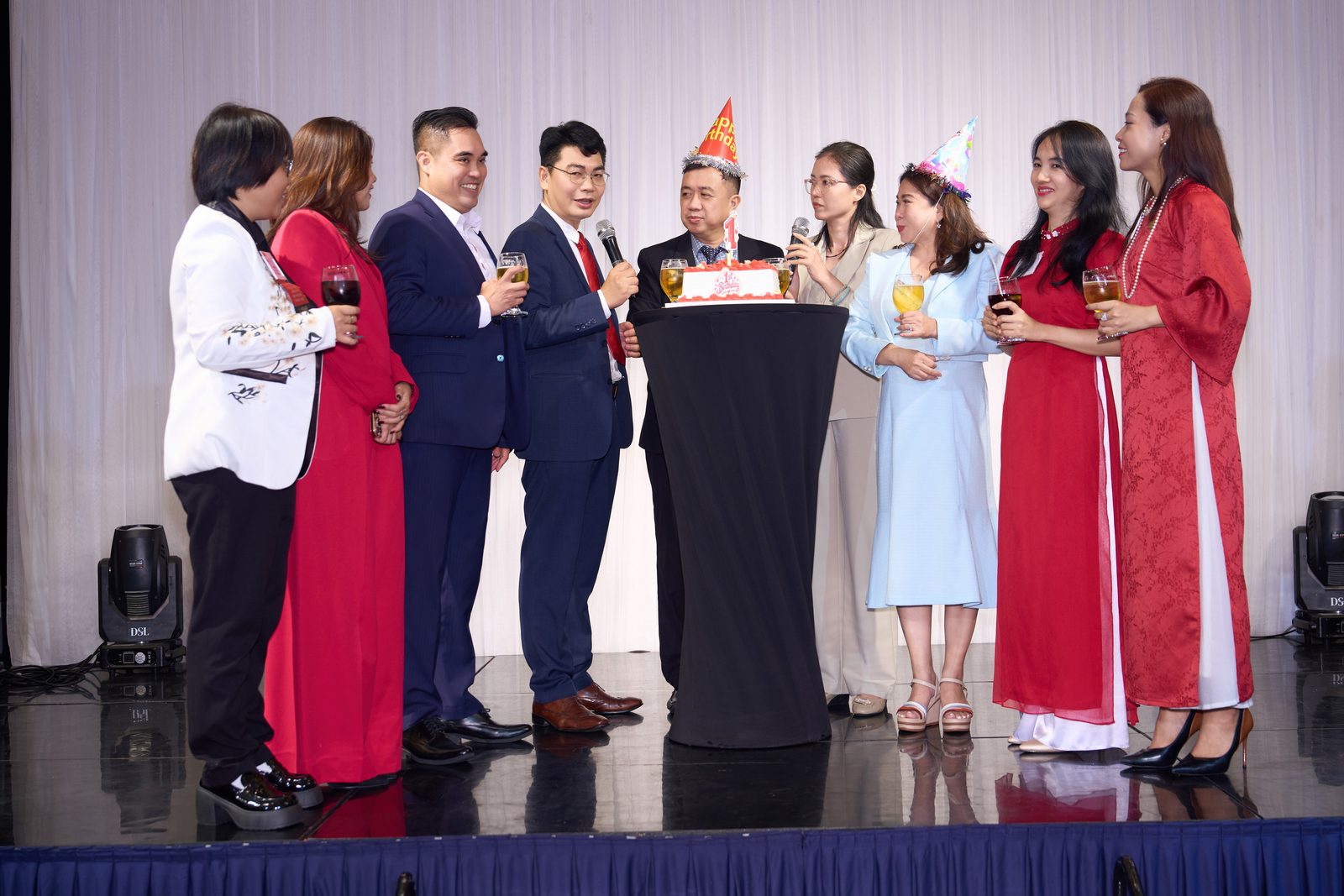
After the ceremony, members and guests moved on to the 1st Anniversary dinner of BNI Substance Chapter. The leadership and members cut the cake and raised a toast to the Chapter’s first birthday, in the warm atmosphere of a family that has shared 365 days of connection.
Givers Gain®: into the second year
Over the past year, BNI Substance has shown that the Givers Gain® philosophy creates real results: referrals, contracts and trusted relationships. With a new Leadership Team and clear goals, the Chapter enters its second year ready to elevate connections and accelerate growth.
BNI Substance Chapter sincerely thanks BNI’s directors, partner chapters, sponsors, members and guests for making it a meaningful day. The Chapter meets every Thursday morning, 7:30 – 10:30 AM. Business owners who would like to visit are welcome to contact President Mr. Nguyen Minh Tan or Visitor Team lead Mr. Le Van Vu via bnisubstance.com.
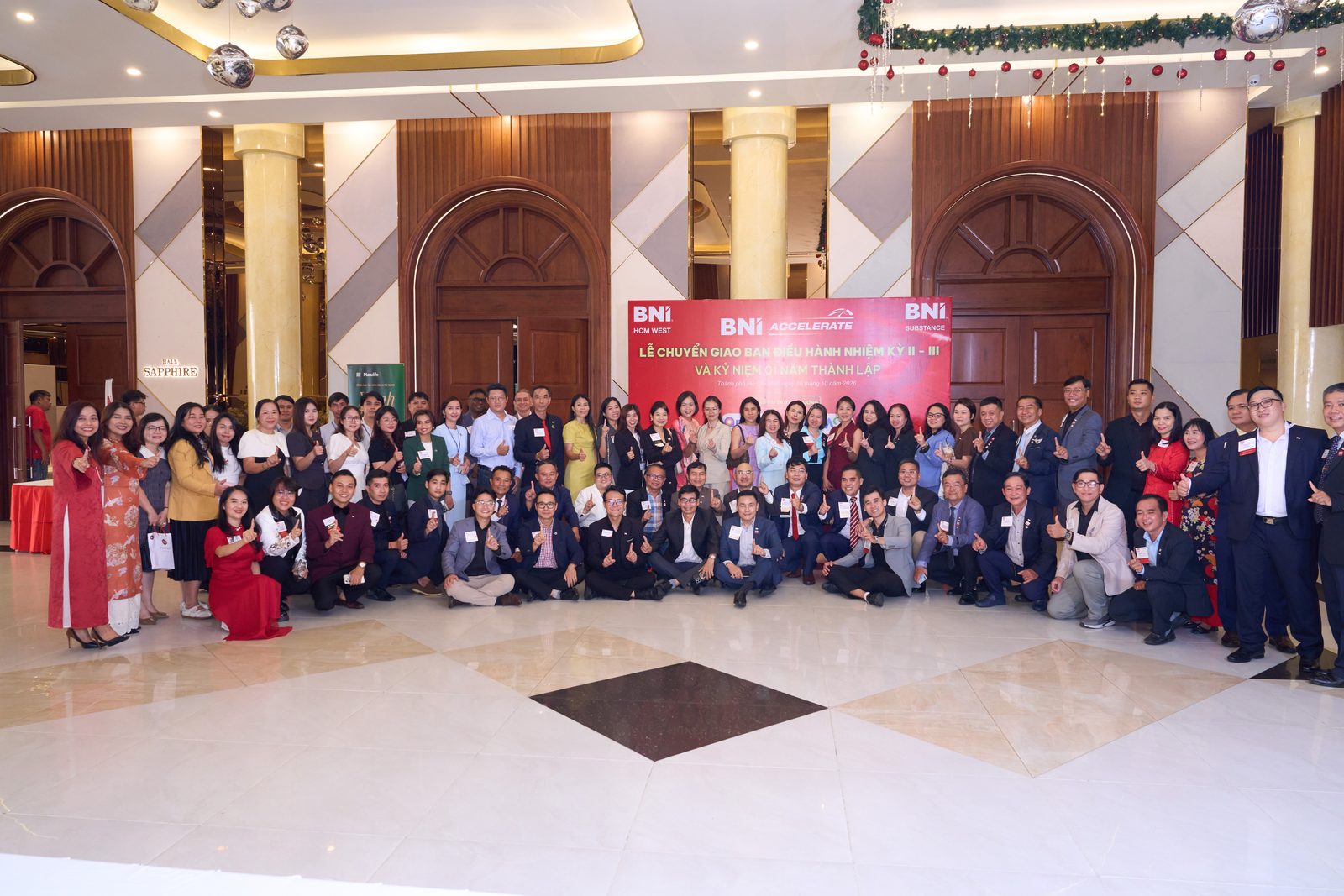

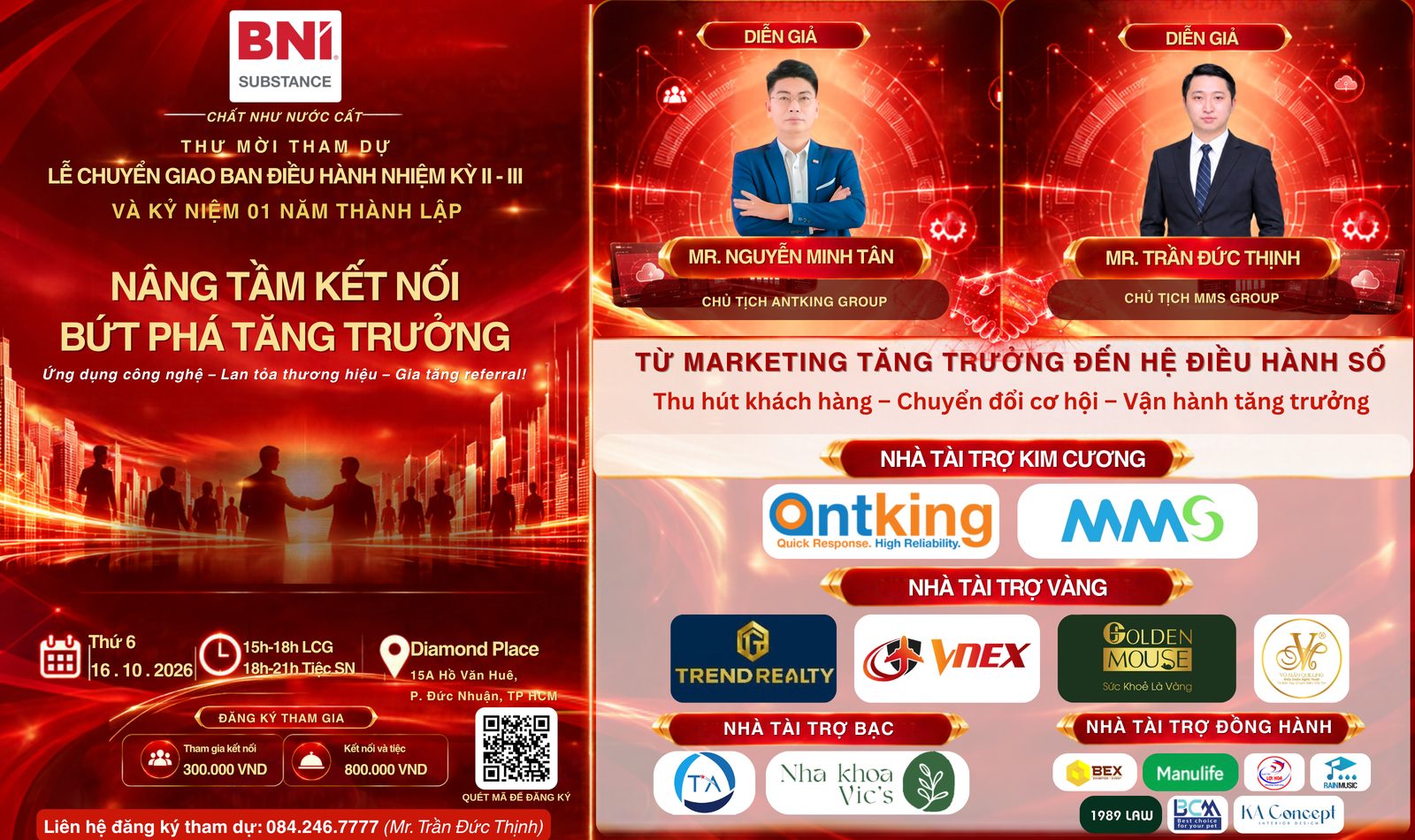
On the afternoon of Friday, 16 October 2026, BNI Substance Chapter (BNI HCM West) will hold its Leadership Team Handover Ceremony for Term II – III and celebrate the Chapter’s first anniversary. The event takes place at Diamond Place, 15A Ho Van Hue, Duc Nhuan Ward, Ho Chi Minh City, under the theme “Elevating Connections – Accelerating Growth”.
One year of “Pure as distilled water”
In its first year, BNI Substance has become a place where business owners from many industries meet every Thursday morning to connect, pass business opportunities and grow together under the philosophy of Givers Gain®. The Chapter’s motto, “Pure as distilled water”, stands for integrity, transparency and quality in every relationship and every referral.
The handover ceremony is a moment to look back on Term II, thank the outgoing Leadership Team and the members who have supported the Chapter, and pass the responsibility to the Term III Leadership Team, led by President Mr. Nguyen Minh Tan, with the goal of raising the quality of connections and creating more valuable referrals for members.
Programme
- 3:00 PM – 6:00 PM: Leadership Team Handover (Term II – III), keynote talk and business networking
- 6:00 PM – 9:00 PM: 1st Anniversary celebration dinner of BNI Substance Chapter
Keynote: From Growth Marketing to a Digital Operating System
The professional highlight of the programme is the talk “From Growth Marketing to a Digital Operating System”, built around three pillars: Attract customers – Convert opportunities – Operate for growth. It addresses a question many business owners are asking: how to turn today’s leads and referrals into revenue, and run that growth in a structured way with technology.
The two speakers:
- Mr. Nguyen Minh Tan – Chairman, ANTKING Group; President of BNI Substance Chapter, Term III
- Mr. Tran Duc Thinh – Chairman, MMS Group
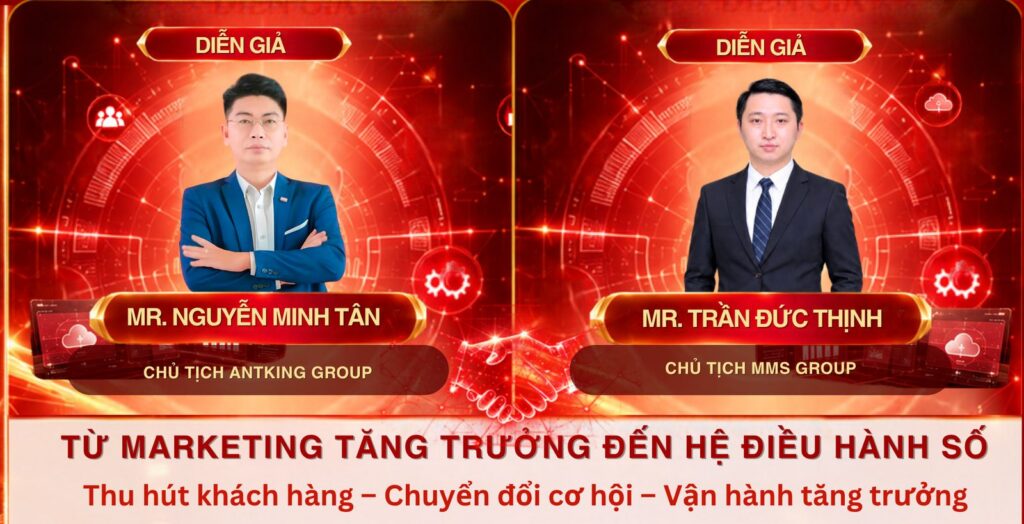
In line with the message “Apply technology – Spread your brand – Grow referrals!”, the event is an opportunity for members and guests to catch up on new approaches to marketing and digital transformation while expanding their network within the BNI business community.
Attendance information
- Time: Friday, 16 October 2026, 3:00 PM – 9:00 PM
- Venue: Diamond Place, 15A Ho Van Hue, Duc Nhuan Ward, Ho Chi Minh City
- Networking: 300,000 VND
- Networking and dinner: 800,000 VND
- Register online: scan the QR code on the invitation or visit https://forms.gle/AqTyZEBN2S1itsvF9
- Registration contact: 084.246.7777 (Mr. Tran Duc Thinh)
Thank you to our sponsors
BNI Substance Chapter sincerely thanks the businesses supporting the event:
- Diamond sponsors: ANTKING Group, MMS Group
- Gold sponsors: Trend Realty, VNEX, Golden Mouse, Vu Man Quilling
- Silver sponsors: T.A, Vic’s Dental Clinic
- Companion sponsors: BEX, Manulife, Loi Hoa Bird’s Nest, Rain Music, 1989 Law, BCM Pet, KA Concept
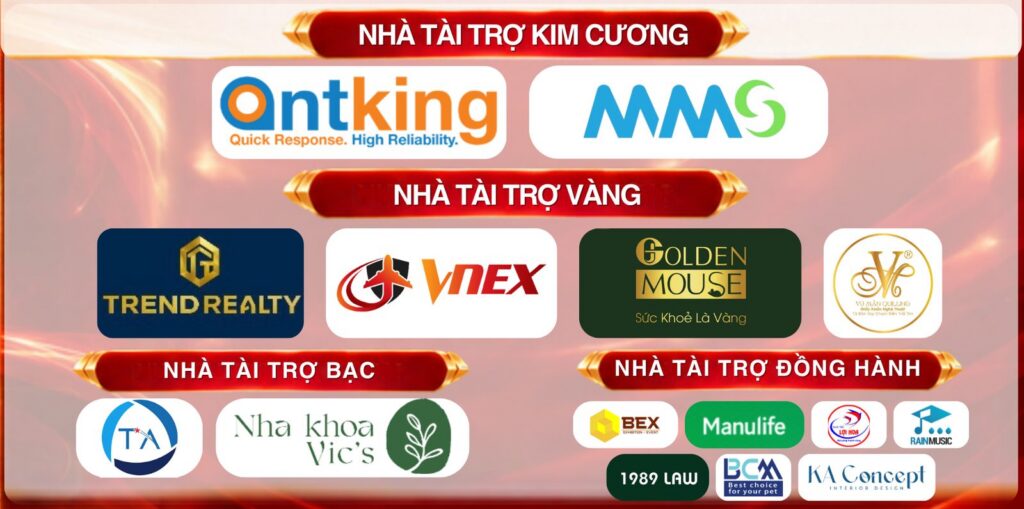
BNI Substance Chapter warmly invites business owners, partners and friends of the BNI community to join us, witness this milestone and together elevate connections and accelerate growth.
On Thursday morning, 1 October 2026, at the Adora Legend Convention Center (32 Hoang Viet St., Tan Son Nhat Ward, Ho Chi Minh City), BNI Substance Chapter (part of BNI HCM West) held its weekly Business Networking meeting with 30 business owners attending as members and visitors. It was the first meeting of October and the opening meeting of the Chapter’s Term III, held in a warm, professional atmosphere and in the collaborative spirit of BNI.
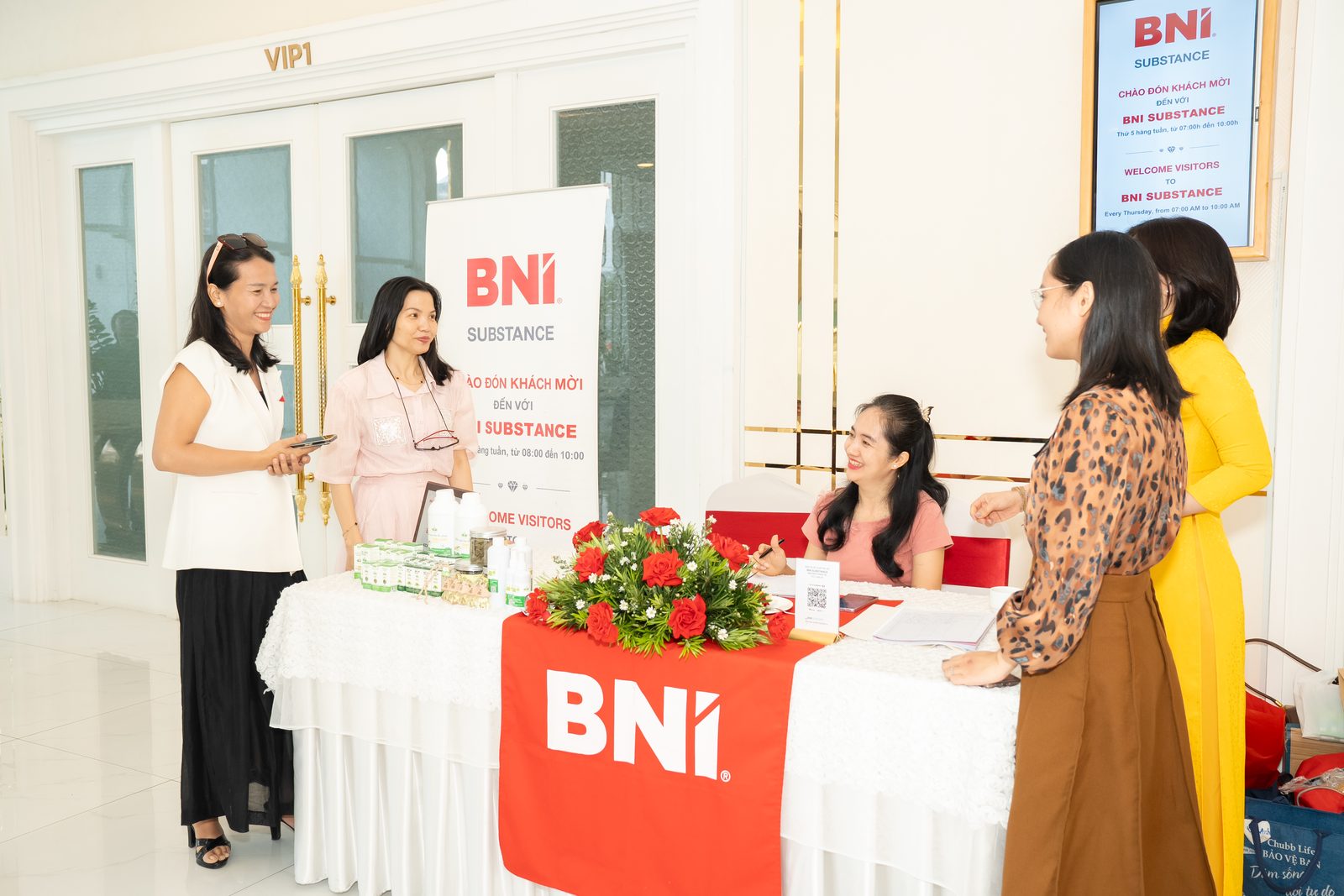
Open Networking: every handshake is an opportunity
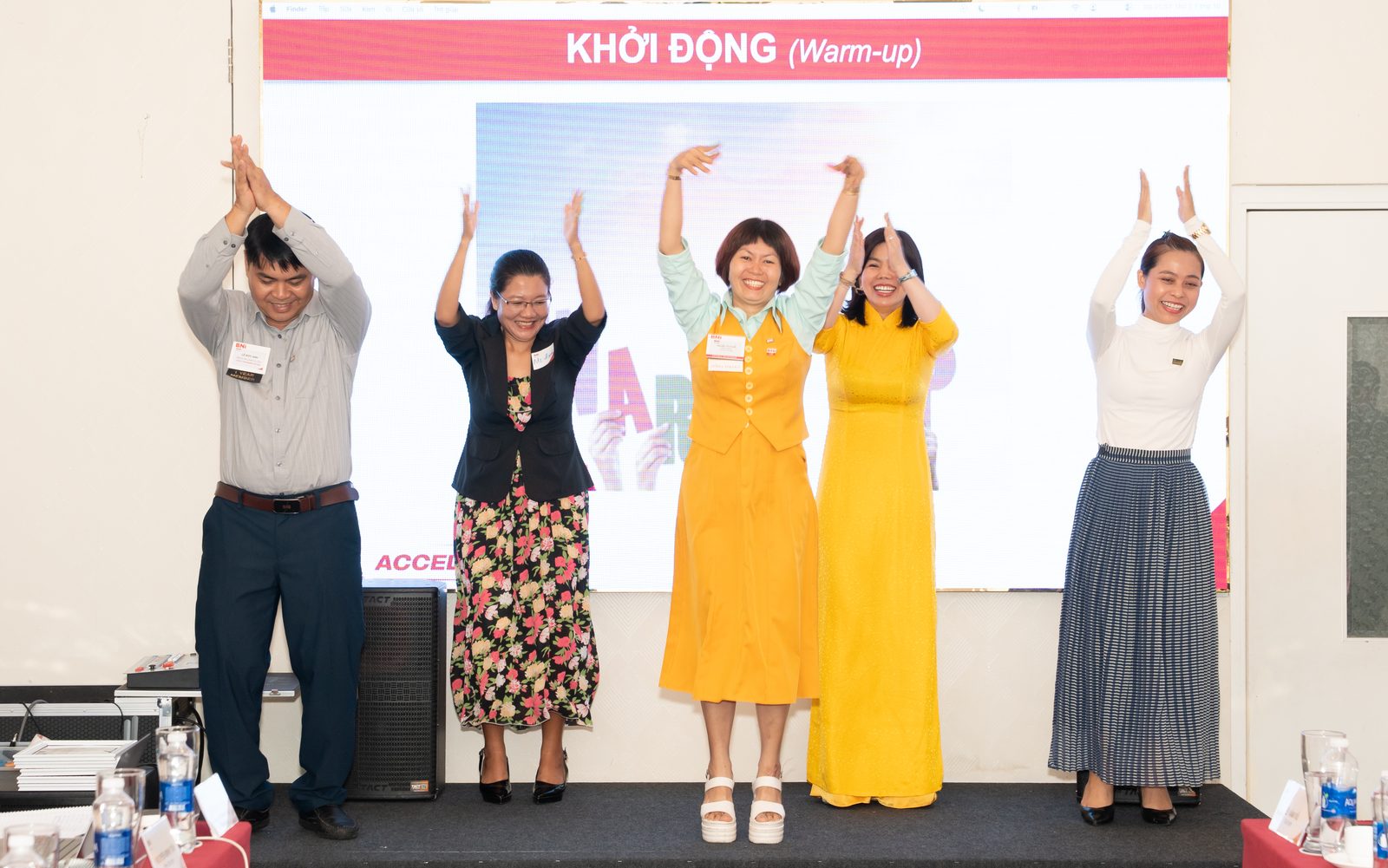
From the very start, Open Networking was lively in the lobby: exchanging business cards, giving short introductions and stopping by the product displays set up by Chapter members. A cheerful warm-up then got the whole room in step before the formal agenda began.
Introducing the Term III Leadership Team
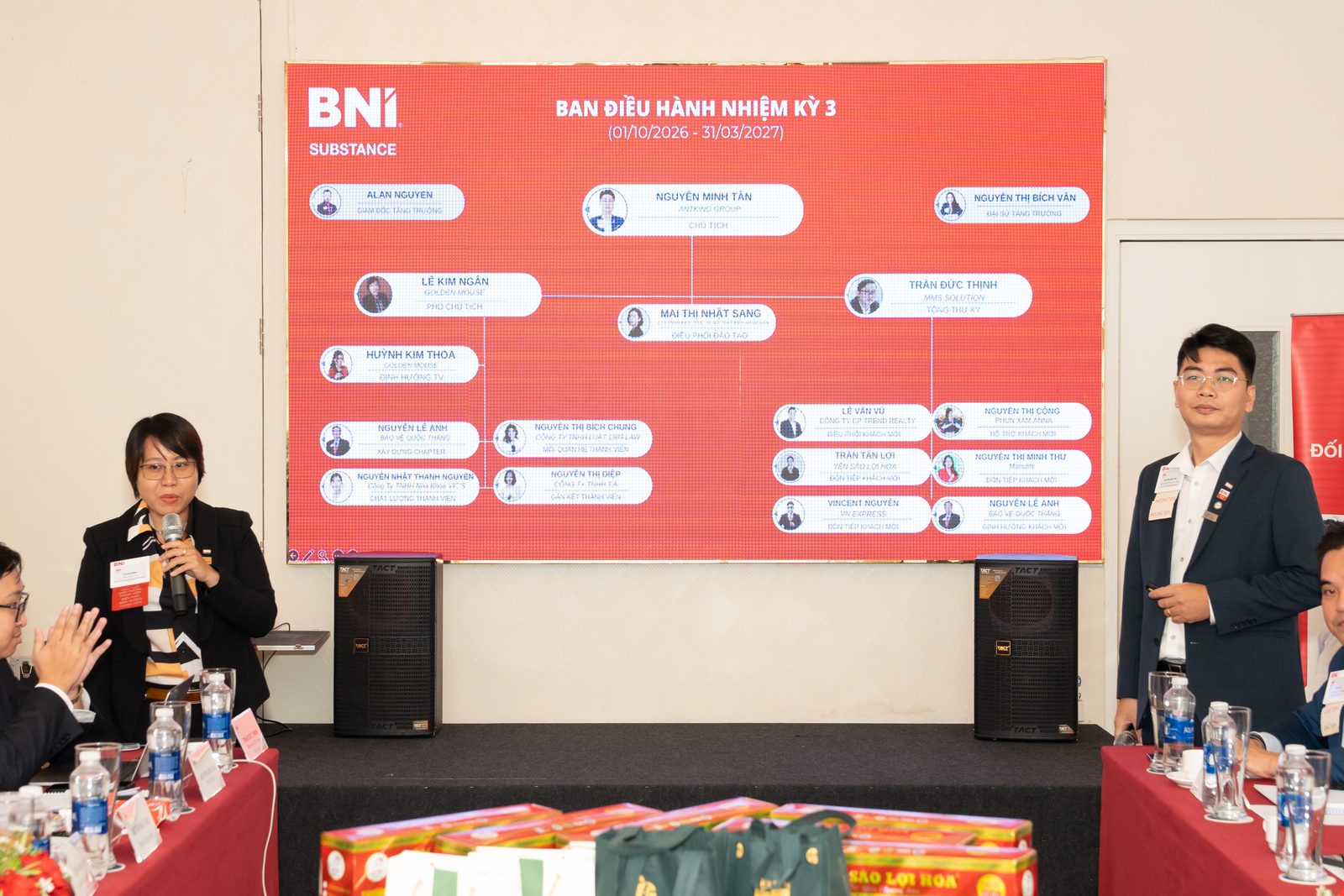
While welcoming visitors, the Chapter introduced its Term III Leadership Team (1 October 2026 – 31 March 2027): President Mr. Nguyen Minh Tan (ANTKING Group), Vice President Ms. Le Kim Ngan (Golden Mouse), Secretary/Treasurer Mr. Tran Duc Thinh (MMS Solution) and Education Coordinator Ms. Mai Thi Nhat Sang, together with the members in charge of membership and visitors. Supporting the Chapter are Growth Director Mr. Alan Nguyen and Growth Ambassador Ms. Nguyen Thi Bich Van. The Term II – III Leadership handover ceremony will take place on 16 October 2026.
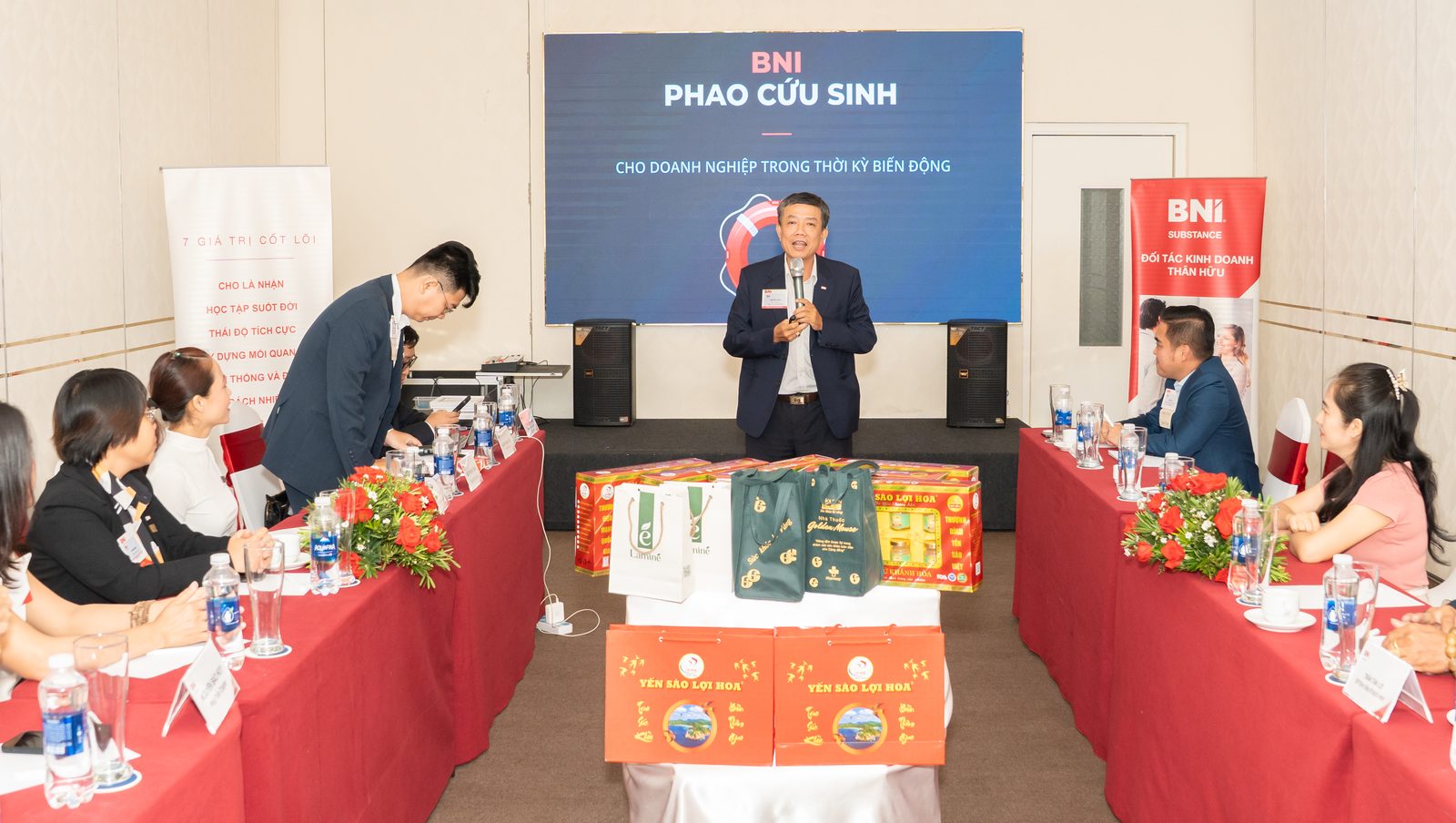
Networking education: “BNI – a lifebuoy for businesses in turbulent times”
The networking education segment was presented by Mr. Nguyen Le Anh — Quoc Thang Security Co., Ltd., on the topic “BNI – a lifebuoy for businesses in turbulent times”.
He started from what every business owner is seeing: rising costs, weaker demand and a tightening market. In a big storm, even the strongest swimmer tires quickly when swimming alone — a business needs a lifebuoy and a rescue team to reach safe shore. In his view, BNI offers exactly three such lifebuoys:
- A revenue lifebuoy — “Cash flow never stops”: a sales force of 20–50 people at no cost, contracts and cash flow sustained by quality referrals, and savings on marketing and advertising budgets
- A knowledge lifebuoy — “One mind is no match for dozens of brains”: no more figuring things out alone, an “advisory board” to help with restructuring, cost reduction and digital transformation, and hard-won lessons from those who have already weathered storms
- A morale lifebuoy — “The power of connection”: the Givers Gain® philosophy builds a solid environment of mutual support, a weekly “charging station” that keeps leaders energised and steady at the helm
A lifebuoy only works if you hold on to it. The call to action was therefore very concrete: 100% attendance, because every meeting is a business opportunity; more 1-2-1s, so that fellow members truly understand your challenges; and open sharing, being willing to accept sincere help from the group. “Alone you go fast, but together you go far — and get through the storm.”
Recognising top members of September and Week 43
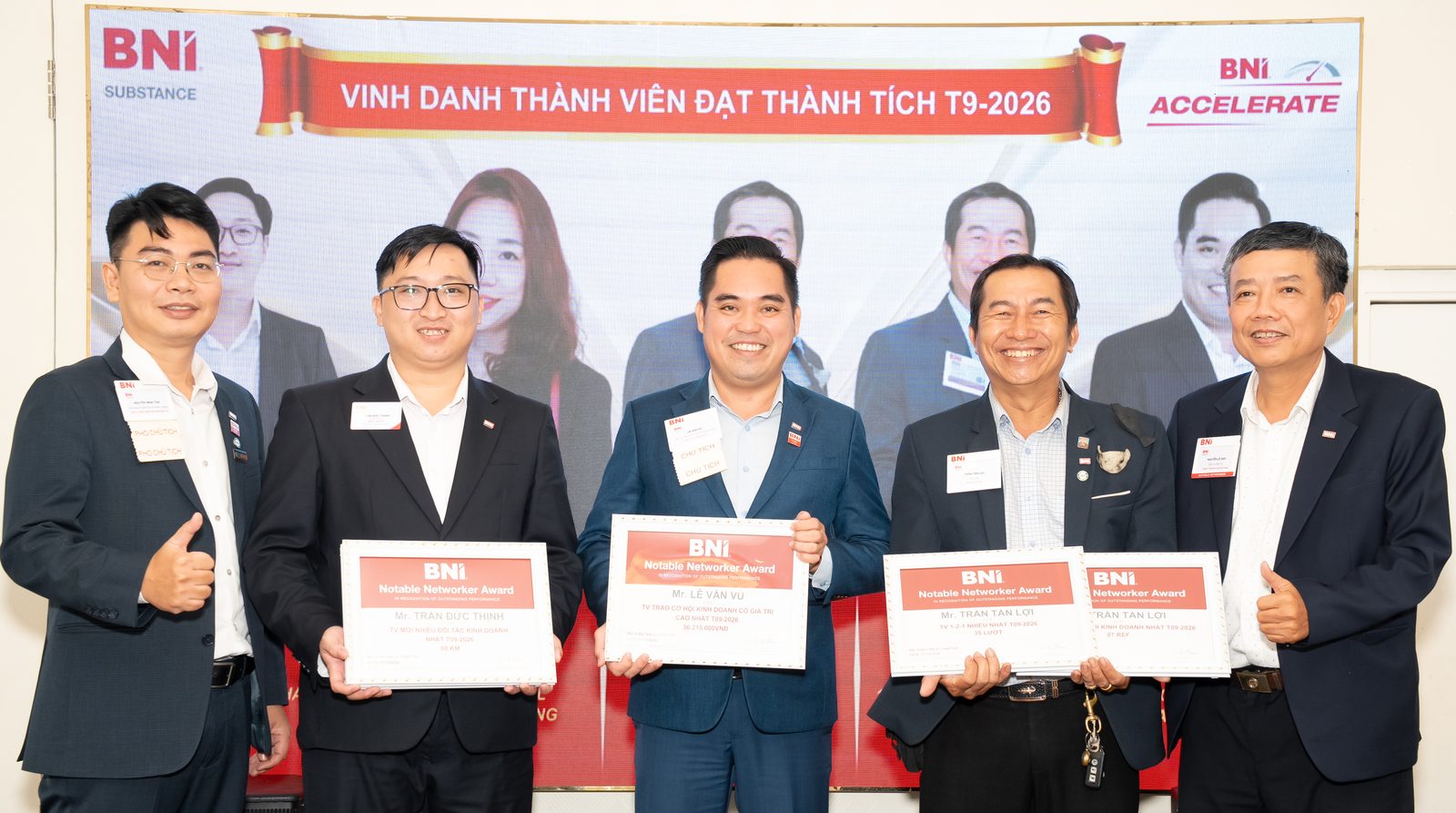
As the first meeting of the month, the Chapter presented the Notable Networker Award to the top performers of September 2026:
- Mr. Tran Duc Thinh — most visitors invited in the month: 8 visitors
- Ms. Nguyen Thanh Ha and Mr. Tran Tan Loi — most referrals given in the month: 7 referrals each
- Mr. Tran Tan Loi — most 1-2-1s in the month: 35
- Mr. Le Van Vu — highest business value in the month: VND 36,215,000
This was followed by recognition of the top members of Week 43:
- Mr. Tran Tan Loi (Loi Hoa) — most 1-2-1s: 9, and most visitors invited: 4
- Mr. Nguyen Minh Tan (ANTKING Group) — most referrals given: 3
- Mr. Le Van Vu (Trend Realty) — highest TYFCB: VND 18,000,000
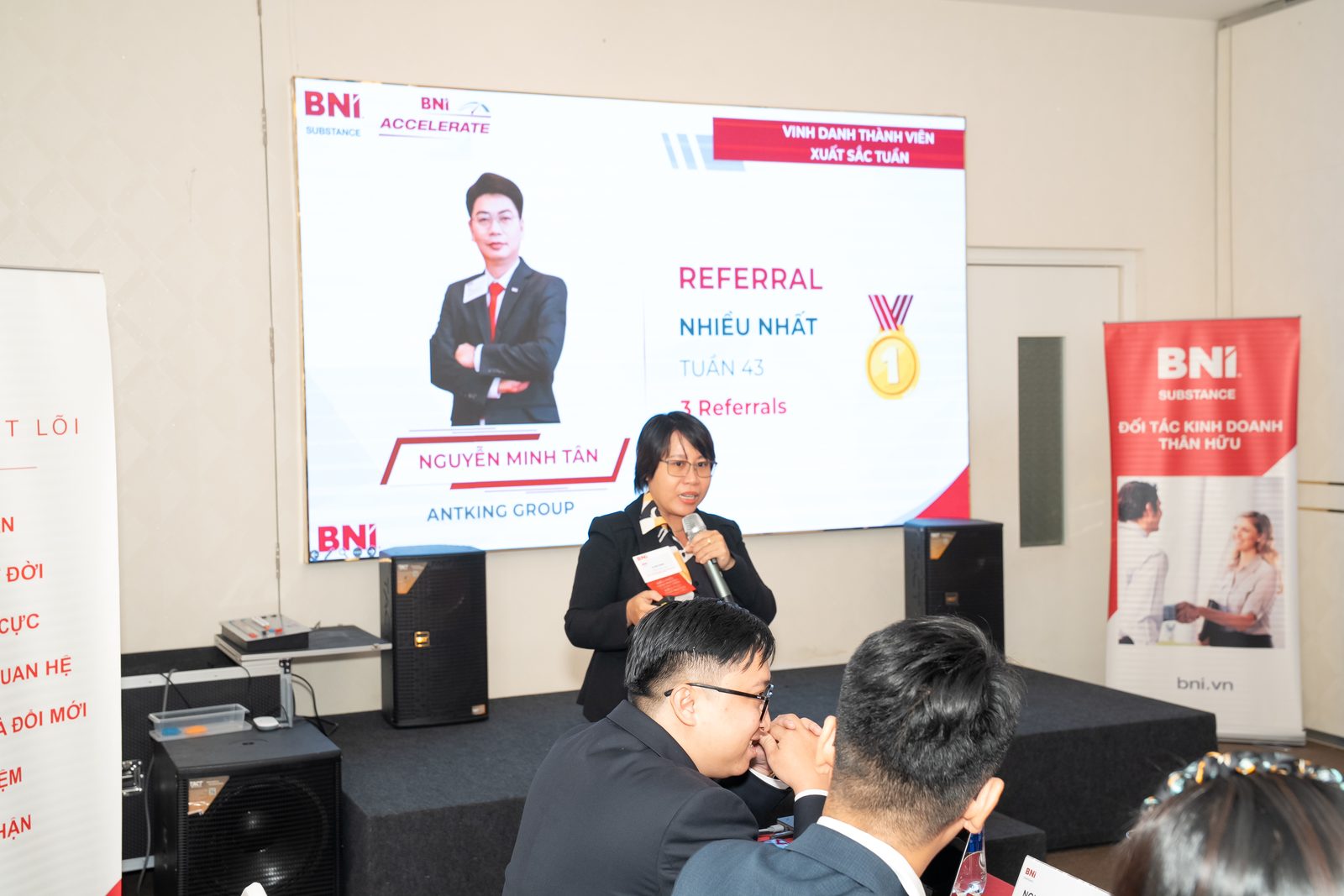
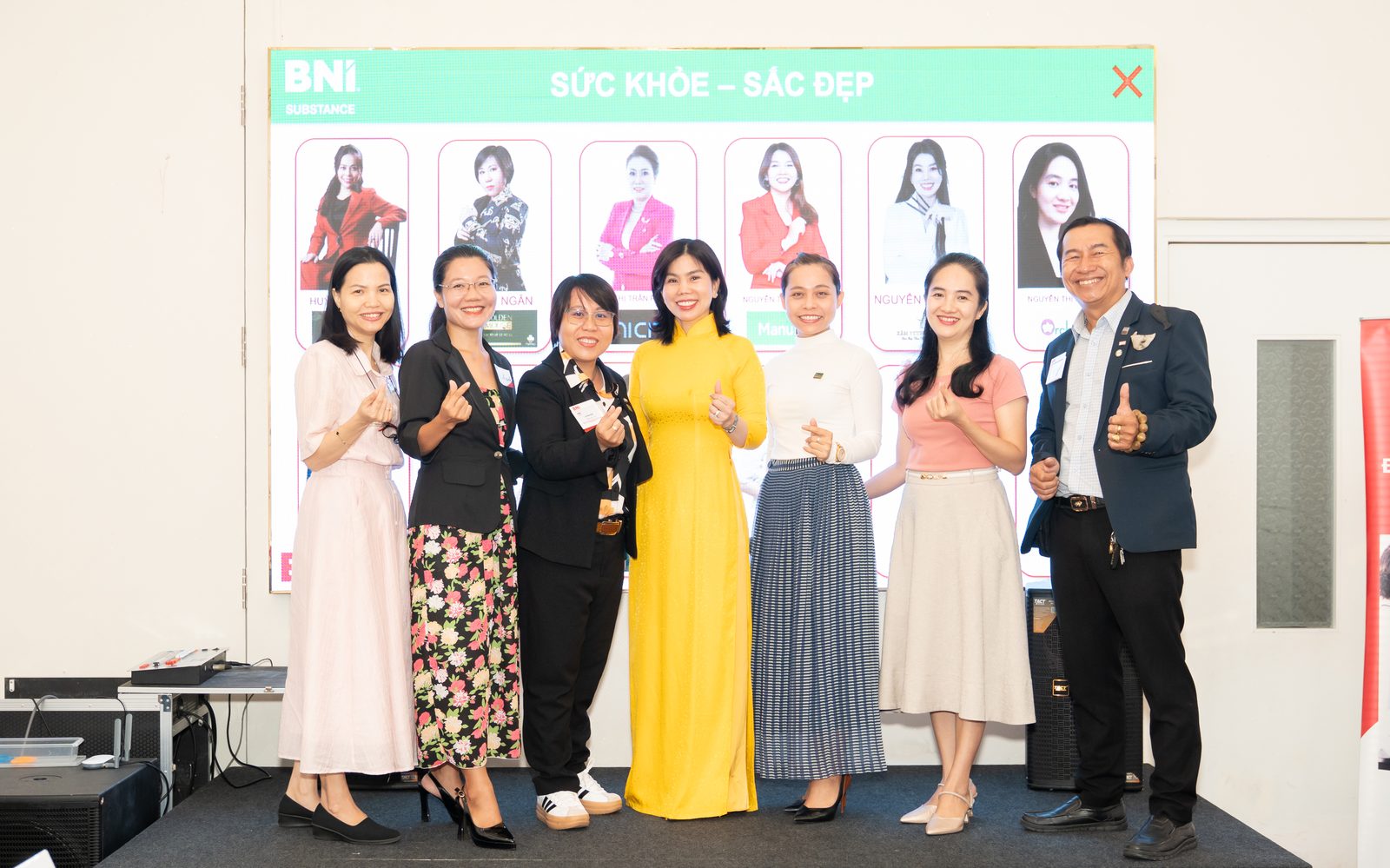
30-second introductions by Power Team
The 30-second introductions were given by Power Team — Health & Beauty, Construction & Real Estate, and Business Support. Each member stated their profession, ideal client and the connection they were looking for that week, so everyone in the room knew exactly how to help.
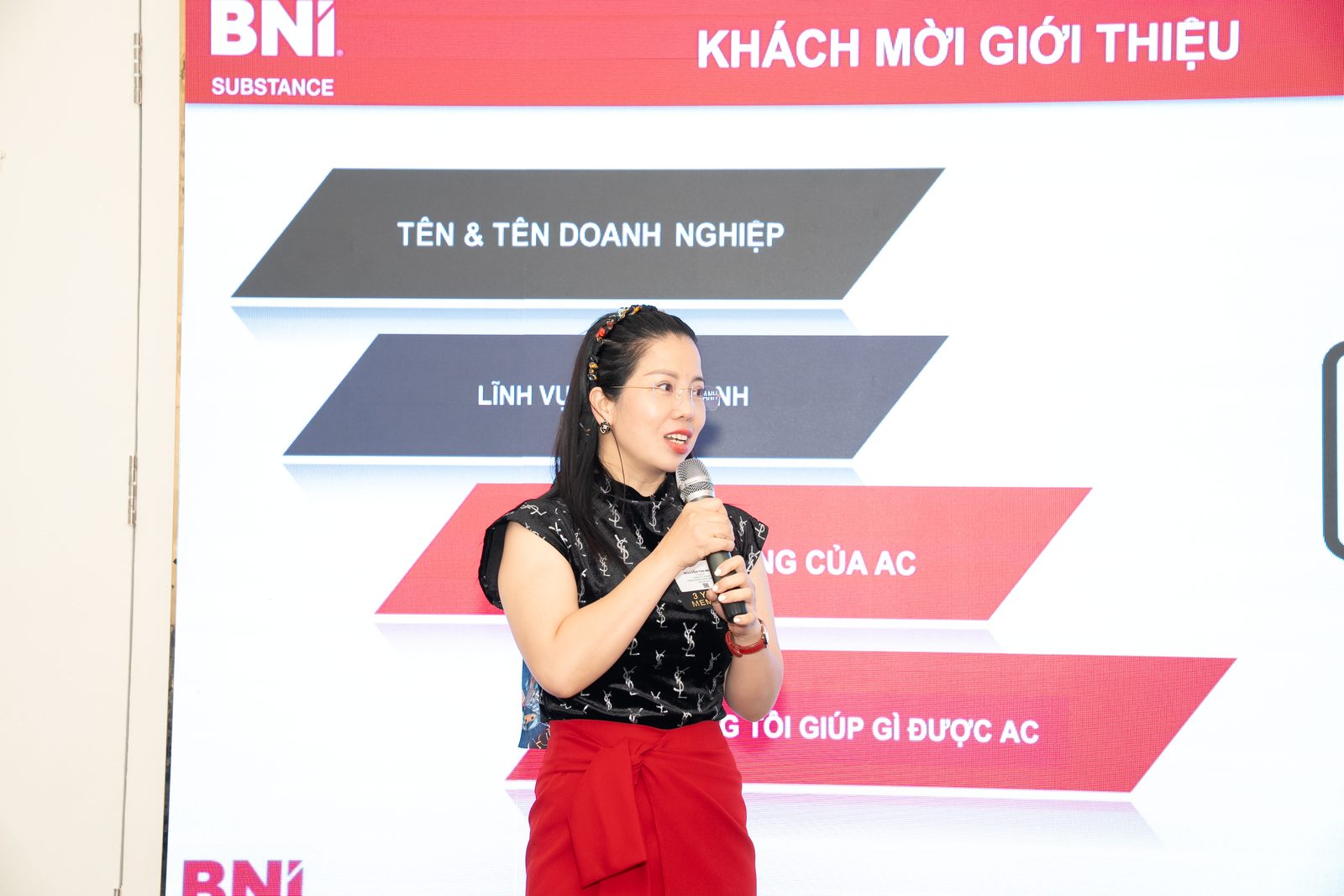
Visitors and first connections
Visitors took turns introducing their company, their line of business, who their clients are and how the Chapter could help. This is usually where the first connections are made — and where members realise which opportunities they can pass on.
Feature Presentation: Xam Phun Cong Anna — “Feng Shui in Cosmetic Tattooing: Refining the Lines, Flattering the Face”
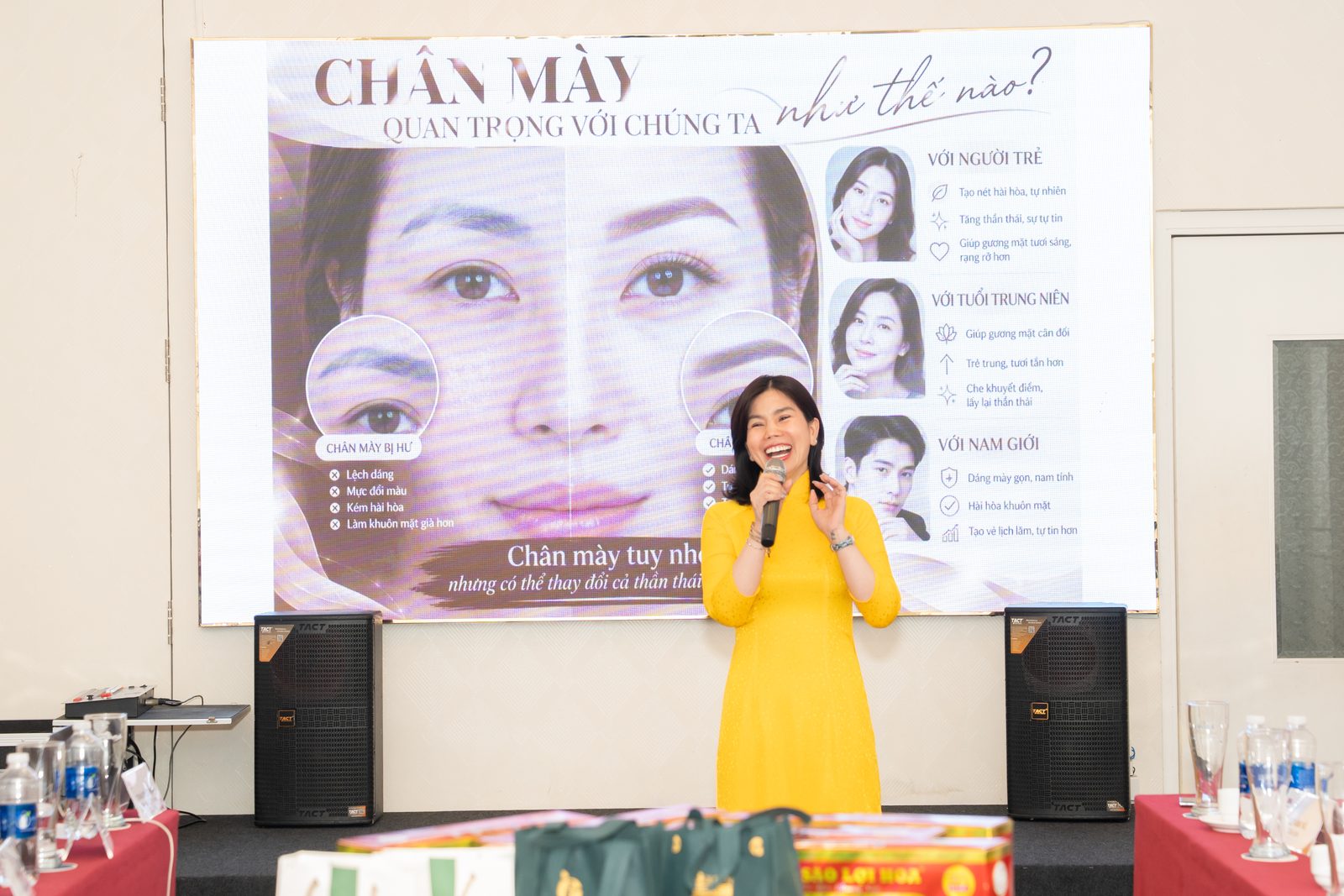
The highlight of the meeting was the Feature Presentation by Ms. Anna Cong (Nguyen Thi Cong) — Director of Xam Phun Cong Anna, titled “Feng Shui in Cosmetic Tattooing: Refining the Lines, Flattering the Face”.
She opened with an everyday question: how much do eyebrows matter? “Eyebrows are small, but they can change the whole character of a face.” Poorly done brows — uneven shape, discoloured ink, lack of harmony — make a face look older; well-designed brows look natural, bring out one’s features and make the face look younger and brighter. For younger people this means confidence and presence; for the middle-aged, a more balanced, fresher face; for men, a neat, masculine and polished look.
In her view, beauty is not about changing completely, but about what suits and brings out each person’s own features. A harmonious appearance rests on three elements:
- Harmonious shape and lines — designed around each face’s structure; balanced head, arch and tail; soft hair strokes that do not weigh the face down
- Proportions that fit the face — enhancing existing features, beautiful while keeping a natural personal look
- Right for the person’s gender and character — no single shape for everyone, but a design based on age, style and individual features
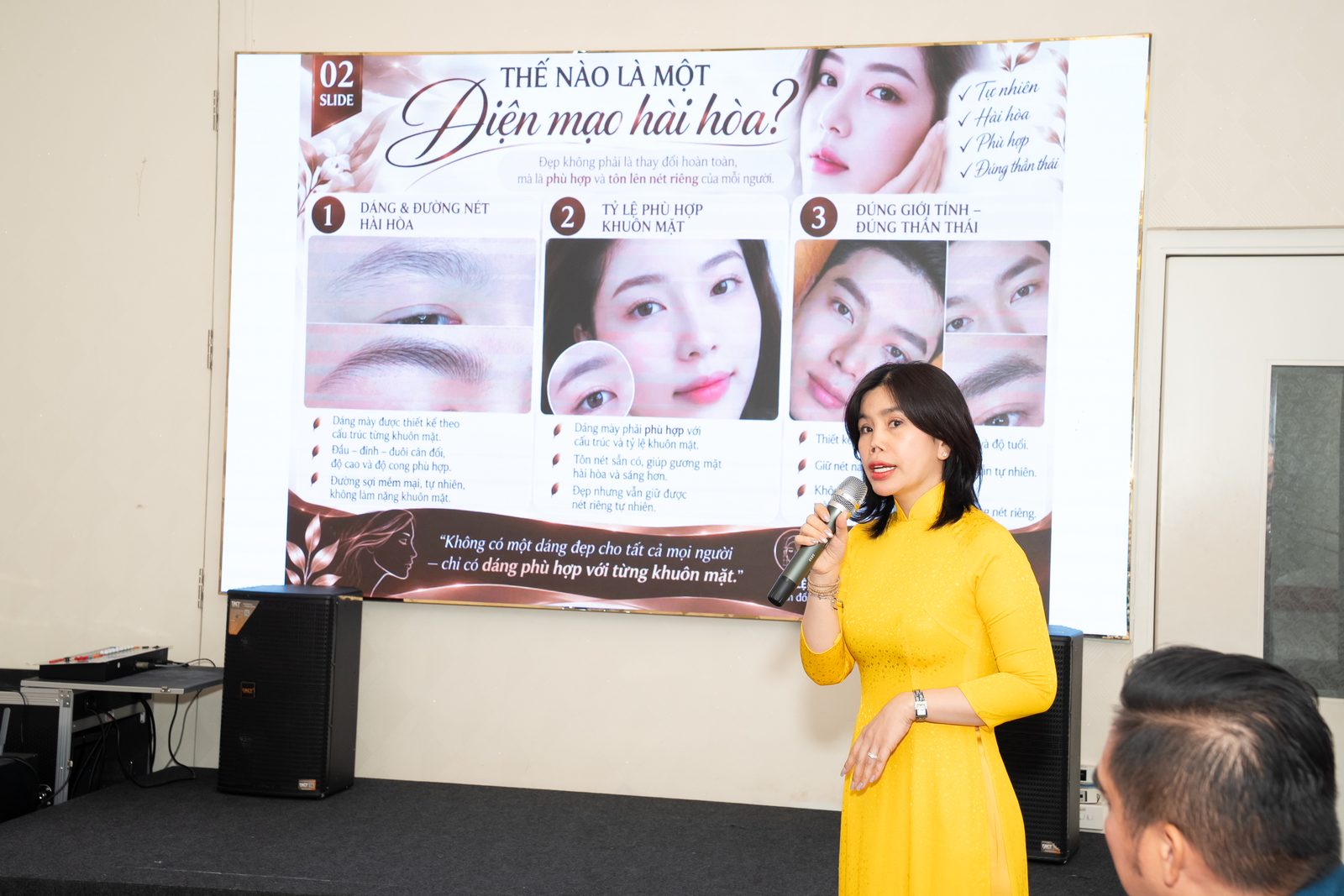
Creating beautiful work takes more than technique. Cong Anna’s process has four steps — examination, consultation, design, technique — on the principle of one design per face, using organic pigments and putting harmony first. For brows damaged by earlier tattooing, the solution is to “fix the old base properly”: assess the old base, remove the old ink by laser, re-check the facial structure and only then design a new shape. “To be beautiful the right way, first treat the base the right way.”
For the Chapter, this is a clear guide to when to refer someone to Cong Anna: people whose old tattooed brows are uneven or discoloured and need correcting; people who want natural-looking brows, eyeliner and lips that suit their face; and men who want neater, more polished brows.
Connecting and spreading value
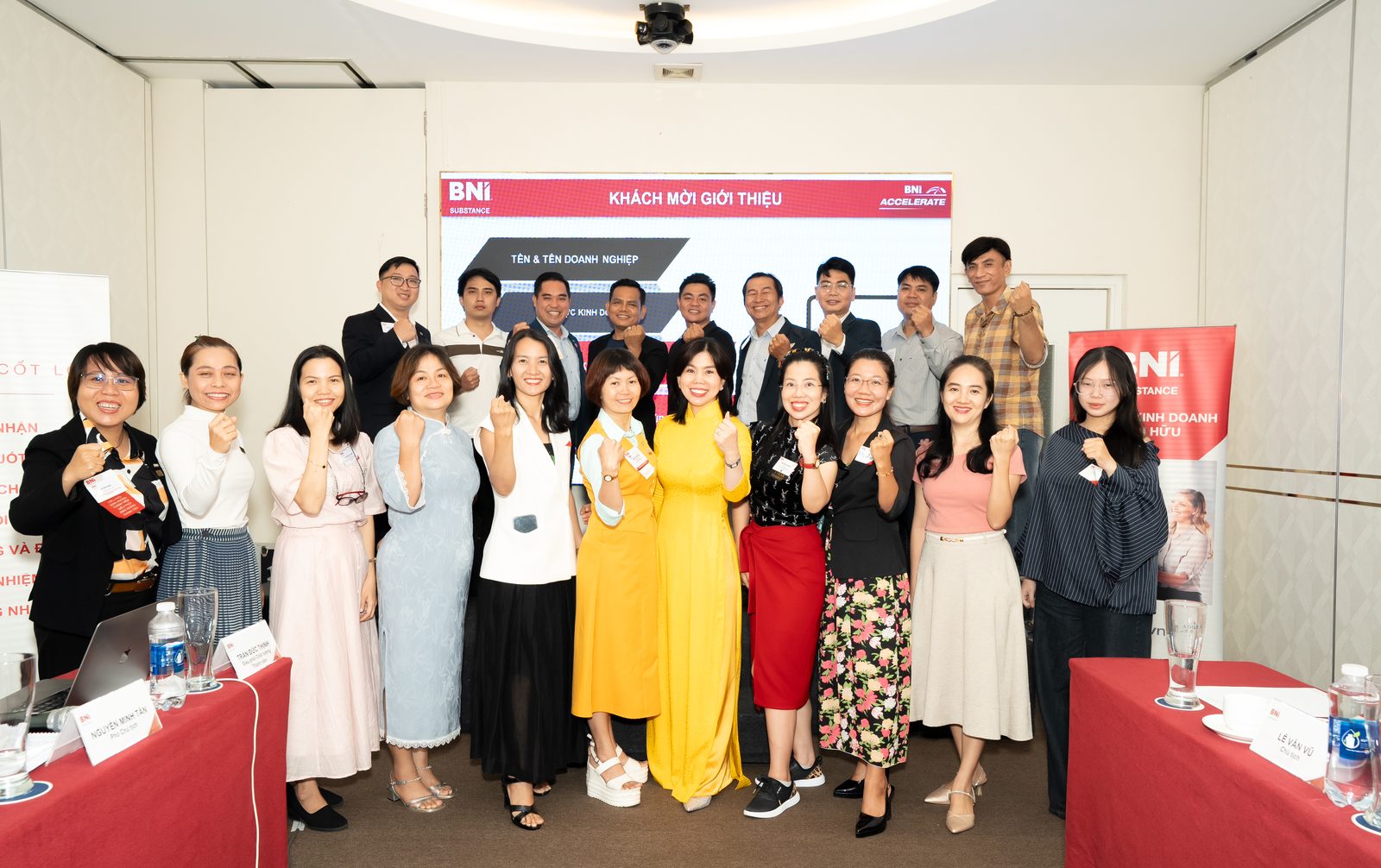
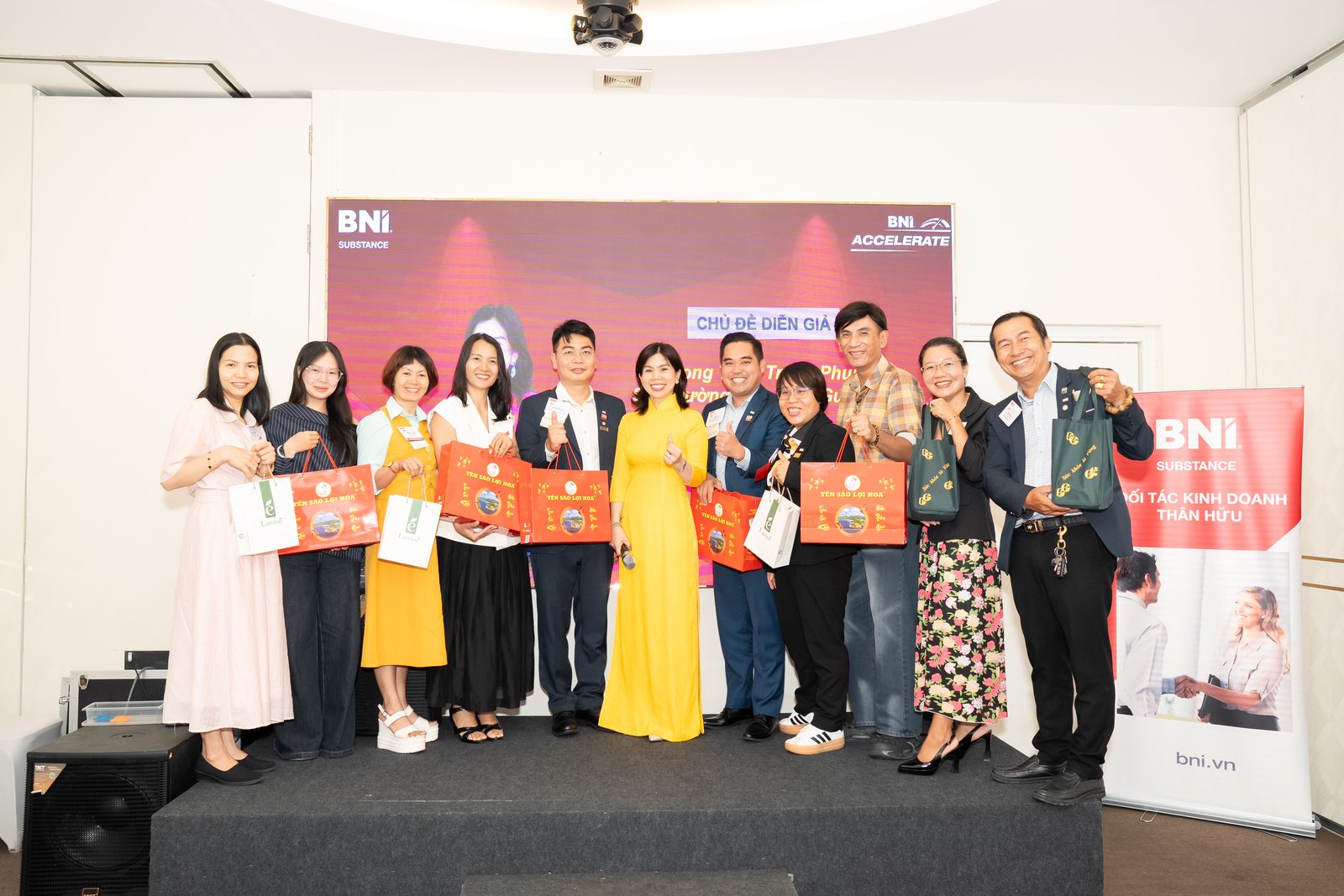
The meeting closed with a lucky draw, thanks to the visitors and a group photo. In the spirit of Givers Gain®, BNI Substance Chapter continues to be a place where business owners learn, broaden their thinking and find trusted partners. The Chapter also reminded members of the APAC SME’s Expo 2026, organised by BNI APAC in Ho Chi Minh City on 8–10 October 2026.
Contact
BNI Substance Chapter sincerely thanks both speakers, all members and visitors. The Chapter meets every Thursday morning, 07:30 – 10:30, at Adora Legend Convention Center, 32 Hoang Viet St., Tan Son Nhat Ward, Ho Chi Minh City.
To register as a visitor: 0989.212.273 (Ms. Minh Thu) · Chapter President: Mr. Nguyen Minh Tan · Growth Director: Mr. Alan Nguyen.
On the morning of Thursday, 24 September 2026, at Adora Legend Convention Centre (32 Hoang Viet Street, Tan Son Nhat Ward, Ho Chi Minh City), BNI Substance Chapter (BNI HCM West) held its weekly Business Networking meeting with 30 business owners — members and invited guests, in the warm, professional and collaborative spirit of BNI.
Open networking: every handshake is an opportunity
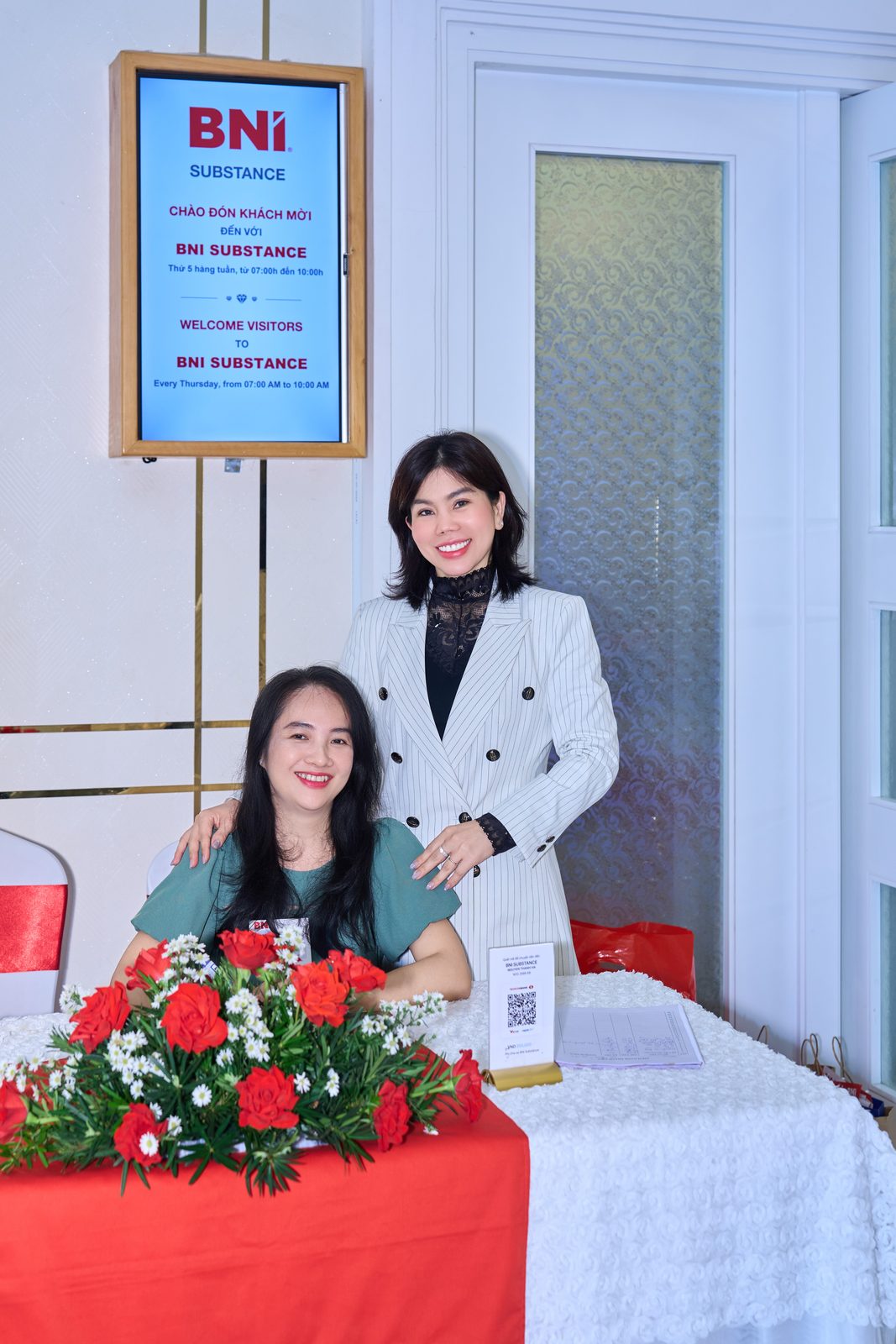
From 07:30, the Open Networking session was in full swing in the foyer. Alongside business cards and quick introductions, guests could try the natural essential oils displayed by one of the Chapter’s members — a very natural way for a business conversation to begin.

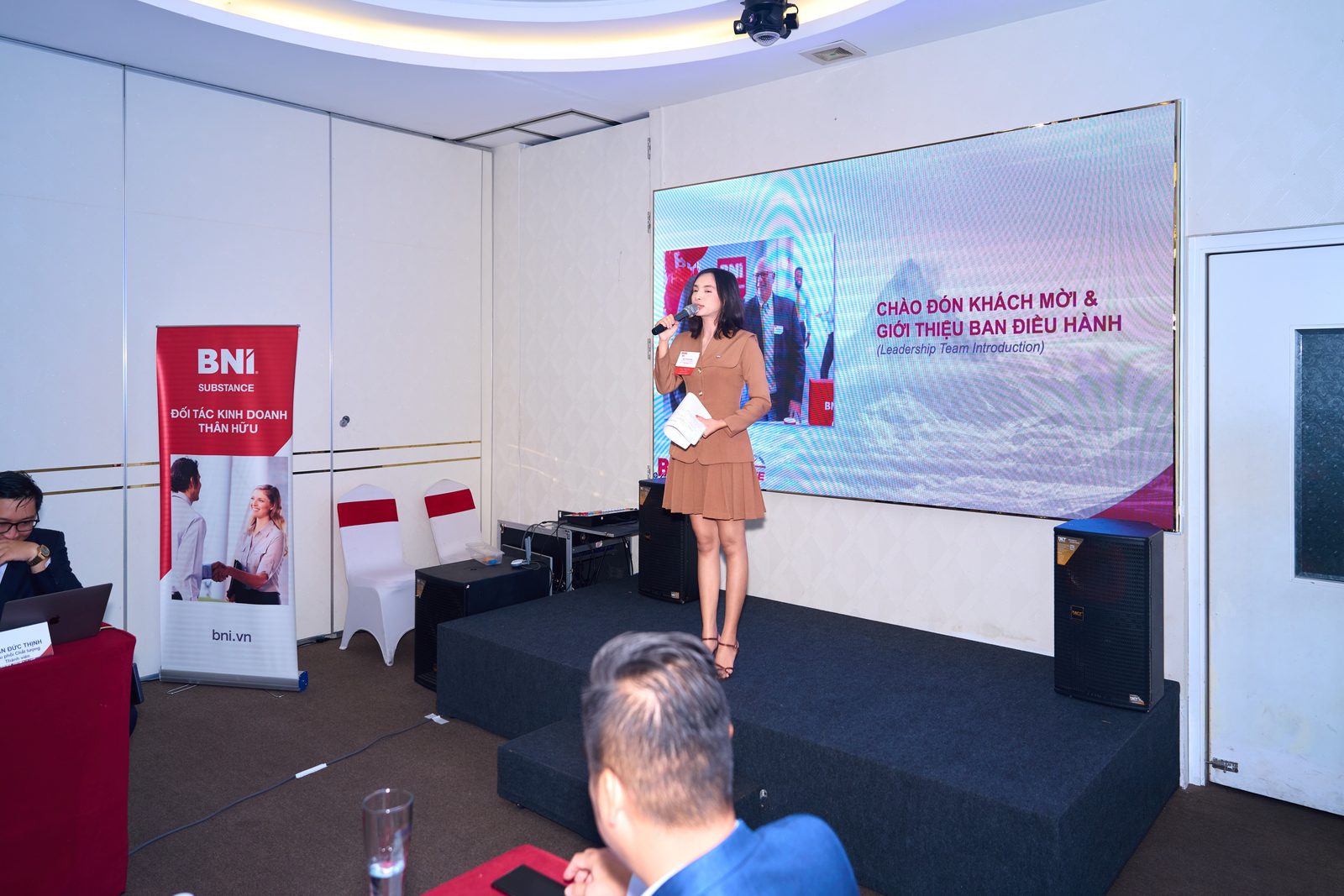
Skills sharing: “Out of sight, out of mind”
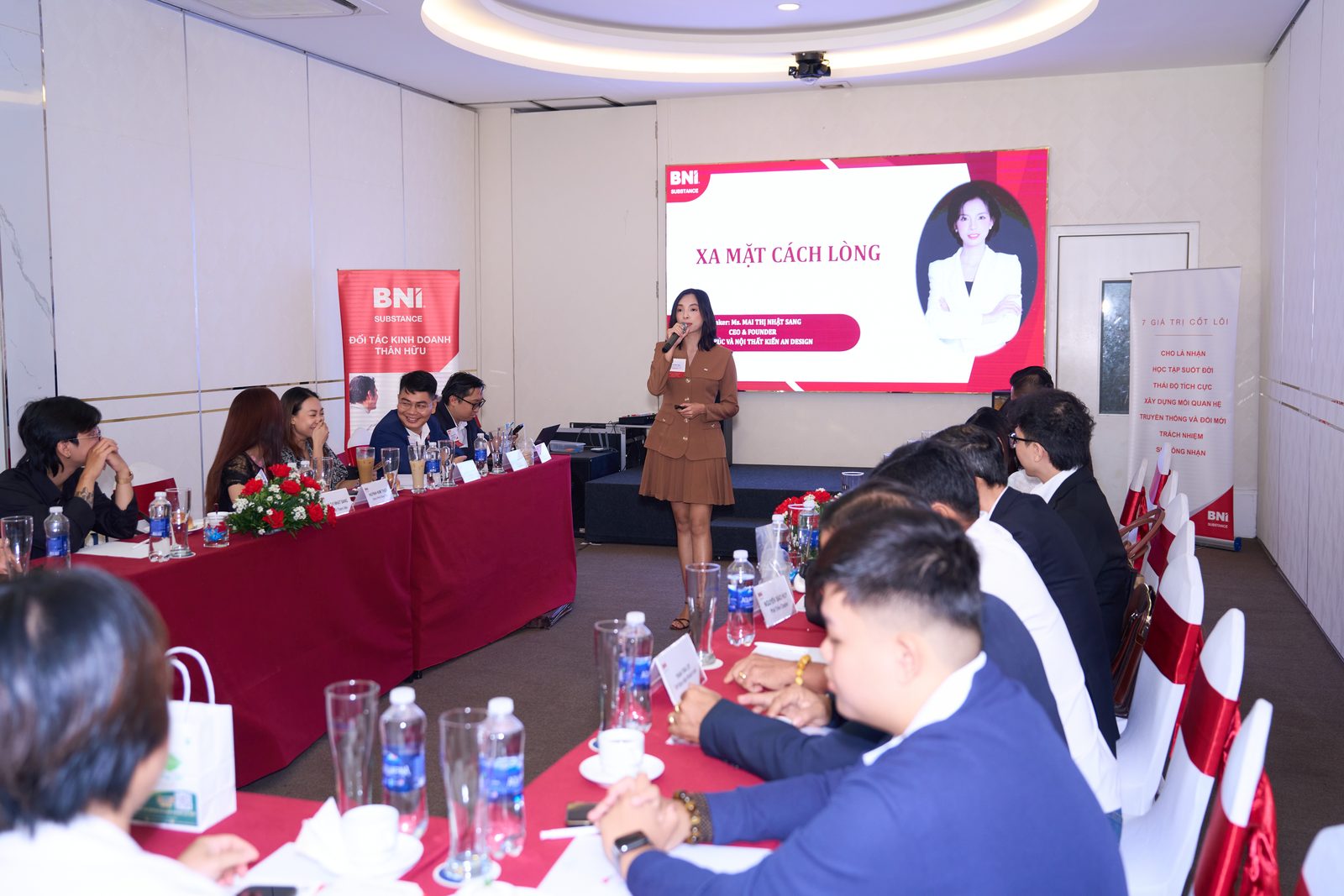
The networking skills segment was delivered by Ms. Mai Thi Nhat Sang — CEO & Founder of Kien An Architecture & Interior Design, on the topic “Out of sight, out of mind”.
She opened with a line from Dr. Ivan Misner, founder of BNI: “Ignoring you is easy.” Nobody forgets you on purpose — it is simply that nobody stays present in the other person’s mind by accident. A good relationship does not maintain itself; it needs regular action.
From there she introduced five ways to stay in touch, and more importantly how to turn each of them into a weekly habit inside the Chapter:
- Meet face to face — weekly one-to-ones, coffee or lunch before and after the meeting
- Call and message — follow up after a referral, congratulate a closed deal, check in when someone is absent
- Social media — 3–5 posts a week; tag and share referrals, post testimonials, review each other
- Email — the easiest and the least effective; best for one-to-one follow-ups and sharing your GAINS profile
- Handwritten thank-you cards — the traditional touch, sent after receiving a referral or a favour
The call to action was clear: commit to being present at next week’s meeting and book a one-to-one with a fellow member. Don’t let busyness quietly erase the relationships you value.
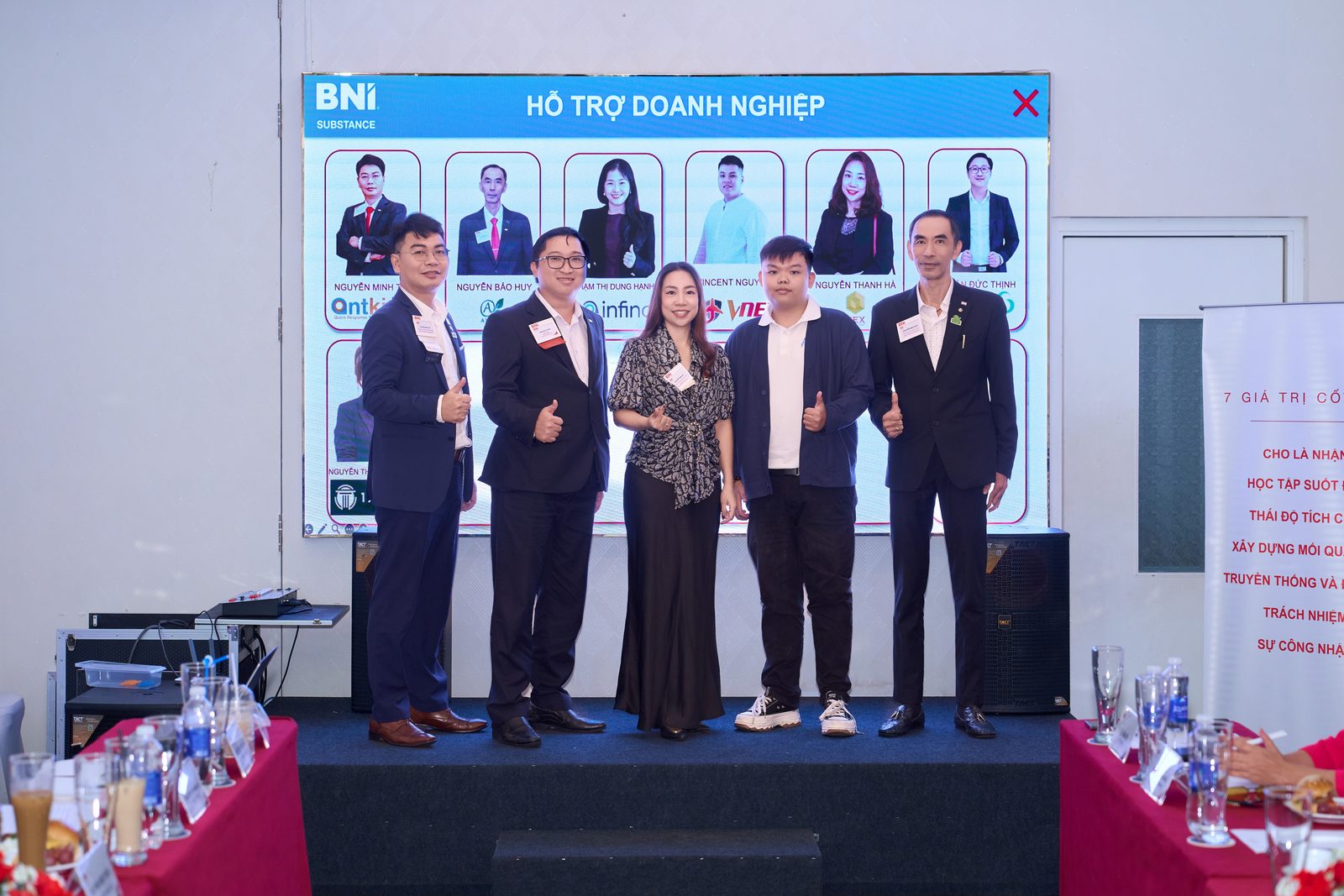
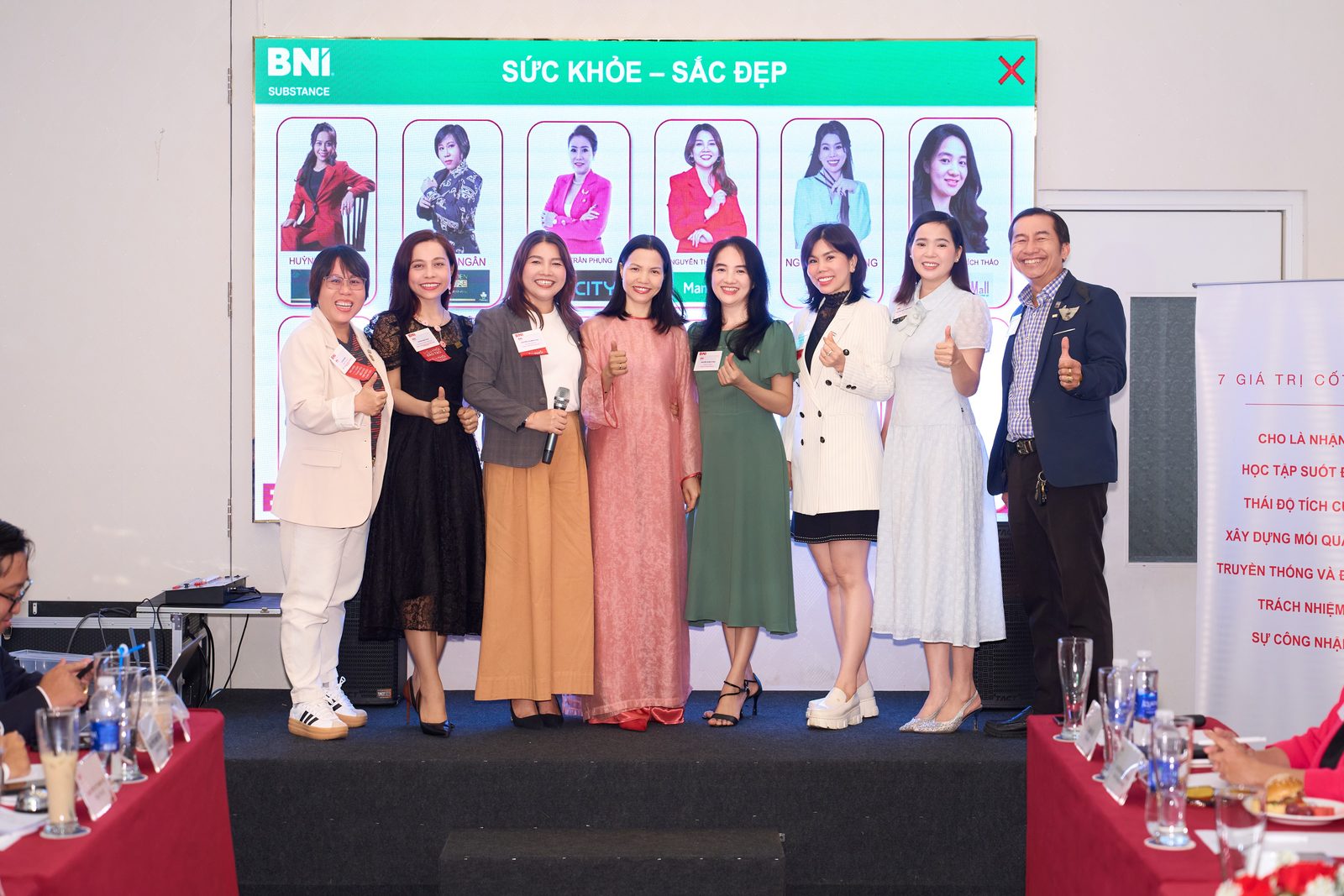
30-second introductions by Power Team
Next came the 30-second introductions by Power Team — Business Support, Health & Beauty, Construction – Real Estate – Manufacturing. Each member stated their industry, ideal customer and the connections they were looking for that week, so the whole room knew exactly how to help.
Feature Presentation: TA Nature — green wellness from the Go Noi growing region
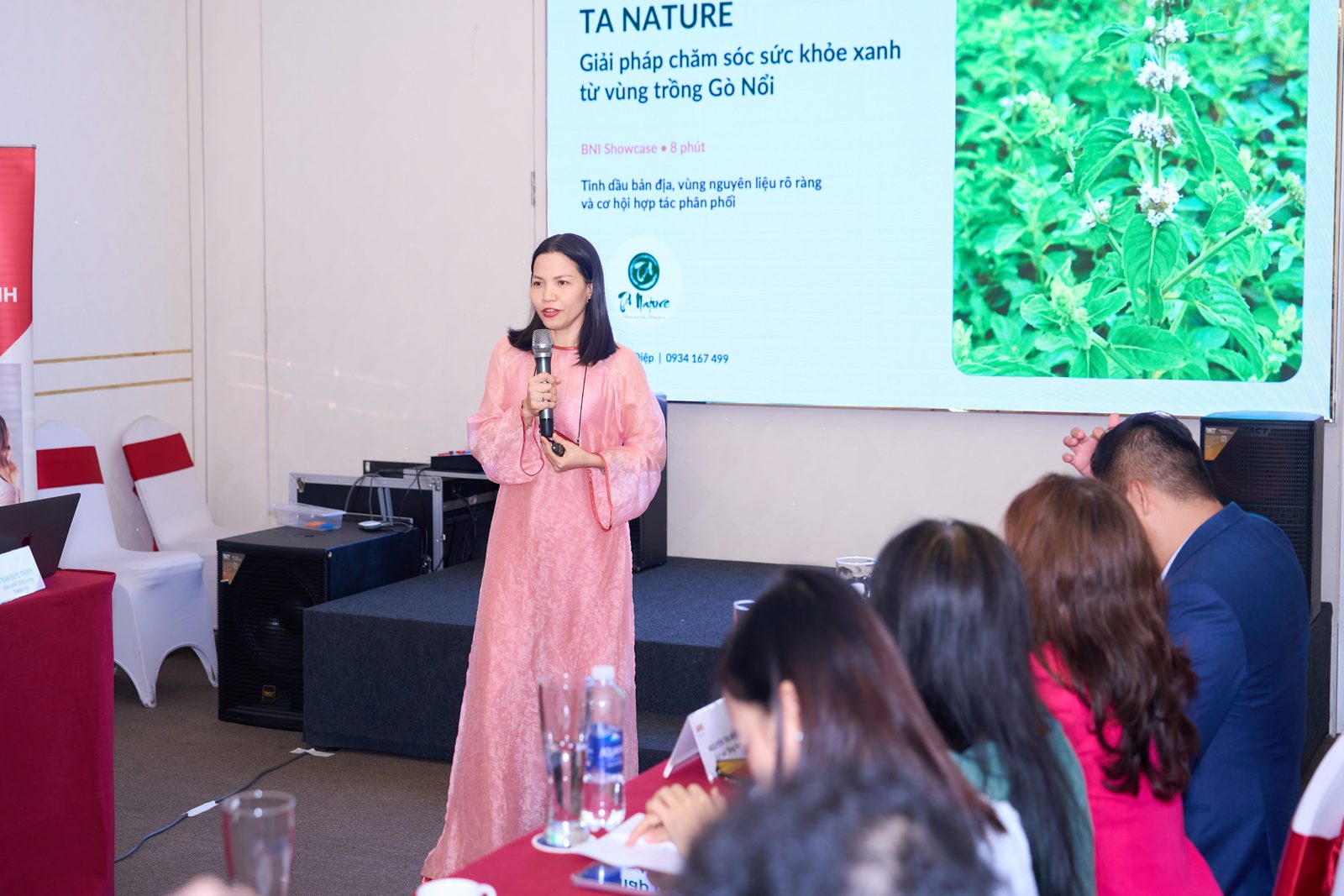
The highlight of the meeting was the Feature Presentation by Ms. Nguyen Thi Diep — Director of T.A Nature, on “Green wellness solutions from the Go Noi growing region”.
She started from three very familiar consumer problems: the overuse of synthetic fragrances and scent chemicals in living spaces; prolonged stress with no natural, safe way to relax at home; and a market where genuine, pure essential oils are hard to tell apart from the rest.
TA Nature’s answer is a value chain that can be told end to end: its own growing area → distillation close to the fields → products that are easy to use and easy to recommend → support for sales partners. The core message: clear origin, honest benefits, easy partnership.
- 9 hectares at Go Noi: 2 ha lemongrass, 2 ha tea tree, 5 ha mint
- Supply capacity of roughly 20–30 litres of essential oil per month
- Go Noi mint reaches 69.4% of its main active content, about twice that of many other growing regions
- Products certified OCOP 3 stars — a foundation partners can rely on when advising customers
Most usefully for the Chapter, TA Nature was explicit about who it wants to meet: spas, homestays and hotels that need experience products and gifts; pharmacies and retail stores expanding advisory points of sale; companies looking for green gifts with a local story; and distributors covering a region.
The partnership model is designed to start small: a 30-day trial, tracking demand and customer feedback, before widening the range or distributing by channel and area. That is exactly the kind of offer a member can comfortably introduce to their own customers.
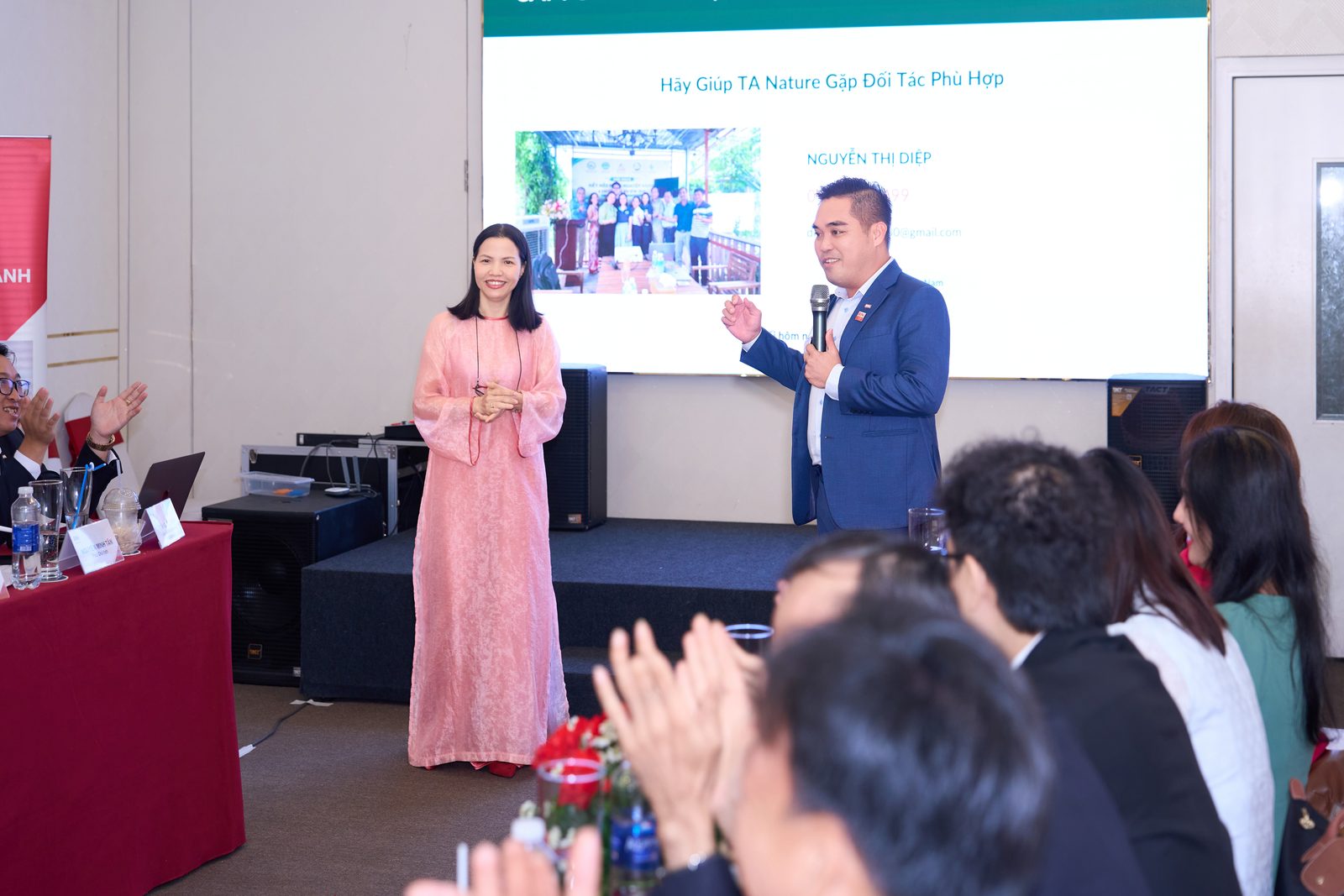
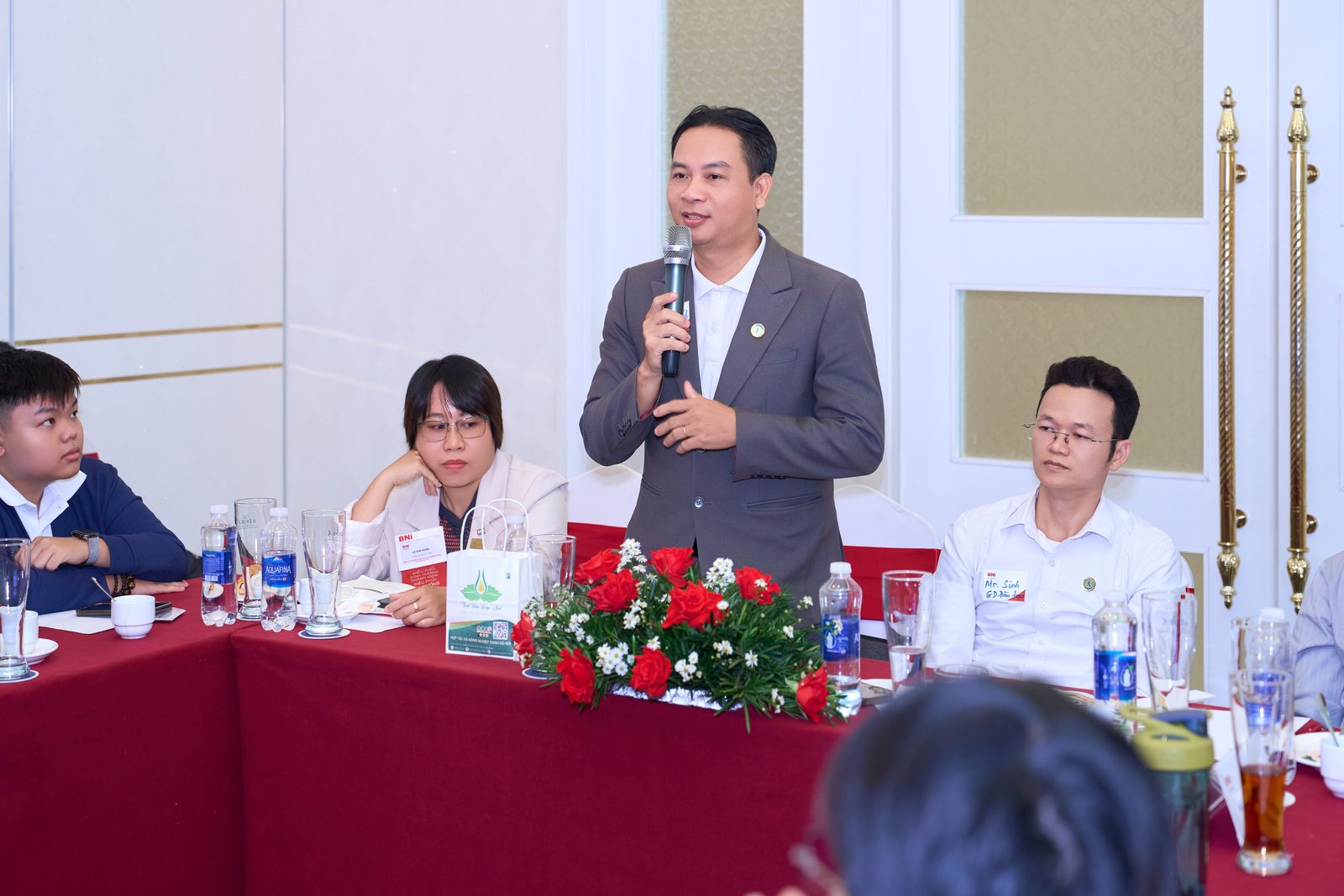
Guests and the first connections
Guests also had their own introduction slot: company name, industry, who their customers are and how the Chapter can help. This is usually where the first connections are made — and where members spot the opportunity they can pass on.
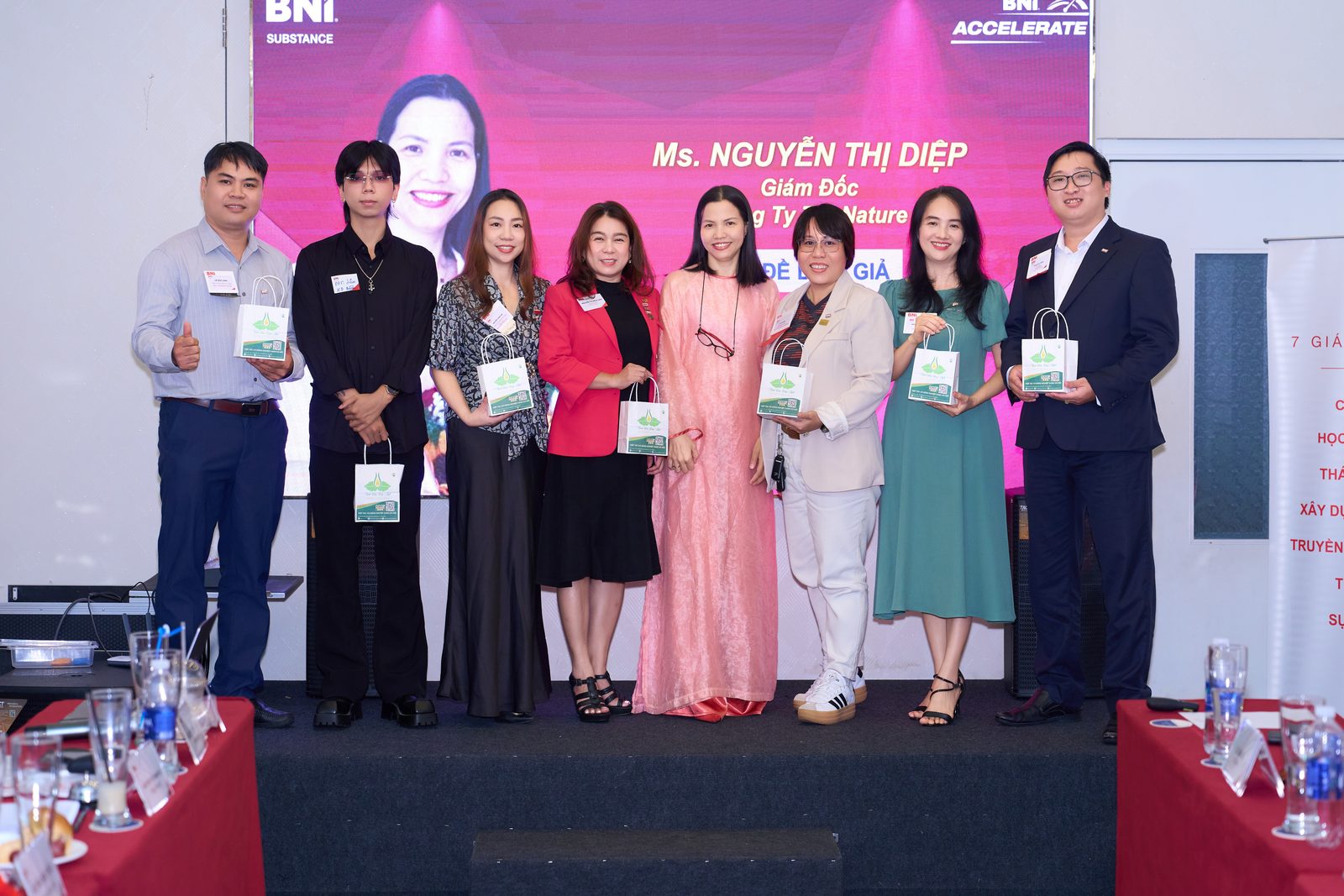
Connecting and spreading value
The meeting closed with thanks to the guests and a group photo. In the spirit of Givers Gain®, BNI Substance Chapter continues to be a place where business owners learn, broaden their thinking and find partners they can trust. The Chapter also reminded members of APAC SME’s Expo 2026, organised by BNI APAC in Ho Chi Minh City.
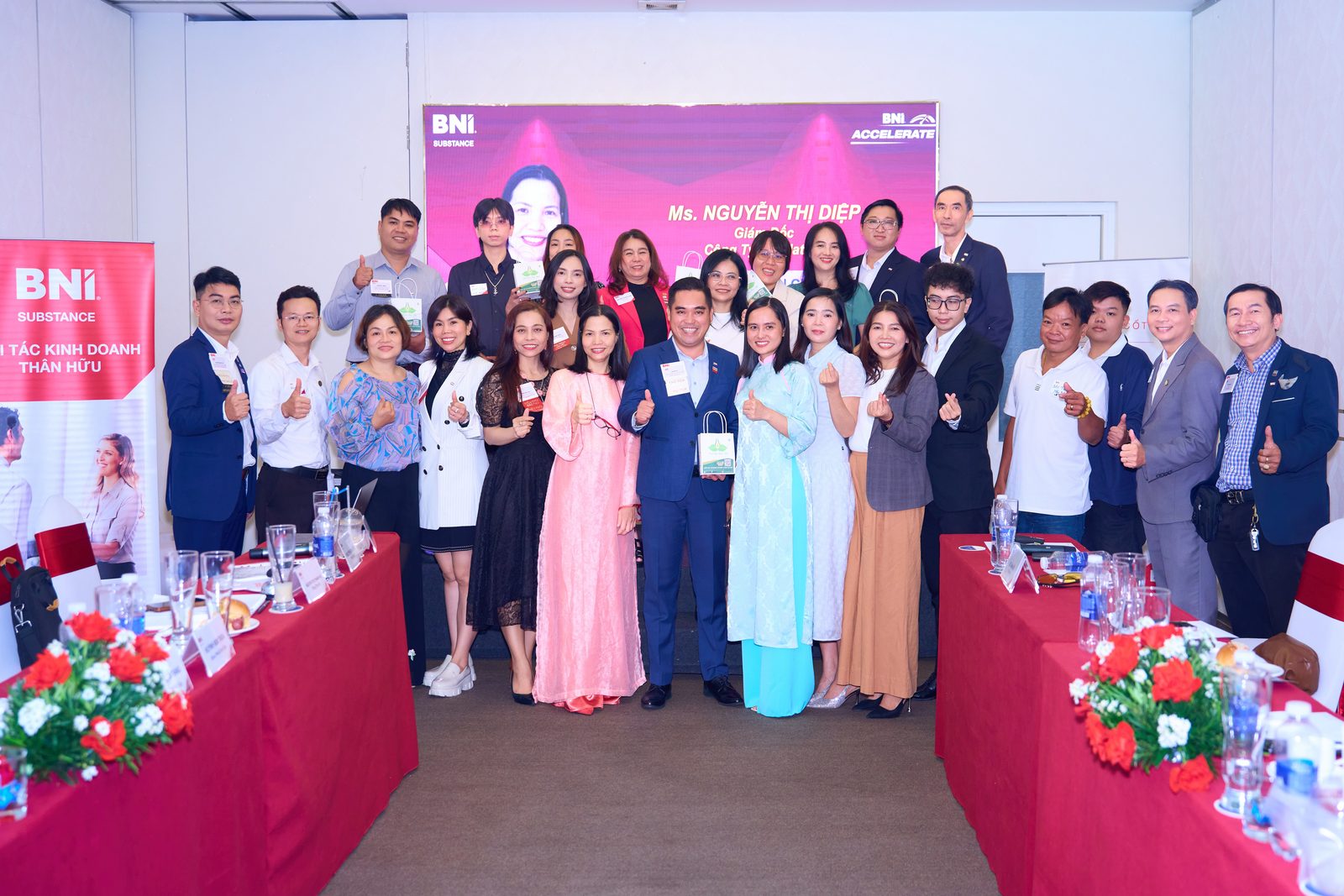
Contact
BNI Substance Chapter sincerely thanks both speakers, all members and guests. The Chapter meets every Thursday morning, 07:30 – 10:30, at Adora Legend Convention Centre, 32 Hoang Viet Street, Tan Son Nhat Ward, Ho Chi Minh City.
Registration: 0989.212.273 (Ms. Minh Thu) · Chapter President: Mr. Le Van Vu · Growth Director: Mr. Alan Nguyen.
On the morning of Thursday, 17 September 2026, at Adora Legend Convention Centre (32 Hoang Viet Street, Tan Son Nhat Ward, Ho Chi Minh City), BNI Substance Chapter (BNI HCM West) held its weekly Business Networking meeting with 30 business owners — members and invited guests. The atmosphere was warm, professional and full of the collaborative spirit of BNI.
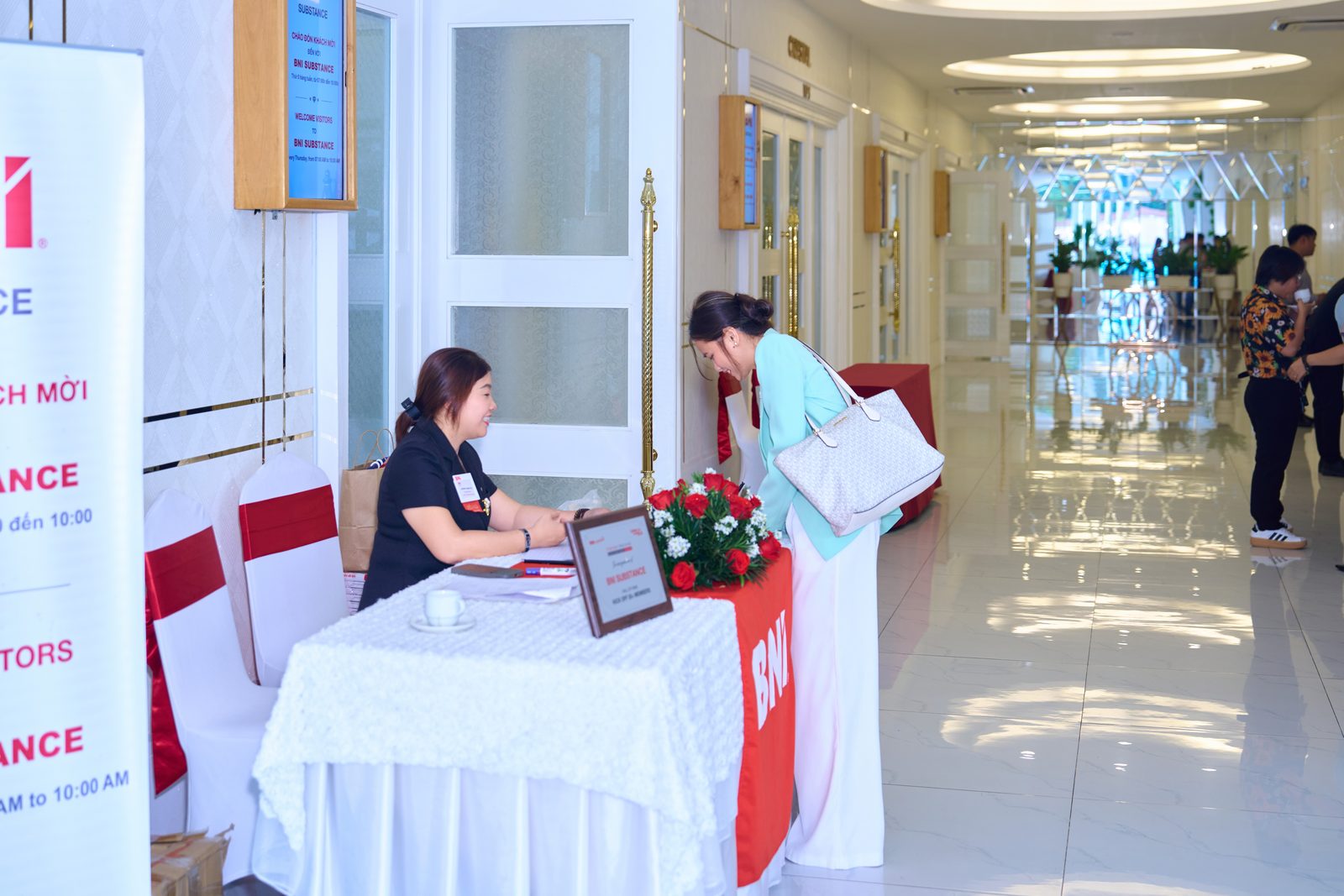
Open networking: every handshake is an opportunity
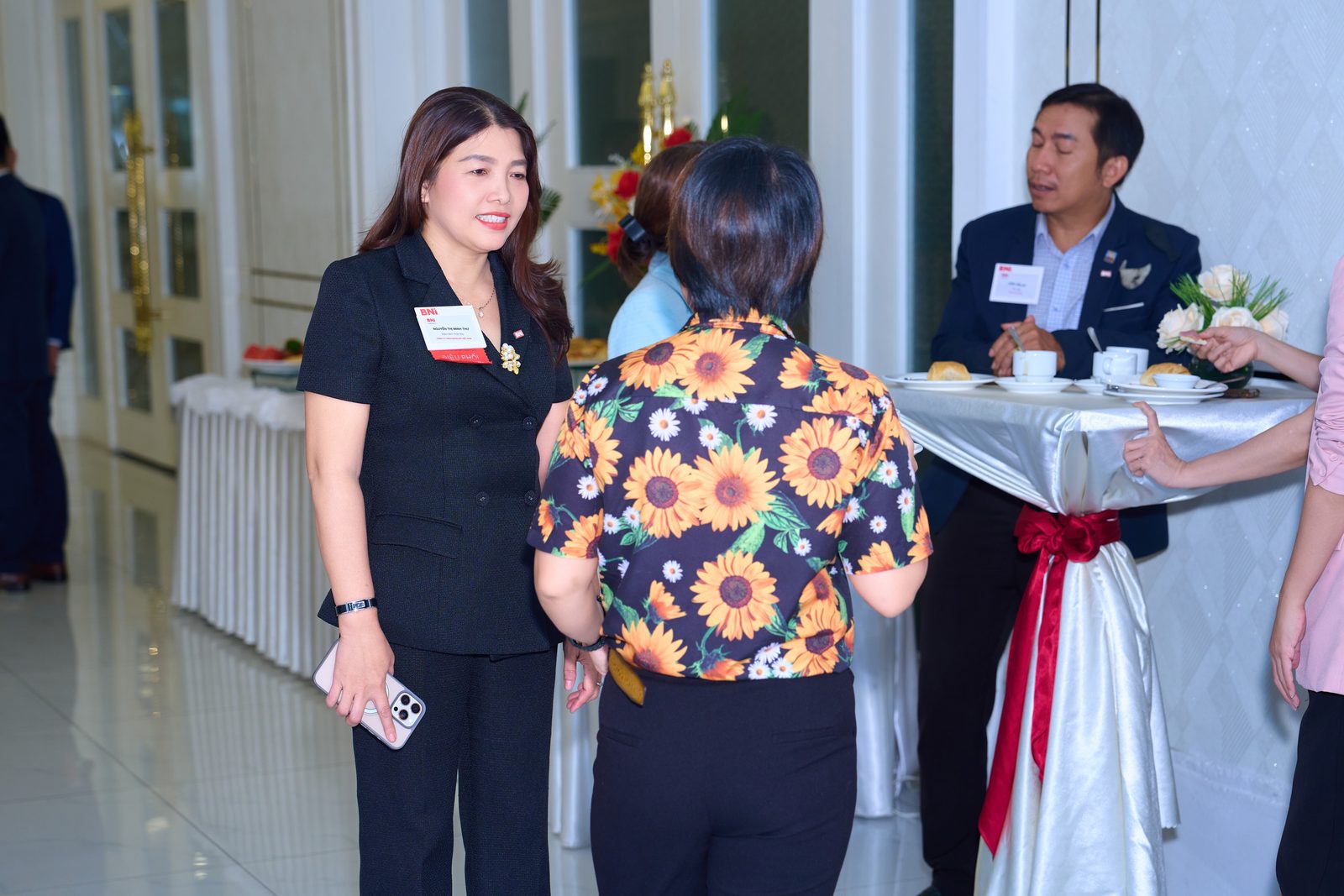
From 07:30, the Open Networking session was in full swing. Members and guests exchanged business cards, introduced their businesses and looked for common ground. In BNI, this is never small talk — every conversation can open a lasting business relationship.
Skills sharing: “Sow value – Attract relationships – Harvest opportunities”
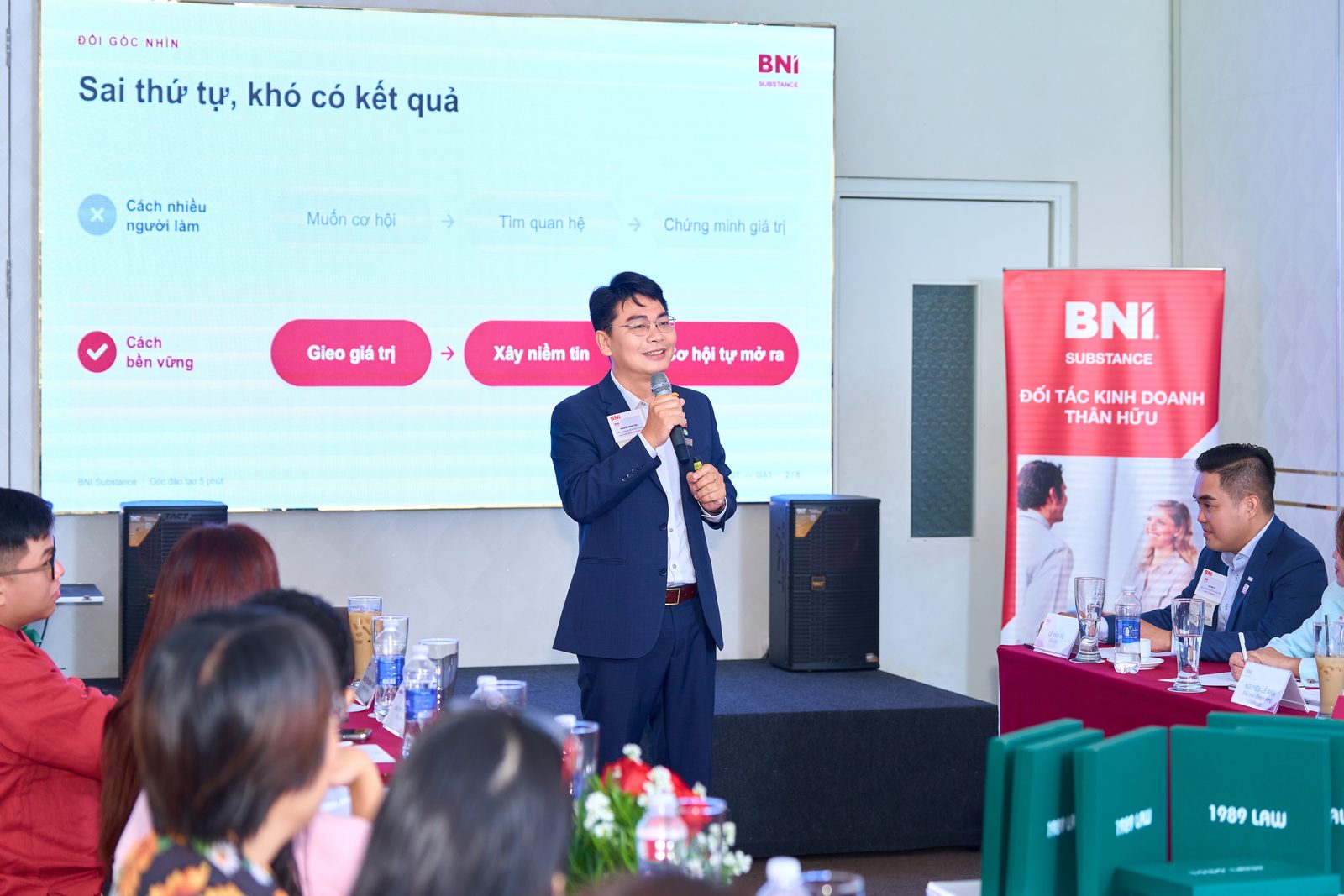
The networking skills segment was delivered by Mr. Nguyen Minh Tan — Chairman of AntKing Group, on the topic “Sow value – Attract relationships – Harvest opportunities”.
He challenged the familiar sequence many people follow: chase the opportunity, then look for relationships, and only then prove value. The sustainable order, he argued, is the reverse — sow value first, trust follows, and opportunities open by themselves. Value does not have to be big: the right introduction, the right information at the right time, a referral with a clear need, or a sincere act of support.
He also stressed that a referral is the result of trust, because the person referring puts their own reputation in our hands. Trust is built through very concrete behaviours: showing up, keeping your word, listening, and giving consistently. The session closed with a simple practice for the week ahead:
- 1 person to understand more deeply
- 1 piece of value to give proactively
- 1 action to follow through completely
Member recognition and 30-second introductions
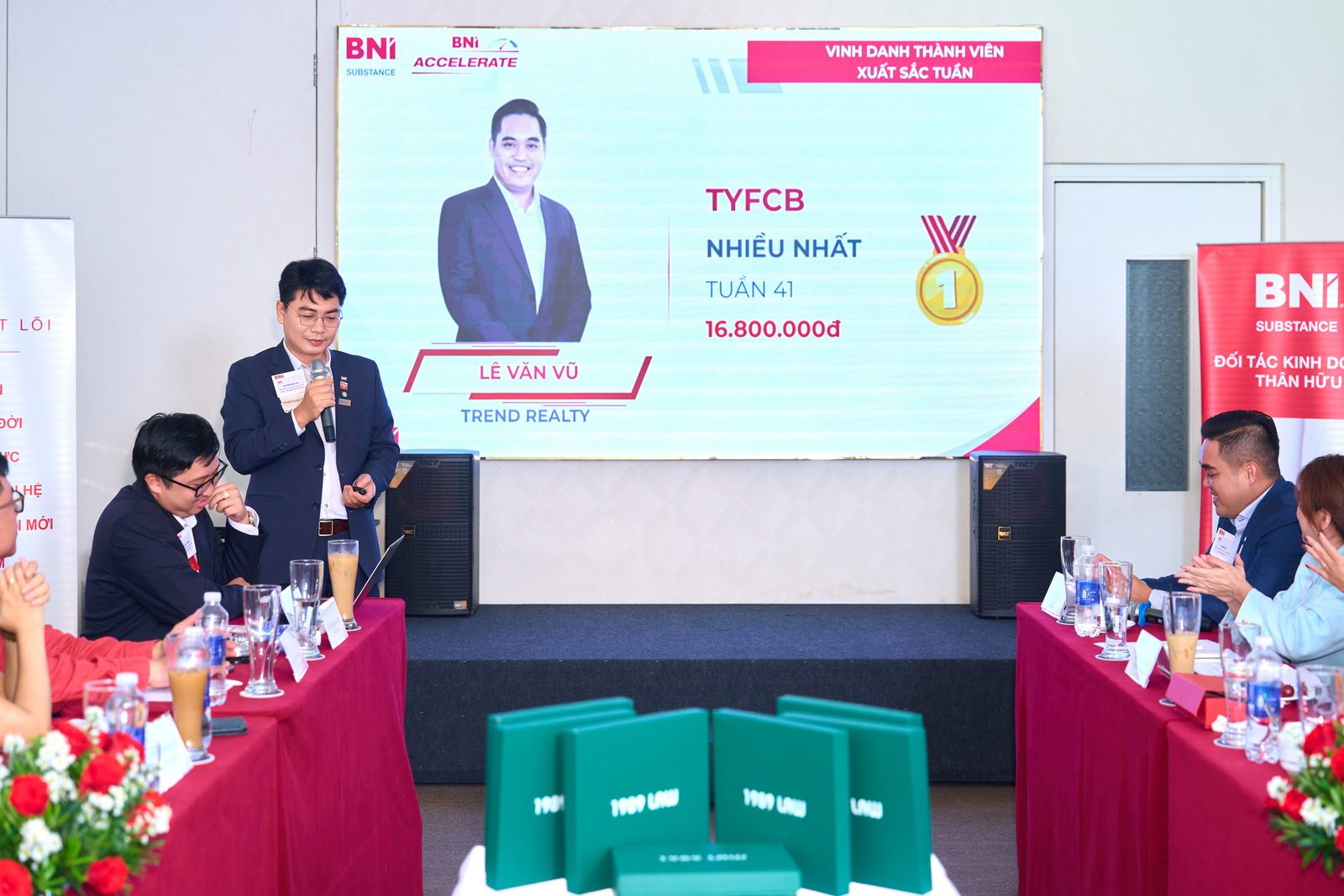
The Chapter recognised its outstanding members for Week 41:
- Tran Duc Thinh (Thien Kim Corp) — Most visitors: 08 guests
- Le Van Vu (Trend Realty) — Highest TYFCB: VND 16,800,000
Membership renewal: one year measured in numbers
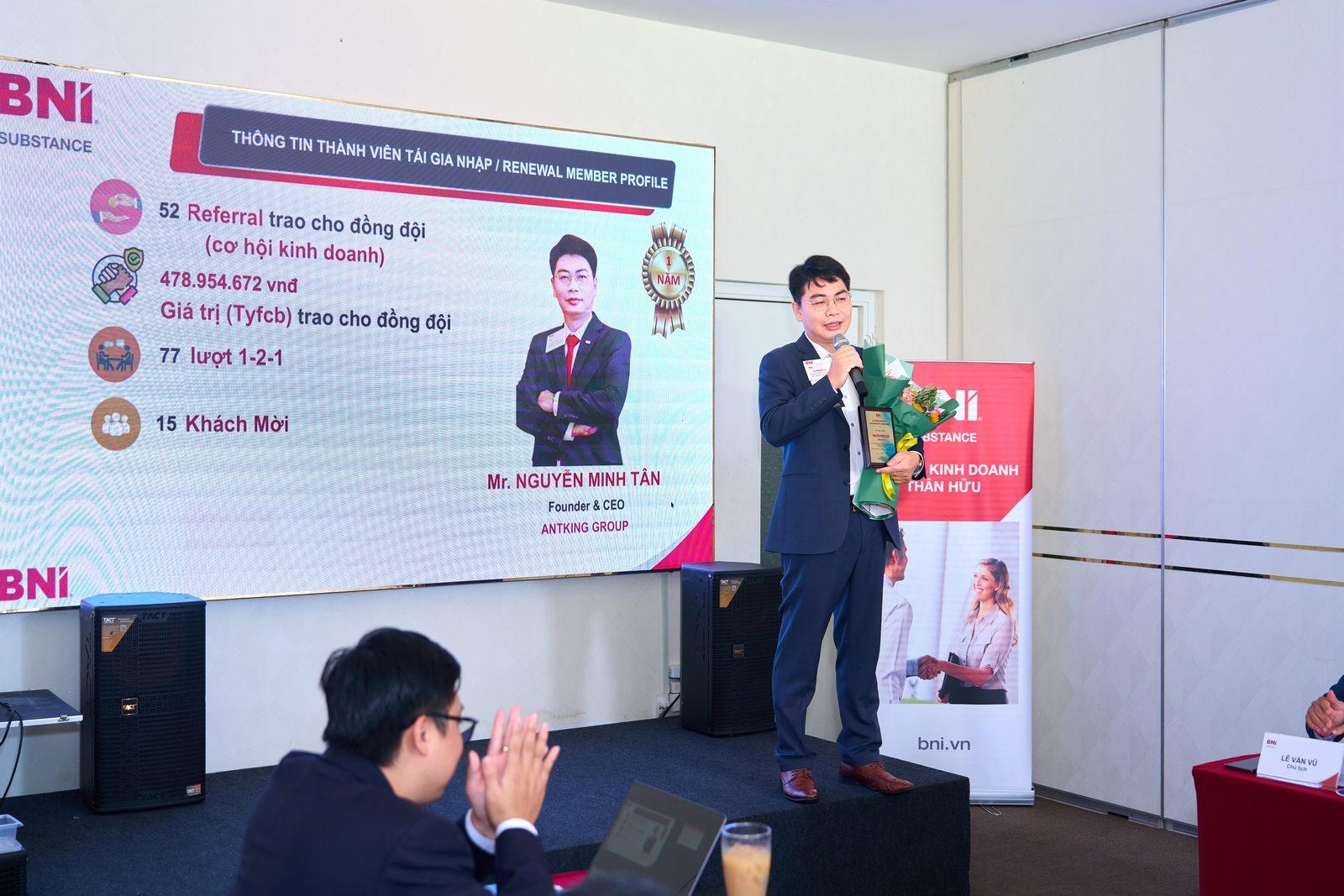
Another meaningful moment of the meeting was the membership renewal of Mr. Nguyen Minh Tan — Founder & CEO of ANTKING Group, marking one full year with BNI Substance Chapter. The Chapter leadership pinned the one-year member badge and recognised his contribution over the term:
- 52 referrals given to fellow members
- VND 478,954,672 in closed business (TYFCB) passed to fellow members
- 77 one-to-one meetings
- 15 guests introduced to the Chapter
The numbers illustrate exactly what the morning’s sharing was about: give first, results follow. A renewal, then, is not simply extending a membership — it is a commitment to keep sowing value for the community.
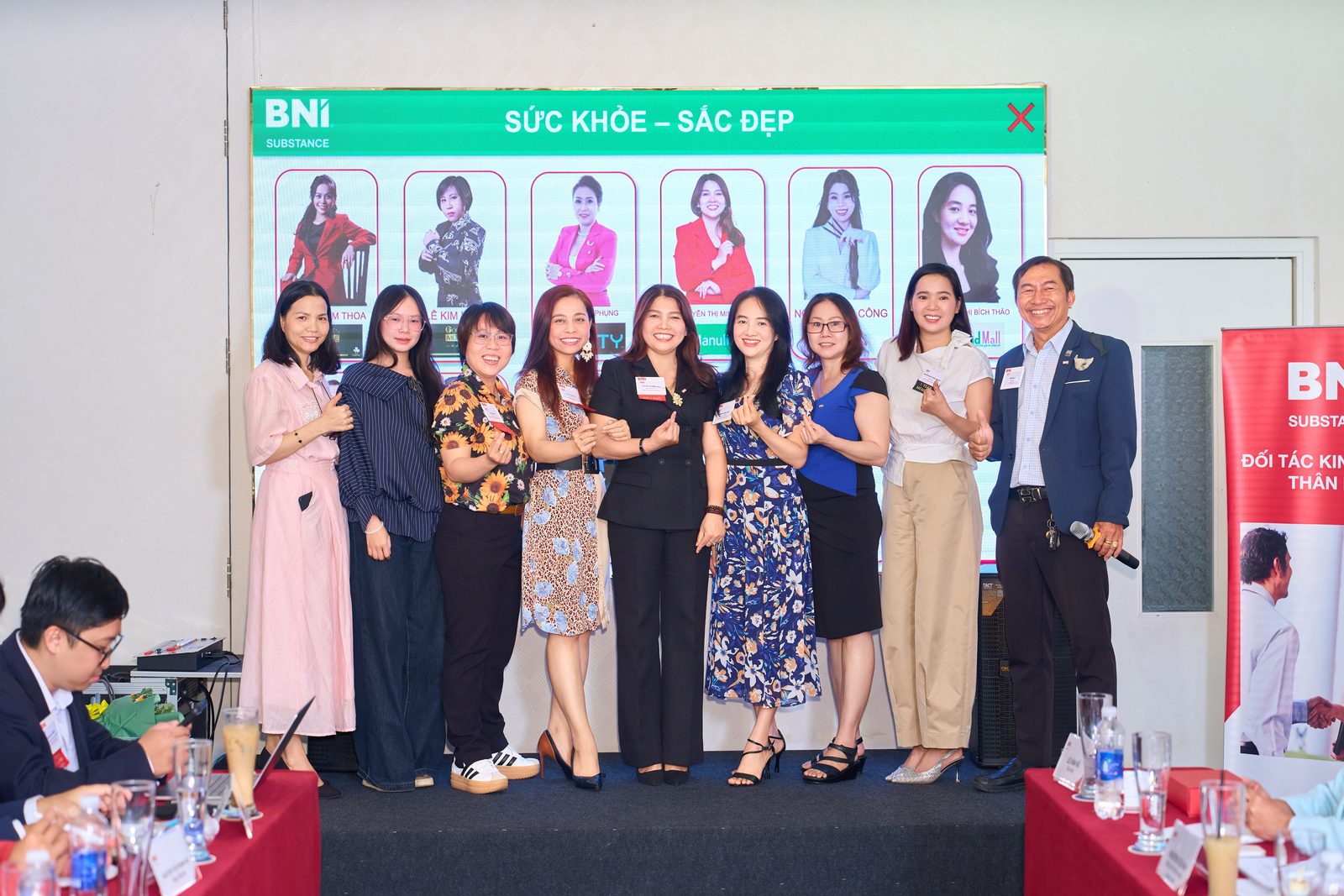
Next came the 30-second introductions by Power Team — Health & Beauty, Business Support, Construction – Real Estate – Manufacturing — where each member stated their industry, ideal customer and the connections they were looking for that week.
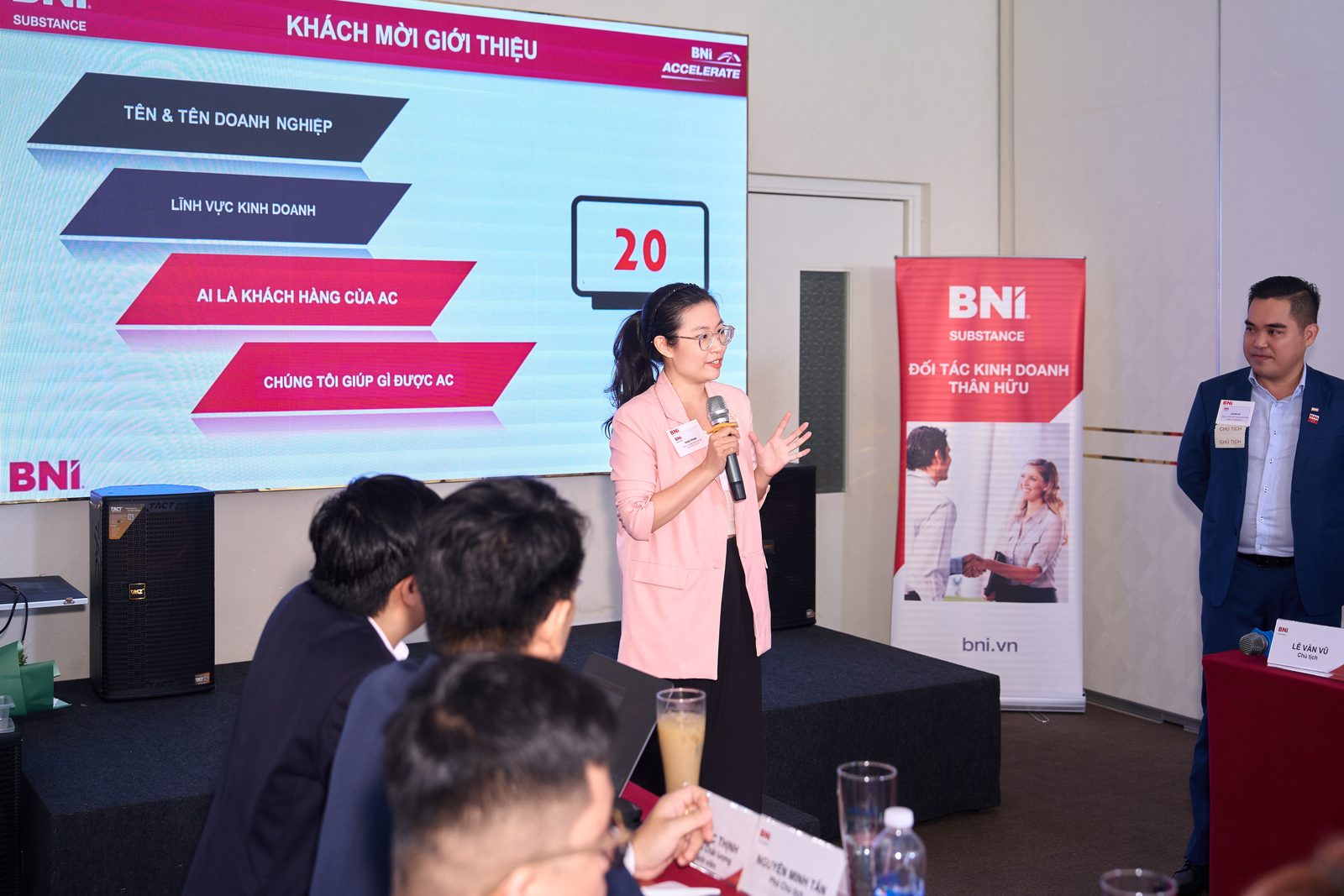
Guests also had their own introduction slot: company name, industry, who their customers are and how the Chapter can help. This is often where the first connections are made.
Feature Presentation: Protecting corporate intellectual property in the digital age
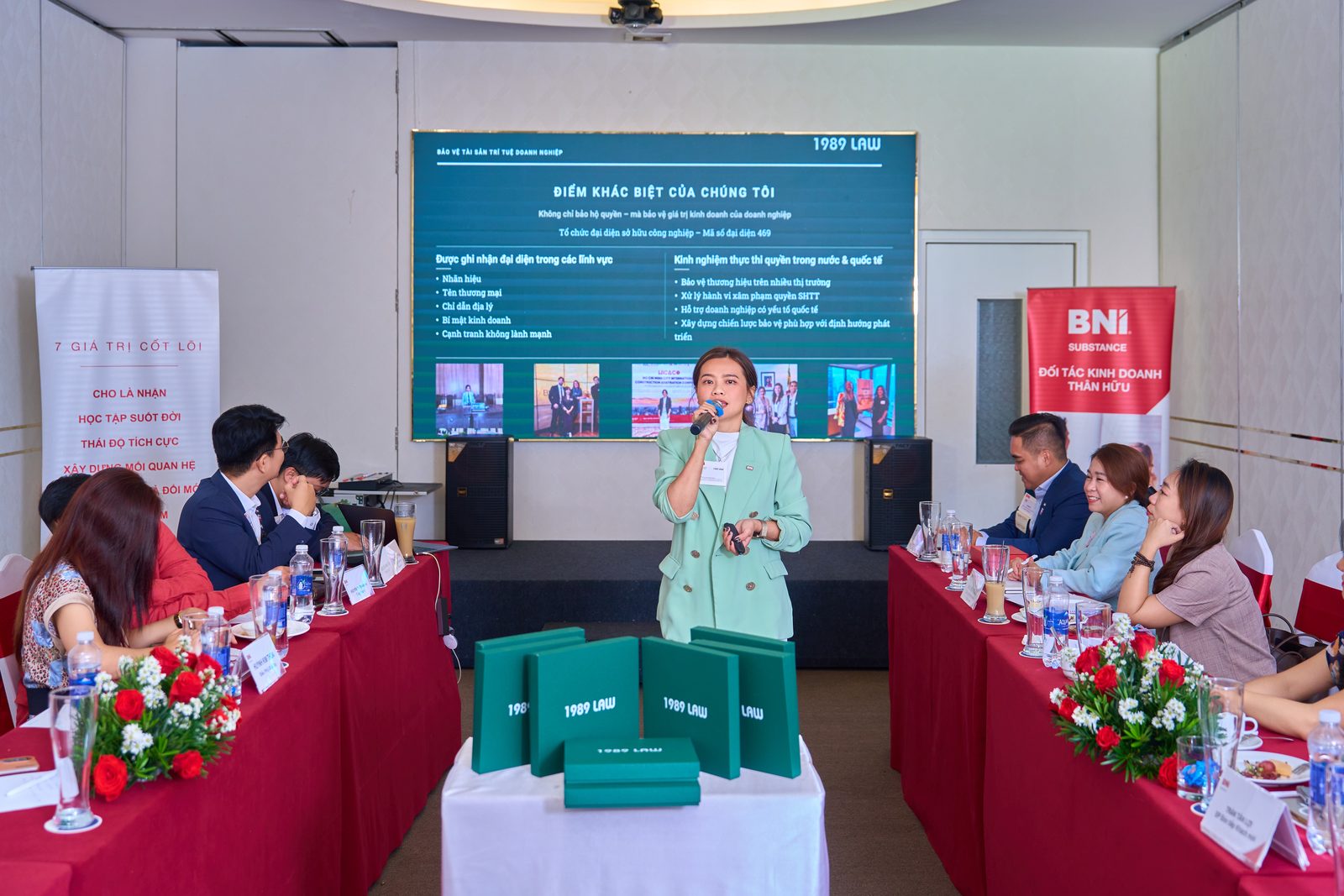
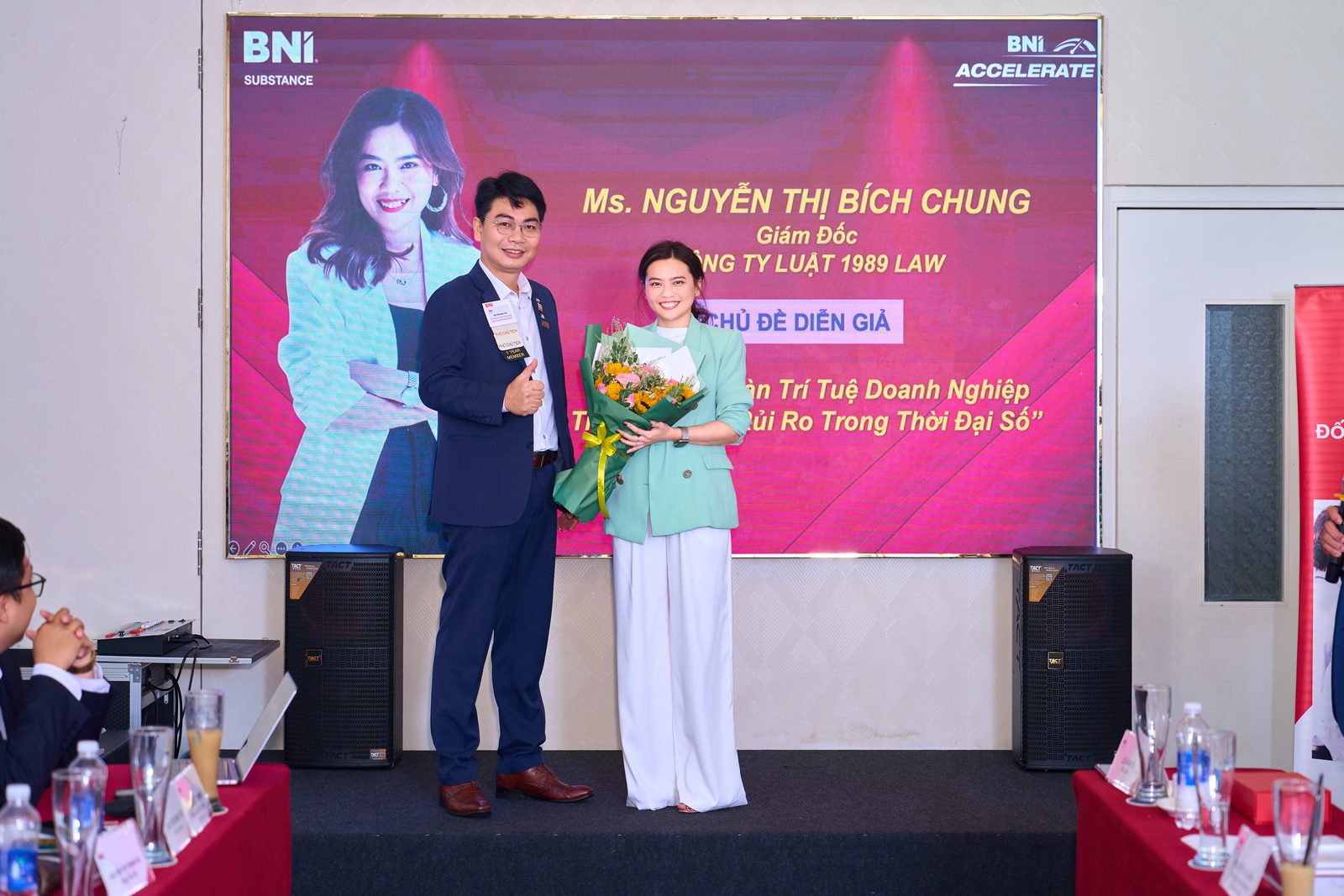
The highlight of the meeting was the Feature Presentation by Ms. Nguyen Thi Bich Chung — Director of 1989 Law Firm, on “Protecting Corporate Intellectual Property Against Risks in the Digital Age”.
She opened with a familiar reality: a business does not only create products to sell, it also creates intellectual property — brand, logo, design, packaging, technology, processes, software, operational know-how. The catch is that creating value and owning value are two different stories. The greatest risk does not appear at the start; it appears once the brand is worth something: losing the right to a brand built over years, logos and designs copied, know-how exploited by others.
The digital age adds another layer of risk: a trade secret can be lost after a single careless disclosure; artificial intelligence creates exposure both on the input side (confidential data and documents fed into AI tools) and the output side (AI-generated content may reproduce third-party rights); social commerce spreads infringement faster; and domain names and online identity are now part of brand protection strategy.
From there, Ms. Bich Chung introduced a four-step approach to managing intellectual property:
- IDENTIFY — brand, designs, technology, data and business know-how
- PROTECT — register the right forms of protection and establish ownership
- MANAGE — manage IP in daily operations: staff, partners, customers, internal processes
- ENFORCE — monitor, handle infringements and defend your rights
The message throughout: intellectual property is not only the legal department’s job — it is part of how the whole company is managed. 1989 Law is a law firm and a registered industrial property agent in Vietnam (agent code 469), accompanying businesses across the entire life cycle of intellectual assets, from identification and protection to management, enforcement and dispute resolution.
She also made the referral triggers very clear: when a business owner says “I built this brand for years and someone else has registered it”, when another party is using a similar name or image, when they are about to open a branch, launch a new product or go overseas, or when they outsource logo design, website development and product development.
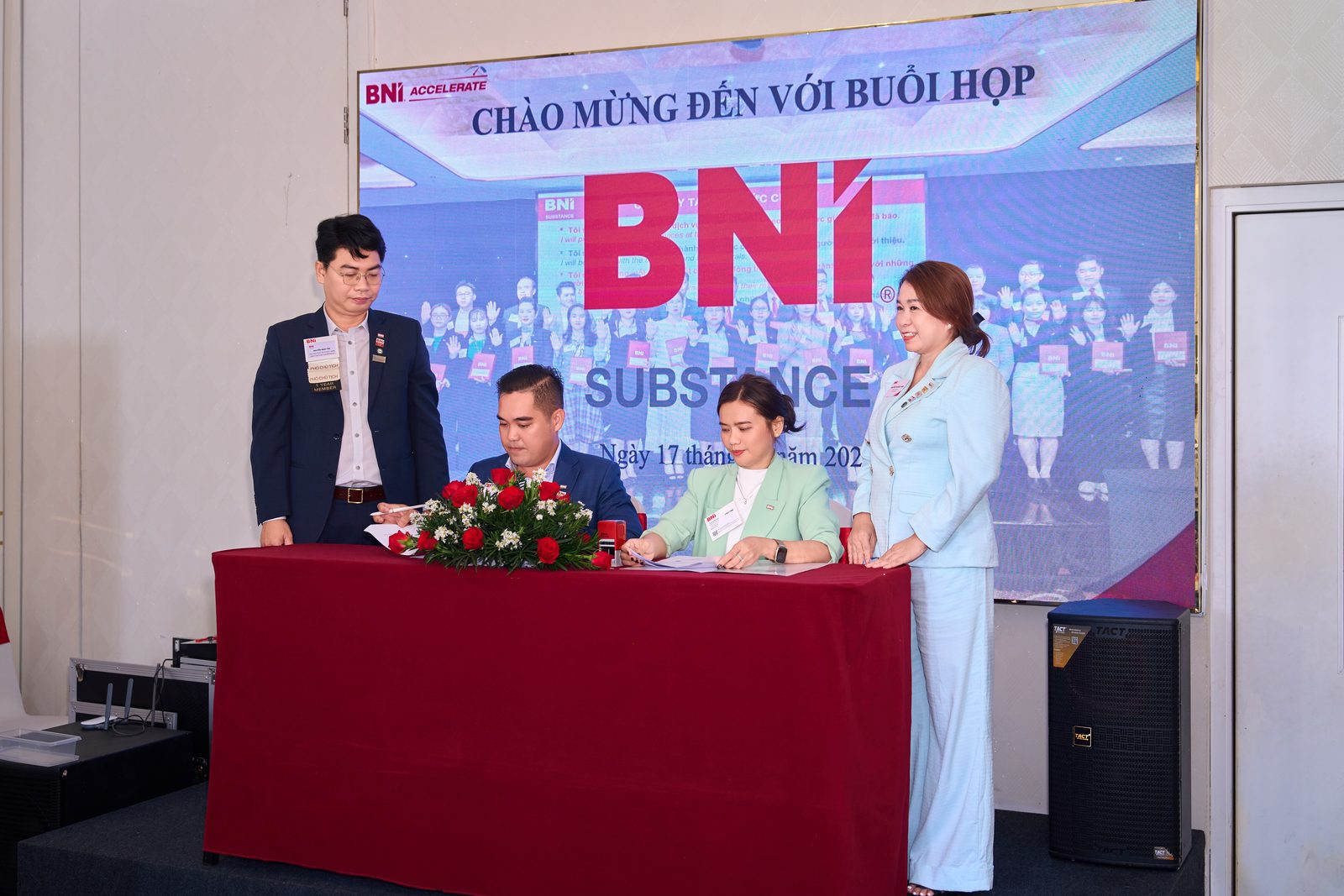
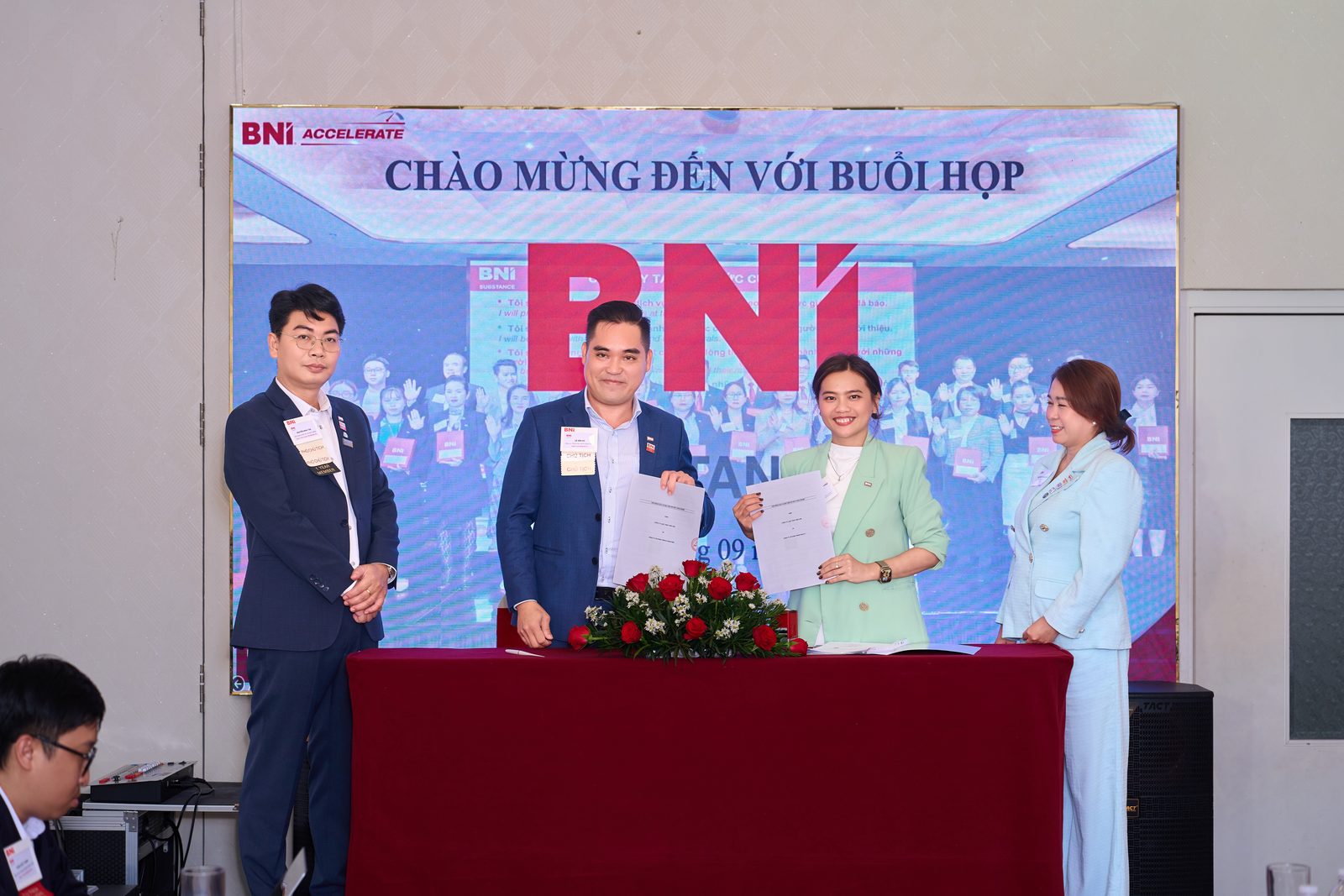
Partnership signed between Trend Realty and 1989 Law
During the meeting, Trend Realty and 1989 Law Firm signed a cooperation contract, witnessed by the Chapter leadership and all members. It is the clearest possible proof of what networking in BNI is for: from one-to-one conversations and introductions around the table, a formal partnership took shape.
Connecting and spreading value
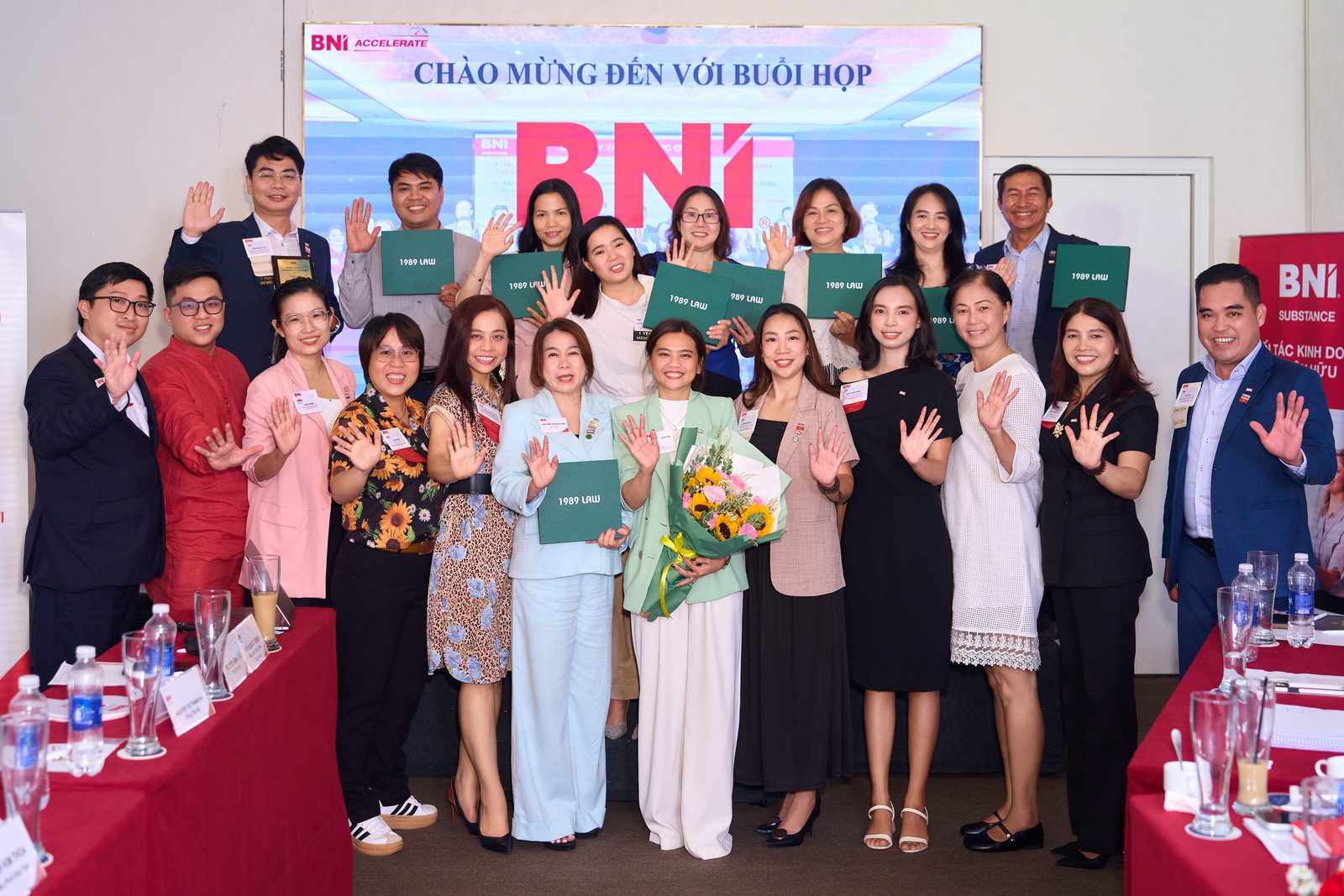
The meeting closed with thanks to the guests and a group photo. In the spirit of Givers Gain®, BNI Substance Chapter continues to be a place where business owners learn, broaden their thinking and find partners they can trust. The Chapter also introduced members and guests to APAC SME’s Expo 2026, organised by BNI APAC in Ho Chi Minh City.
Contact
BNI Substance Chapter sincerely thanks both speakers, all members and guests. The Chapter meets every Thursday morning, 07:30 – 10:30, at Adora Legend Convention Centre, 32 Hoang Viet Street, Tan Son Nhat Ward, Ho Chi Minh City.
Registration: 0989.212.273 (Ms. Minh Thu) · Chapter President: Mr. Le Van Vu · Growth Director: Mr. Alan Nguyen.
A morning of connection at BNI Substance
On the morning of Thursday, 10 September 2026, at Adora Legend Convention Centre (ground floor, 32 Hoang Viet Street, Tan Son Nhat Ward, Ho Chi Minh City), BNI Substance Chapter – part of the BNI HCM West region – held its weekly Business Networking meeting with 35 business owners and visitors in attendance.
From 07:30 the welcome desk was already busy. The atmosphere was warm yet professional – exactly what BNI Substance stands for: people arrive with a spirit of collaboration and leave with concrete business opportunities.
Open networking – every handshake is an opportunity
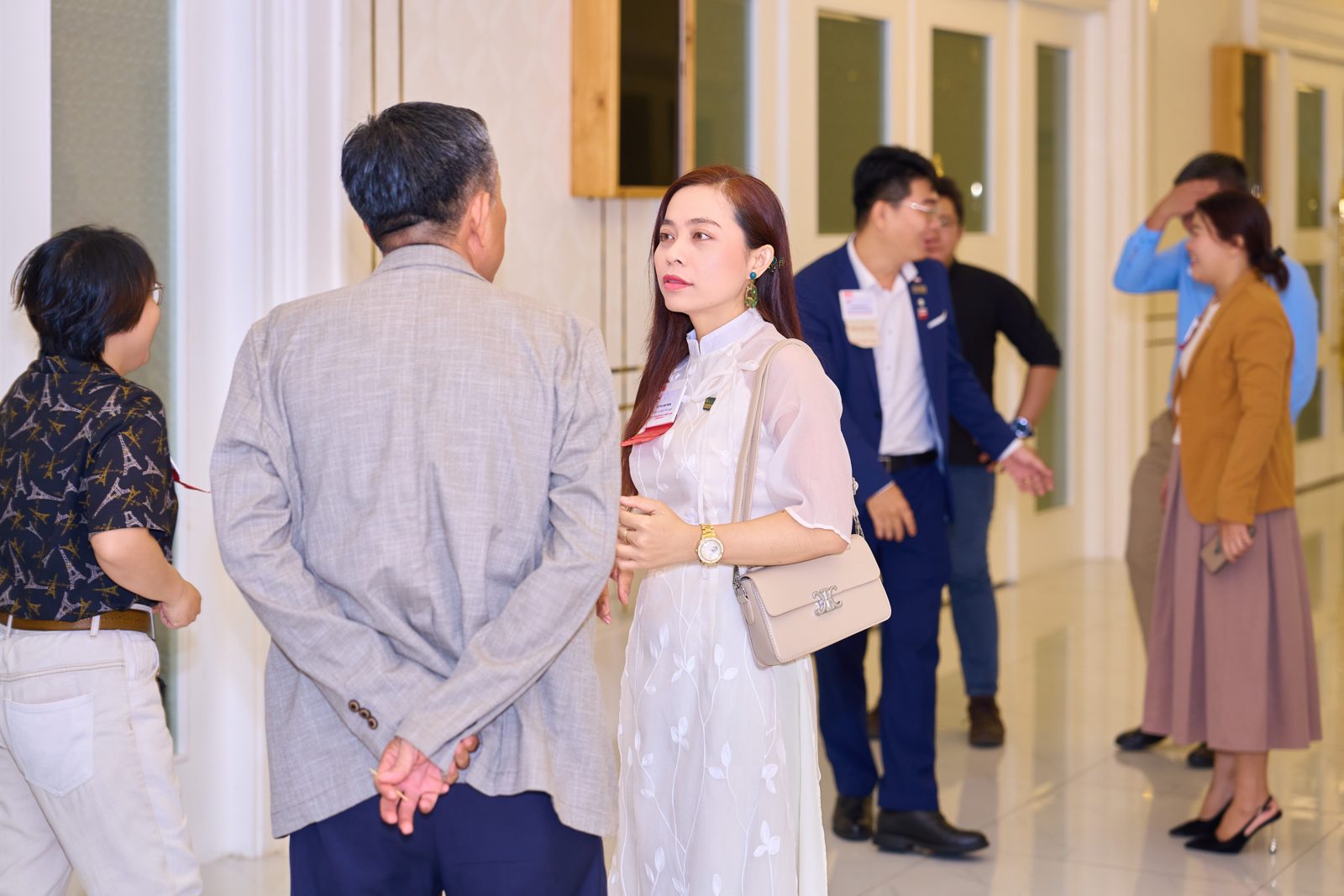
The Open Networking session (07:30 – 08:00) opened the meeting. Business owners exchanged cards and gave quick 30-second introductions about their field and the connections they were looking for. Many of the Chapter’s business opportunities begin right here – not from a presentation, but from one conversation with the right person.
Introducing the Term II Leadership Team
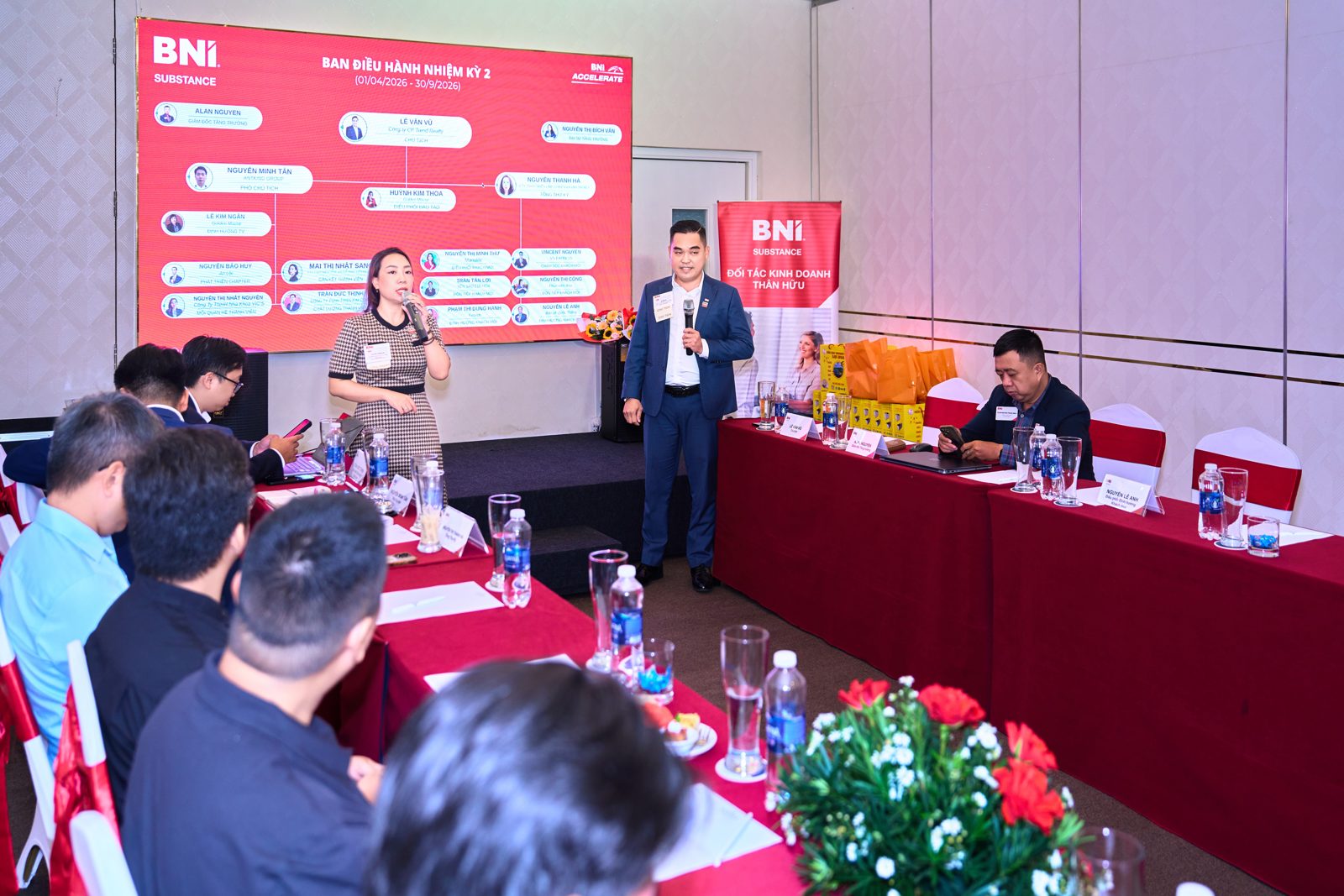
The main meeting started at 08:00 with the welcome of visitors and the introduction of the Term II Leadership Team (1 April 2026 – 30 September 2026), led by Chapter President Mr. Le Van Vu and Growth Director Mr. Alan Nguyen. The Chapter also revisited the BNI mission and its seven core values, with Givers Gain® as the guiding principle.
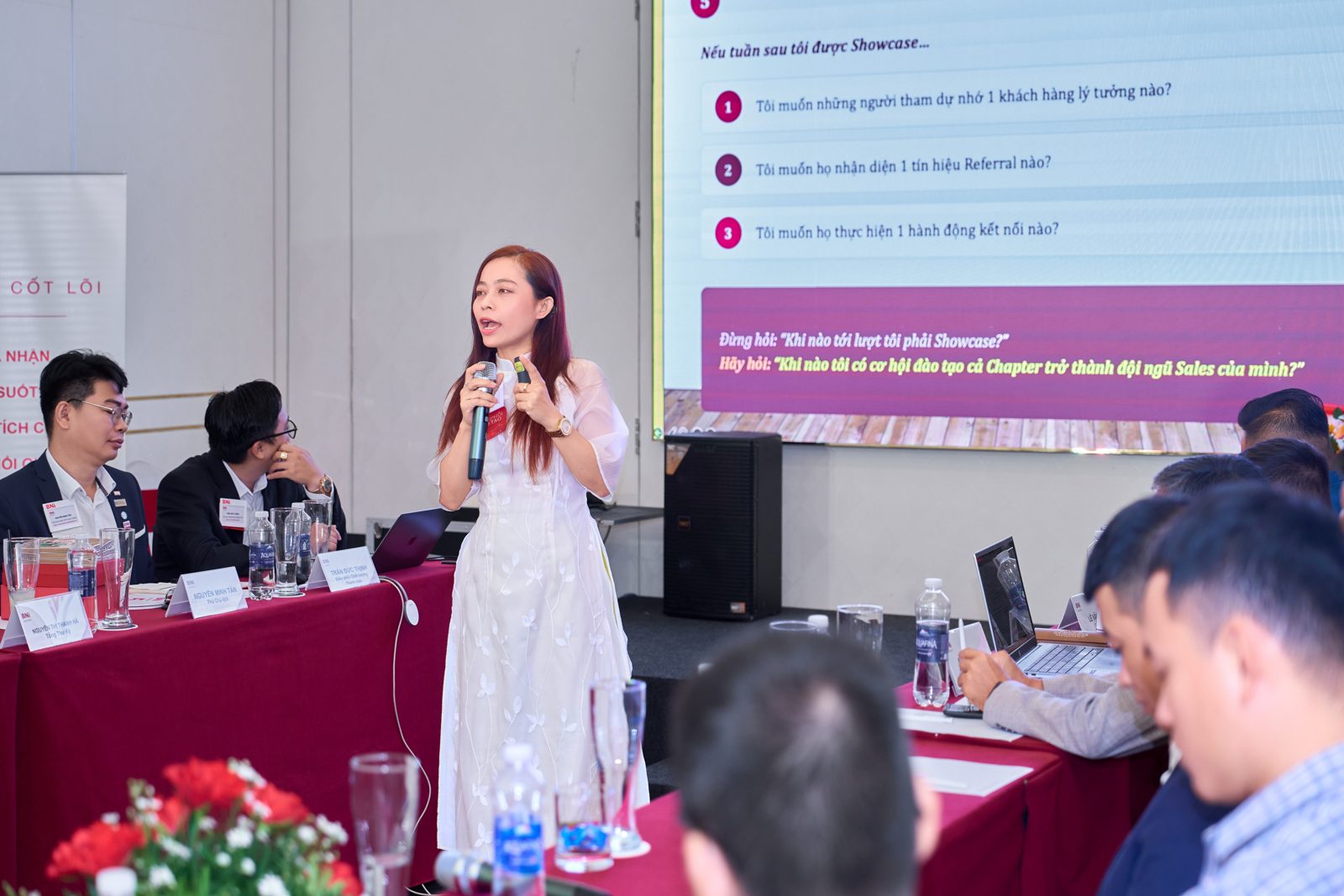
Networking skills: “How to build a professional marketing team in just 8 minutes” – Ms. Huynh Kim Thoa
The networking education session was delivered by Ms. Huynh Kim Thoa, Director of Golden Mouse Pharma, with a perspective that made the whole room rethink the 8-minute Showcase.
Most of us, she said, still treat the Showcase as “I have 8 minutes to introduce myself”. The right way to see it is: “I have 8 minutes to train my referral-generating team”. In a Chapter of more than 30 members, a Showcase should not simply leave you with 30 people who know what you do – it should give you 30 business radars scanning the market on your behalf.
Ms. Thoa offered a “3 REMEMBERS” formula for an effective Showcase: REMEMBER THE PERSON – who exactly is my ideal client, described vividly enough that members can picture them, never “anyone can be my customer”; REMEMBER THE SIGNAL – what does a prospect have to say for members to think of me, which is the referral trigger; and REMEMBER HOW TO CONNECT – how should members introduce me once they meet that person.
Her closing call to action: stop asking “when is my turn to do a Showcase?” and start asking “when do I get the chance to train the whole Chapter to become my sales team?” A Showcase is not 8 minutes for you to shine – it is 8 minutes for more than 30 other people to learn how to make you shine in the market.
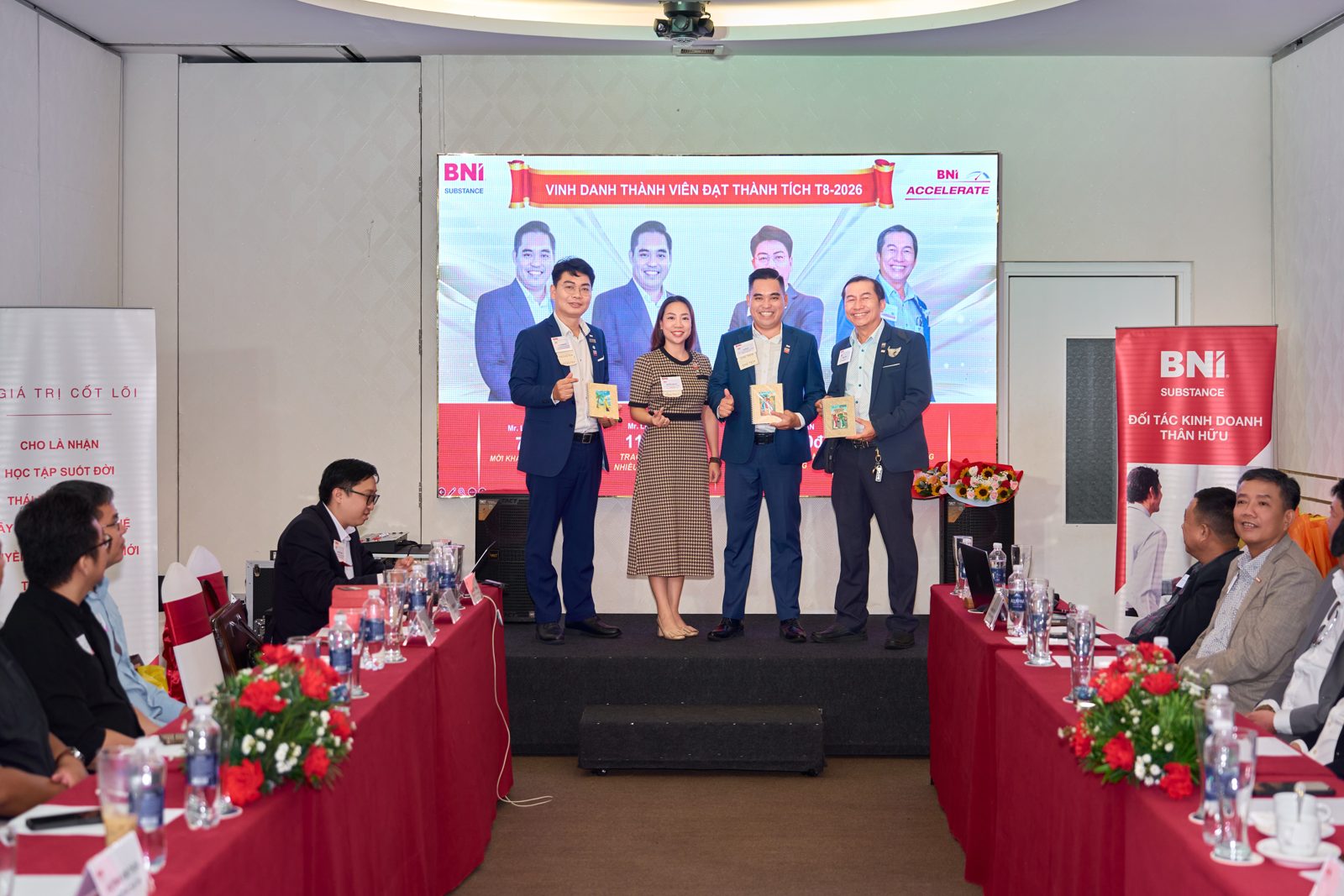
Honouring outstanding members of August 2026
The Chapter recognised the members with outstanding activity figures in August 2026:
- Mr. Le Van Vu – 7 visitors – Most visitors invited during the month
- Mr. Le Van Vu – 11 referrals – Most referrals given during the month
- Mr. Nguyen Minh Tan – VND 142,030,000 – Highest thank-you-for-closed-business (TYFCB) value of the month
- Mr. Tran Tan Loi – 21 one-to-one meetings – Most 1-2-1s during the month
These numbers are more than personal achievements. Every referral given is a real business opportunity handed to a teammate, and every 1-2-1 is a relationship built one level deeper.
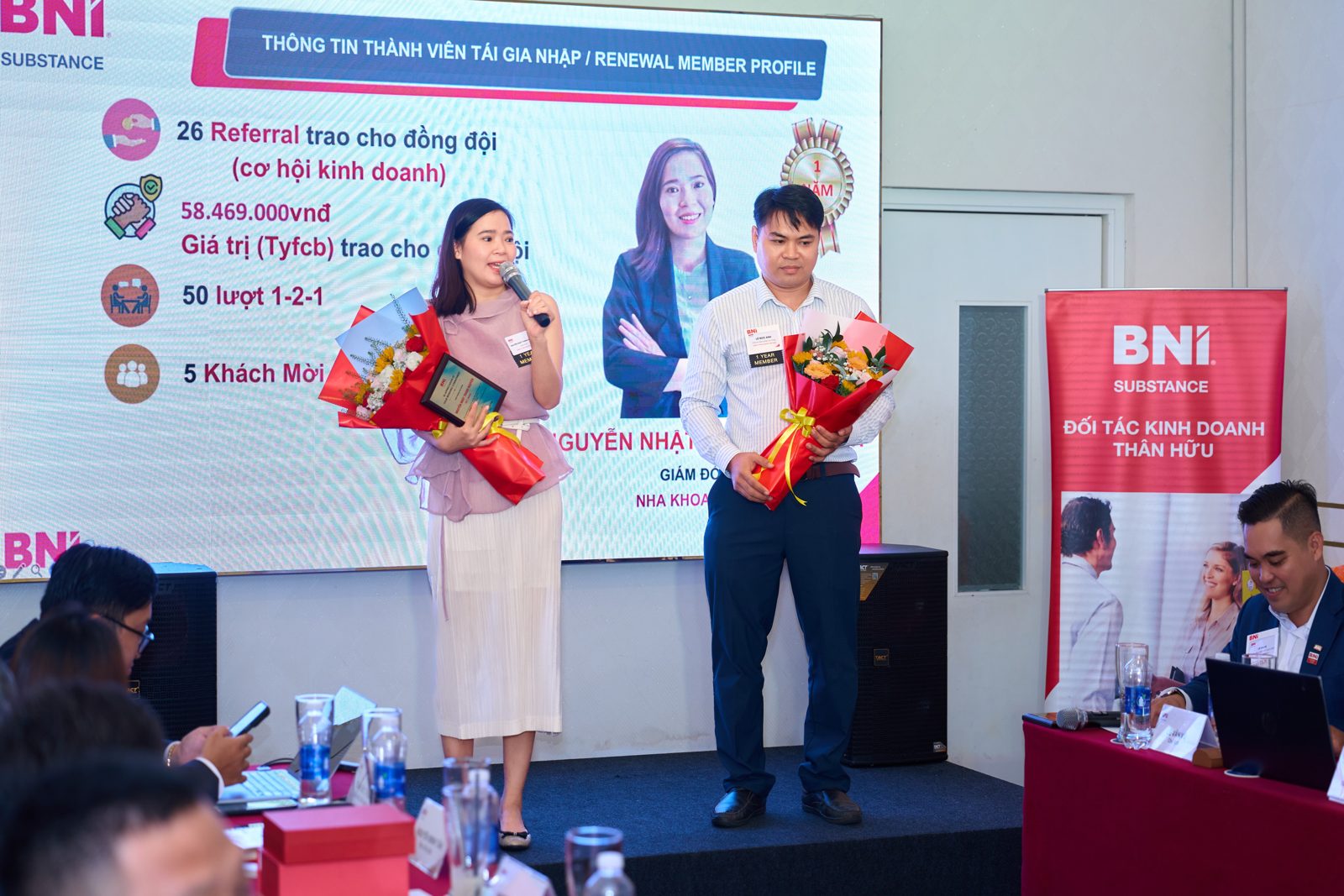
Membership renewal ceremony
One of the most meaningful moments of the morning was the renewal ceremony, recognising members who continue their journey with the Chapter for another term, together with their results over the past year:
- Ms. Nguyen Nhat Thanh Nguyen – Director of Vic’s Dental Clinic Co., Ltd: 26 referrals given to teammates, VND 58,469,000 in closed business (TYFCB) passed to teammates, 50 one-to-one meetings and 5 visitors invited.
- Mr. Le Duc Anh – Director of BCM PET Vietnam: 5 referrals given to teammates, VND 12,683,000 in closed business (TYFCB) passed to teammates and 12 one-to-one meetings.
In BNI, renewing membership is not simply an administrative step – it is a commitment to keep giving and to keep building the community.
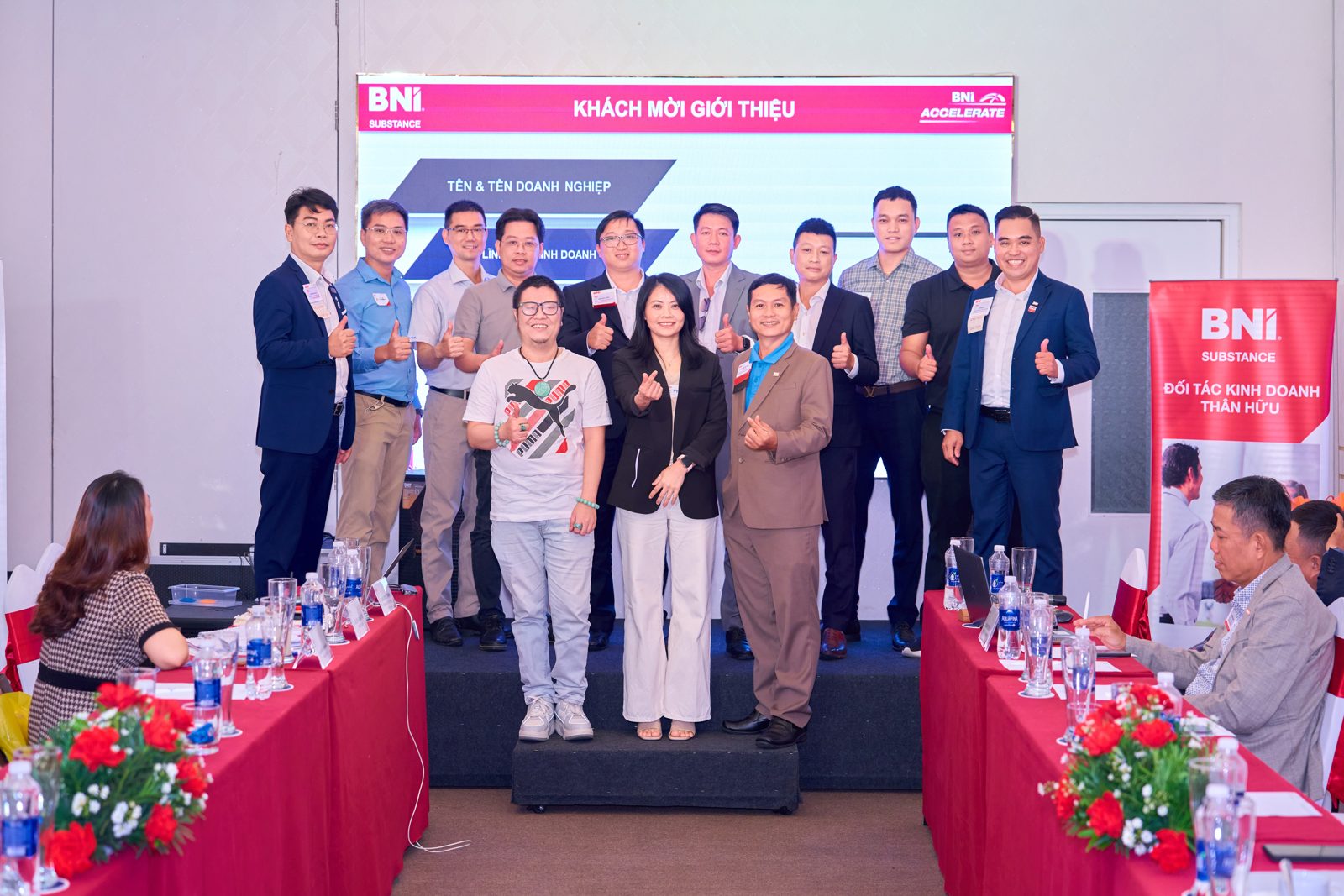
30-second introductions and the visitors’ session
The 30-second introductions ran by Power Team – Health & Beauty, Business Support, and Construction – Real Estate – Manufacturing. Each member had 30 seconds to make three things clear: what they do, who they want to meet, and how they can help the community.
Visitors then took the stage to introduce their name, company, industry and the connections they were looking for – and many new relationships started right there in the room.
Feature Presentation: MMS Solution – From marketing to a business growth ecosystem
The highlight of the meeting was the Feature Presentation by Mr. Tran Duc Thinh, Director of MMS Solution, on the theme “From marketing to a business growth ecosystem”.
He opened with a question aimed straight at the owner’s wallet: where is your business losing money? Ads cost money, but clicks do not guarantee real customers. Websites get traffic yet produce few leads and few orders. Data sits in silos, so no one knows which channel actually generates revenue. Leads arrive but are not followed up in time, and sales leak away. The problem, Mr. Thinh argued, is not a lack of marketing effort – it is the lack of a connected system.
MMS Solution positions itself as a growth partner for SMEs, working across four pillars: Marketing (SEO, Google Ads, content, website) to attract customers; Technology (tracking, CRM, automation) to connect the data; AI to lift the productivity of content, sales and customer care; and Growth (CRO, reporting, scale) to optimise revenue. MMS does not sell disconnected service packages – it designs a complete growth journey, from search to conversion to retention and continuous optimisation.
The MMS Growth System was presented in five stages – Traffic, Conversion, Data, Retention and Scale – along with the question he put to the room: at which point in that system are your customers falling through?
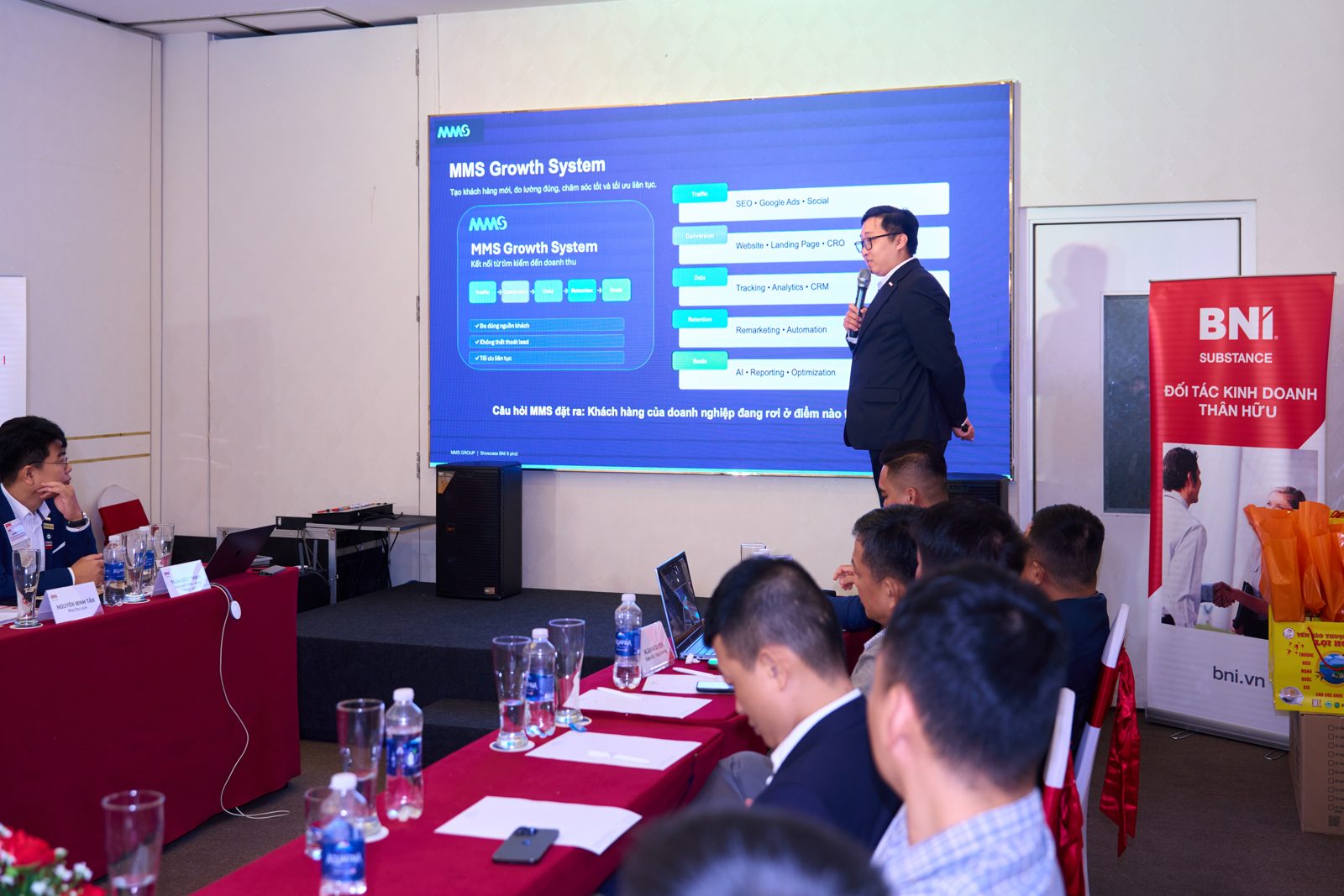
The case studies made the argument with data. For the coffee franchise brand Huong Cao Nguyen, the SEO strategy moved from intent-based keyword research and a content map built around the buying journey to SEO and AI Search optimisation, reaching more than 24,000 impressions, over 1,160 clicks and an average position of 7.1 on Google Search. On Google Ads, MMS shared tracked conversion figures across several projects, with cost per tracked conversion ranging from roughly VND 66,000 to VND 202,000 depending on the industry.
The differentiator Mr. Thinh emphasised is MMS Growth Technology – an in-house toolset that automates social, reputation, traffic and data touchpoints, moving MMS closer to an Agency + Product + AI model rather than purely manual delivery.
He closed with the slide that matters most to Chapter members: the referral triggers. When a prospect says “I spend a lot on ads but customers are not consistent”, “we have a website but it brings no customers”, “I want to rank on Google but don’t know how”, “we do a lot of marketing but can’t tell what drives revenue”, or “I want to apply AI but don’t know where to start” – think of MMS Solution and connect them with Mr. Tran Duc Thinh. The ideal client is a CEO, founder or B2B/SME owner with a stable product or service and a sales team, whose customer pipeline is not yet consistent and who is ready to invest in a long-term system.
Connecting and spreading value
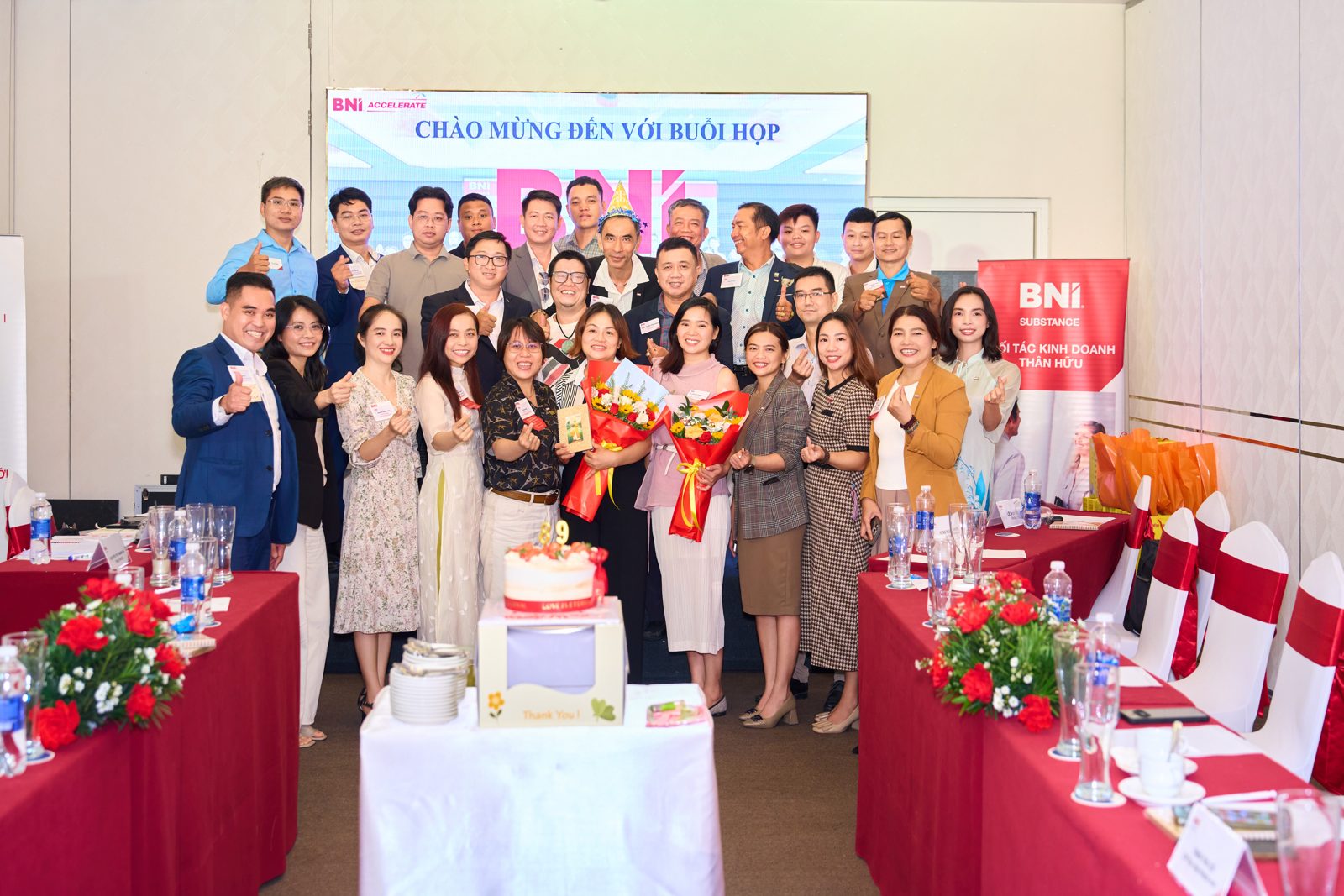
The meeting closed with a lucky draw and group photos. Looking back on the morning, what stays with you is not only the referral counts and business values, but the spirit of Givers Gain® – the principle that has made BNI Substance Chapter a place where business owners learn, broaden their thinking and find partners they can trust.
Thanks and contact
BNI Substance Chapter sincerely thanks Ms. Huynh Kim Thoa and Mr. Tran Duc Thinh for two valuable sessions, and thanks all members and especially the visitors who spent their morning with the Chapter.
BNI Substance Chapter meets every Thursday morning from 07:30 to 10:30 at Adora Legend Convention Centre – ground floor, 32 Hoang Viet Street, Tan Son Nhat Ward, Ho Chi Minh City. Businesses interested in attending as a visitor can register via: 0989 212 273 (Ms. Minh Thu).
Chapter President: Mr. Le Van Vu · Growth Director: Mr. Alan Nguyen
On the morning of Thursday, 3 September 2026, at the Adora Legend Convention Centre (Ground Floor, 32 Hoang Viet St., Tan Son Nhat Ward, Ho Chi Minh City), BNI Substance Chapter — part of BNI HCM West — hosted its regular Business Networking meeting, welcoming 30 business owners, members and visitors. In a warm, professional and collaborative atmosphere, the meeting once again affirmed the core value BNI stands for: Givers Gain®.

Open networking — every handshake opens an opportunity
From 07:30, the Adora Legend foyer was already buzzing with greetings. The Open Networking session that opened the programme is when business owners exchange cards, deliver their 30-second introductions and look for points of collaboration. At BNI, this is far more than a social formality — it is the first step of a value chain: understand each other, trust each other, and only then refer clients to each other.

Many conversations began with a very ordinary question — “How are you currently finding your clients?” — and ended with an appointment for a one-to-one coffee. That is exactly how a lasting business relationship is born.
Skills session: “The 200-Hour Rule” — shaping core relationships
The business-relationship skills session was led by Ms. Nguyen Thi Minh Thu – Senior Manager at Manulife, on the topic “200 Hours – Shaping Core Relationships.”

She opened with a candid observation: a quality referral rarely begins with asking for one. It begins when someone understands you well enough and trusts you enough to place their own reputation in your hands. From there, she walked the room through the four milestones of building trust:
- 50 hours — TO BE KNOWN. Others start to know who you are, what you do and which clients you are looking for. Consistent presence at chapter meetings, one-to-ones, training sessions and networking activities is the starting point: “No presence → no data for others to understand you.”
- 90 hours — FROM KNOWING TO LIKING (Know → Like). Through repeated encounters, people see how you work, how you keep your commitments and how you treat the community. Every one-to-one moves the relationship from “knowing a profession” to “understanding a person” — and no one can shorten those 90 hours by being absent.
- 120 hours — WHEN TRUST IS BIG ENOUGH (Like → Trust). Trust is built on four habits: keeping your word (even small commitments are honoured), giving first (living the spirit of Givers Gain®), caring for referrals (fast responses, professional follow-through) and walking alongside others (caring about fellow members’ success). Because when a member refers a client to you, they are not merely passing on an opportunity — they are placing their own reputation in your hands.
- 200 hours — BEING REMEMBERED WHEN THE OPPORTUNITY APPEARS. The complete value chain: full presence → one-to-one connection → giving referrals → accumulated trust → outstanding opportunities.
Her key takeaway came as a reversed question worth sitting with: stop asking “How many referrals has BNI given me?” and start asking “Have I invested enough for others to TRUST and REMEMBER me?” — because the formula is always TIME → CONNECTION → TRUST → REFERRAL → OPPORTUNITY.
Recognising outstanding members for August 2026 & 30-second introductions
A moment the whole room had been waiting for was the recognition of outstanding member performance for August 2026. Four members received the Notable Networker Award, certificates signed by Chapter President Mr. Le Van Vu and dated 3 September 2026:
- Mr. Nguyen Minh Tan — member who gave the highest-value business opportunities in August 2026: VND 142,030,000
- Mr. Le Van Vu — member who invited the most business partners in August 2026: 7 visitors
- Mr. Le Van Vu — member who gave the most business opportunities in August 2026: 11 referrals
- Mr. Tran Tan Loi — member with the most one-to-ones in August 2026: 21 meetings

Read together, those four awards are almost a summary of the training session that had just ended: invite visitors, meet one-to-one, give referrals — and only then does closed business value appear at the end of the chain.
The Chapter then recognised weekly performance for weeks 38 and 39. The highest TYFCB (Thank You For Closed Business) award went to Mr. Nguyen Minh Tan – ANTKING Group, with closed business worth VND 136,000,000.

Next came the 30-second introductions from members grouped by Power Team — Business Support, Health & Beauty, and Construction – Real Estate – Manufacturing — followed by introductions from visitors, structured around four points: name and company, line of business, who your ideal clients are, and how we can help you.

Feature Presentation: VIC’S Dental — “Raising the Standard of Vietnamese Dentistry”
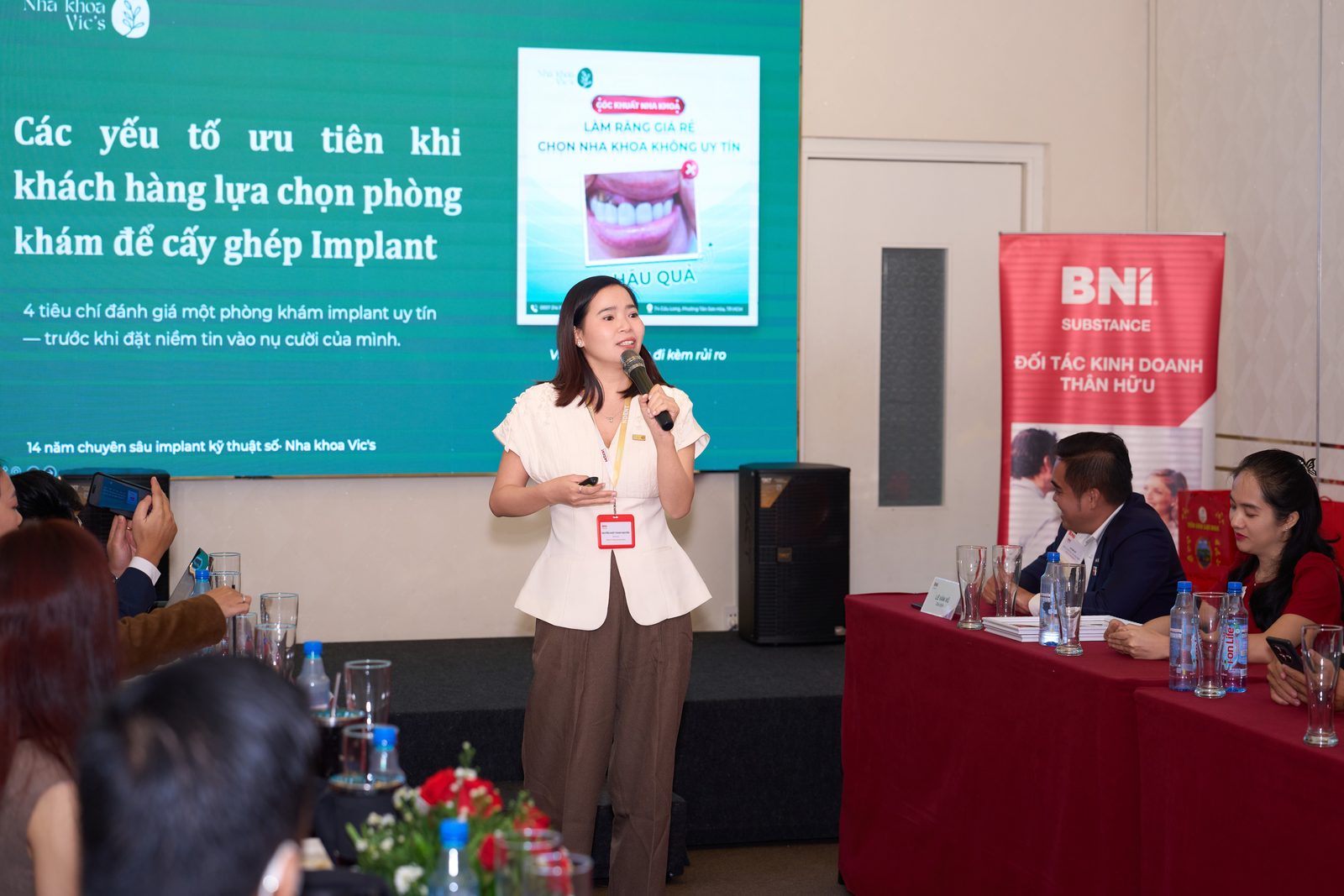
The highlight of the meeting was the Feature Presentation by Ms. Nguyen Nhat Thanh Nguyen – Chief Executive Officer of VIC’S Dental, on a highly practical topic: “What clients should prioritise when choosing a clinic for dental implants — and why a low price always comes with risk.”
Drawing on 14 years of specialisation in digital implantology, she laid out four criteria for evaluating a trustworthy implant clinic — before entrusting it with your smile:
- A clinic that meets surgical standards. The clinic must be licensed to perform implant placement, must have a separate sterile operating room, and must use 3D scanning and CT Cone Beam imaging to determine the exact position and angle of the implant before surgery. This is the clear dividing line between a technology-driven practice and a traditional manual one.
- The clinical team and hands-on experience. Doctors need a practising licence and implant specialty certification, must keep updating their techniques, and should publish their credentials. The real measure is the number of successfully treated cases — especially complex ones such as full-arch tooth loss, sinus lifts and bone grafts. Her advice was direct: ask your treating doctor how many times they have handled a case like yours.
- Origin and transparency of implant materials. The brand and origin of the implant fixture must be clear. An unusually low price often means non-genuine materials — with a risk of rejection and infection that costs far more than the initial saving. A reputable clinic is always ready to show full documentation of origin on request.
- Warranty and post-operative care. An implant needs several months to integrate with the jawbone, so scheduled follow-up visits are essential to address any complication in time. A reputable clinic commits to a written warranty setting out duration, scope and responsibility — and does not walk away when problems arise.
Alongside the criteria, Ms. Thanh Nguyen presented the technology platform VIC’S Dental has invested in as part of a fully digital approach: non-invasive, pain-free 3D dental scanning; precise positioning of implant location and angulation; platelet-rich fibrin (PRF) to support healing; and implant design accurate to within 10 micrometres.

The message that stayed with the room was clear: an implant case is not an ordinary cosmetic service but a surgical procedure — and what clients should compare is not the price list, but surgical standards, clinical skill, material provenance and a long-term commitment to care. That is how VIC’S pursues its goal of raising the standard of Vietnamese dentistry.
Connecting and spreading value
The programme closed with a lucky draw and gifts for members and visitors — a light-hearted moment that is nonetheless very “Substance”: give first, and the joy comes back around.

What lingered after the morning of 3 September was not merely the business cards exchanged, but the spirit of Givers Gain® running through the whole session: from the lesson on investing 200 hours in trust, to the reminder about transparency and professional responsibility in healthcare, to the handshakes that opened new opportunities for collaboration.

BNI Substance Chapter sincerely thanks Ms. Nguyen Thi Minh Thu, Ms. Nguyen Nhat Thanh Nguyen, and all members and visitors who made this a morning full of energy and value.
BNI Substance Chapter meets every Thursday morning, 07:30 – 10:30, at the Adora Legend Convention Centre – Ground Floor, 32 Hoang Viet St., Tan Son Nhat Ward, Ho Chi Minh City. Businesses interested in attending as visitors are welcome to contact Ms. Minh Thu – 0989.212.273. Chapter President: Mr. Le Van Vu · Growth Director: Mr. Alan Nguyen.
On the morning of Thursday, 20 August 2026, at the Adora Legend Convention Centre (Ground Floor, 32 Hoang Viet St., Tan Son Nhat Ward, Ho Chi Minh City), BNI Substance Chapter — part of BNI HCM West — hosted its regular Business Networking meeting, welcoming more than 40 business owners, members and visitors. In a warm, professional and collaborative atmosphere, the meeting once again affirmed the core value BNI stands for: Givers Gain®.

Open networking — every handshake opens an opportunity
From 07:30, the Adora Legend foyer was already buzzing with greetings. The Open Networking session that opened the programme is when business owners exchange cards, deliver their 30-second introductions and look for points of collaboration. At BNI, this is far more than a social formality — it is the first step of a value chain: understand each other, trust each other, and only then refer clients to each other.
Many conversations began with a simple question — “How are you currently finding your clients?” — and ended with an appointment for a one-to-one coffee. That is exactly how a lasting business relationship is born.
Skills session: “The Hot Potato” — The power of the Power Team
The business-relationship skills session was led by Mr. Le Van Vu – Chairman of Trend Realty and President of BNI Substance Chapter, on the topic “The Hot Potato – The Power of the Power Team.”

He opened with a striking figure — 67% of business opportunities come from the Power Team — and quoted BNI founder Dr. Ivan Misner: “Givers in BNI pass referrals to each other like a hot potato.” The principle is clear: within a Power Team, a referral should never be held longer than 24–48 hours. Hold it and it goes cold; pass it to the right person at the right time and its value multiplies.
The strength of a Power Team lies in complementary professions, so that a single client can generate 4–7 business opportunities for the whole group:
- Property chain: real estate → bank loan → insurance → home renovation → interior design → moving services. One client alone can produce 4–7 referrals across the team.
- Health chain: health check-up → nutrition → gym → supplements → insurance → monitoring devices. One client can generate 4–6 transactions for the team.
- As a result, a Power Team can multiply value 3–10 times compared with isolated relationships within a chapter.
So what makes a Power Team strong? His answer was direct: cover every link of the Power Team so the “hot potato” is not lost along the way. Each member should actively review their own contact sphere and that of their team, then let the Chapter know which professions are still missing — because every empty link is an opportunity slipping away.
Key takeaway: a strong Power Team requires structure, accountability, training and consistency. A Power Team is where referrals are not merely passed on — they are amplified. That is how the chapter grows stronger, member businesses grow stronger, and relationships between members turn into lasting momentum.
Feature Presentation: Golden Mouse Pharmacy — “Living Long, Living Well, Living Happy IS A CHOICE”
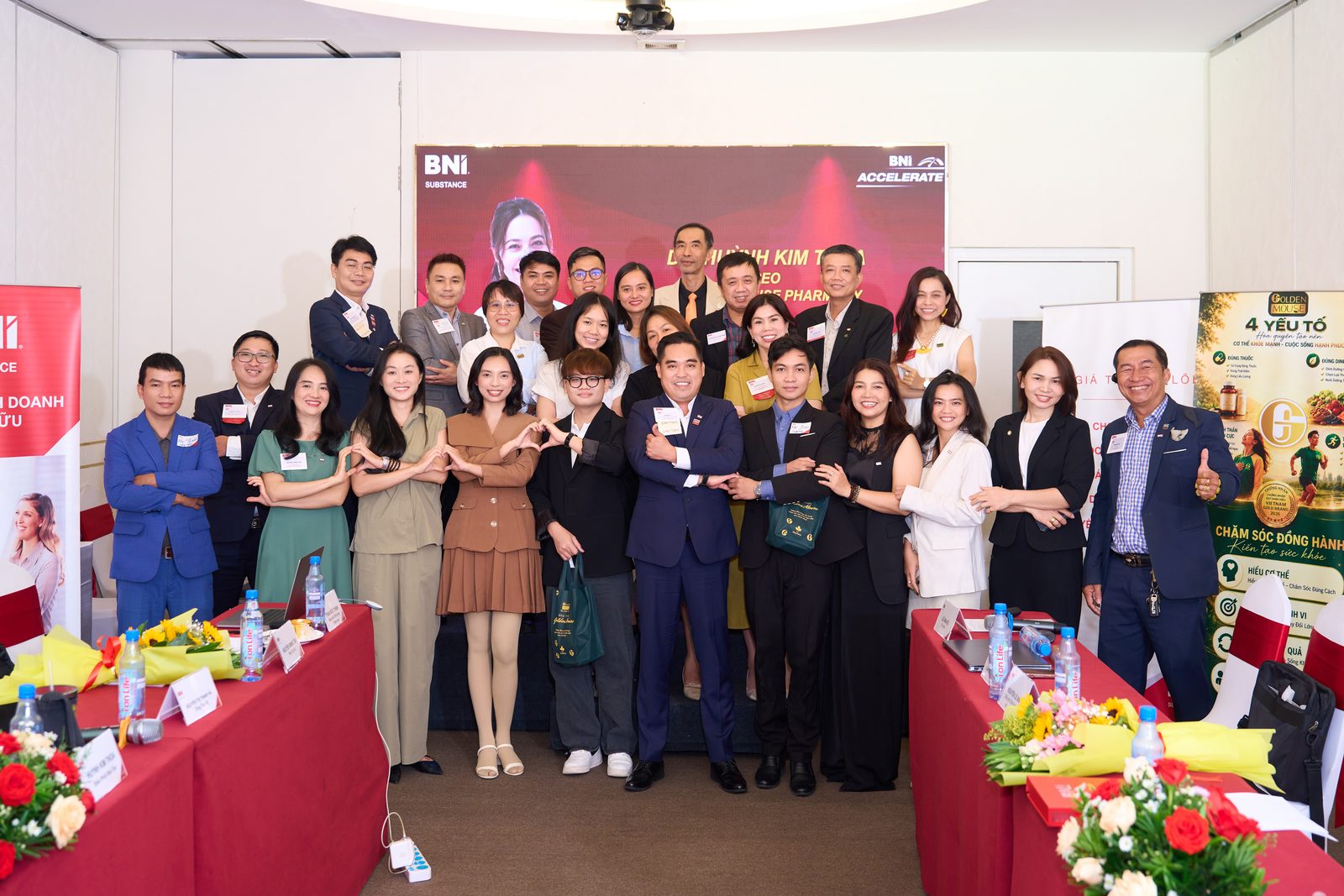
The highlight of the meeting was the Feature Presentation by Pharm. Huynh Kim Thoa – Chief Executive Officer of GOLDEN MOUSE PHARMACY, built around a simple yet powerful message: “Living long, living well and living happy is a choice.”

She opened with an uncomfortable picture of public health in Vietnam. Each year the country records more than 200,000 strokes, at ever younger ages; over 8 million people living with type 2 diabetes; over 20 million people overweight or obese; with the economic cost of illness estimated at VND 20,000 billion per year. Those numbers raise a question many prefer to avoid: is serious illness really just a matter of fate?
Her answer was unequivocal: “A stroke is never sudden.” The body always signals first — we simply have not truly listened:
- Persistent fatigue and headaches; poor, restless sleep
- Shortness of breath, difficulty concentrating, poor appetite
- Blood-sugar irregularities and abnormal blood lipids
- Blood pressure from 125/75 mmHg upwards
She also revisited the international rule for spotting the early signs of a stroke — BE FAST (Balance – Eyesight – Face – Arm – Speech – Time) — because in stroke emergencies, every minute counts.

Illness does not appear out of nowhere — it enters through what we eat, and grows out of our habits and lifestyle. From that perspective, Golden Mouse Pharmacy presented its framework of four pillars of healthy living, grounded in the World Health Organization (WHO) definition: health is a state of complete physical, mental and social well-being, not merely the absence of disease or infirmity. Living well, therefore, is the sum of a healthy body, a peaceful mind and good social connection.
To put that philosophy into practice, Golden Mouse Pharmacy has built the Golden Mouse Healthy Living Club — where the four pillars are personalised for each individual, supported by a team that accompanies members every day, online and offline, to establish long-term health outcomes, with all knowledge standardised by specialists.
Closing her presentation, Pharm. Huynh Kim Thoa outlined the partners Golden Mouse Pharmacy hopes to connect with:
- Investors who share the vision: creating cash-flow value while spreading value to the Vietnamese community
- Quality traditional and modern medicine clinics with a genuine care mindset toward patients
- Physical and mental wellness providers
- Individuals and businesses who want to CHOOSE HEALTHY LIVING for themselves and their teams
More about Golden Mouse Pharmacy: www.goldenmouse.vn.
New Member Induction: Welcoming 1989 LAW LLC
One of the most formal and moving moments of the meeting was the New Member Induction Ceremony. Following a rigorous vetting process in line with BNI procedures and approval by the Chapter Leadership Team, BNI Substance officially welcomed Ms. NGUYEN THI BICH CHUNG – Director of 1989 LAW LLC, in the Legal Services category, as an official member of the Chapter. More than a formality, it marked the start of a new journey — one of connection, learning and growing together in the spirit of Givers Gain®.

1989 Law is a licensed law firm and a registered industrial property agent in Vietnam, operating under the philosophy “Your Trusted Solutions.” The firm delivers comprehensive legal solutions across nine practice areas: dispute resolution, corporate, labour, intellectual property, M&A, investment, real estate, data & technology, and tax. For Ms. Bich Chung, legal advice does not stop at answering a legal question — it means standing beside clients from risk prevention all the way to full resolution — because a business may spend years building its reputation, yet a single loosely drafted contract or an unprotected trademark can put all of that at risk.

During the ceremony the new member received her Member Toolkit, then raised her hand alongside the whole Chapter to recite the BNI Commitment — to provide the quality of services at the price quoted, to be truthful with members and their referrals, to build goodwill and trust among members and visitors, and to take responsibility for following up on every referral received. President Le Van Vu then welcomed her on behalf of the Chapter and walked the room with her to shake hands with every attendee.

The new member was then handed over to Ms. Le Kim Ngan – Membership Orientation for close onboarding support, to accelerate her integration and generate quality referrals from the very first weeks. The Chapter also thanked Mr. Nguyen Minh Tan, the sponsoring member whose trust and support brought this valuable new piece to the Substance family.

Connecting and spreading value
As the programme closed at 10:30, what lingered was not merely the business cards exchanged, but the spirit of Givers Gain® running through the whole morning: from the lesson on passing an opportunity quickly to the right person, to the invitation to choose a healthier way of living, to the handshake that welcomed a new member into the family.
BNI Substance Chapter sincerely thanks Mr. Le Van Vu, Pharm. Huynh Kim Thoa, and all members and guests who made this a morning full of energy and value.
BNI Substance Chapter meets every Thursday morning, 07:30 – 10:30, at the Adora Legend Convention Centre – Ground Floor, 32 Hoang Viet St., Tan Son Nhat Ward, Ho Chi Minh City. Businesses interested in attending as visitors are welcome to contact Ms. Minh Thu – 0989.212.273. Chapter President: Mr. Le Van Vu · Growth Director: Mr. Alan Nguyen.
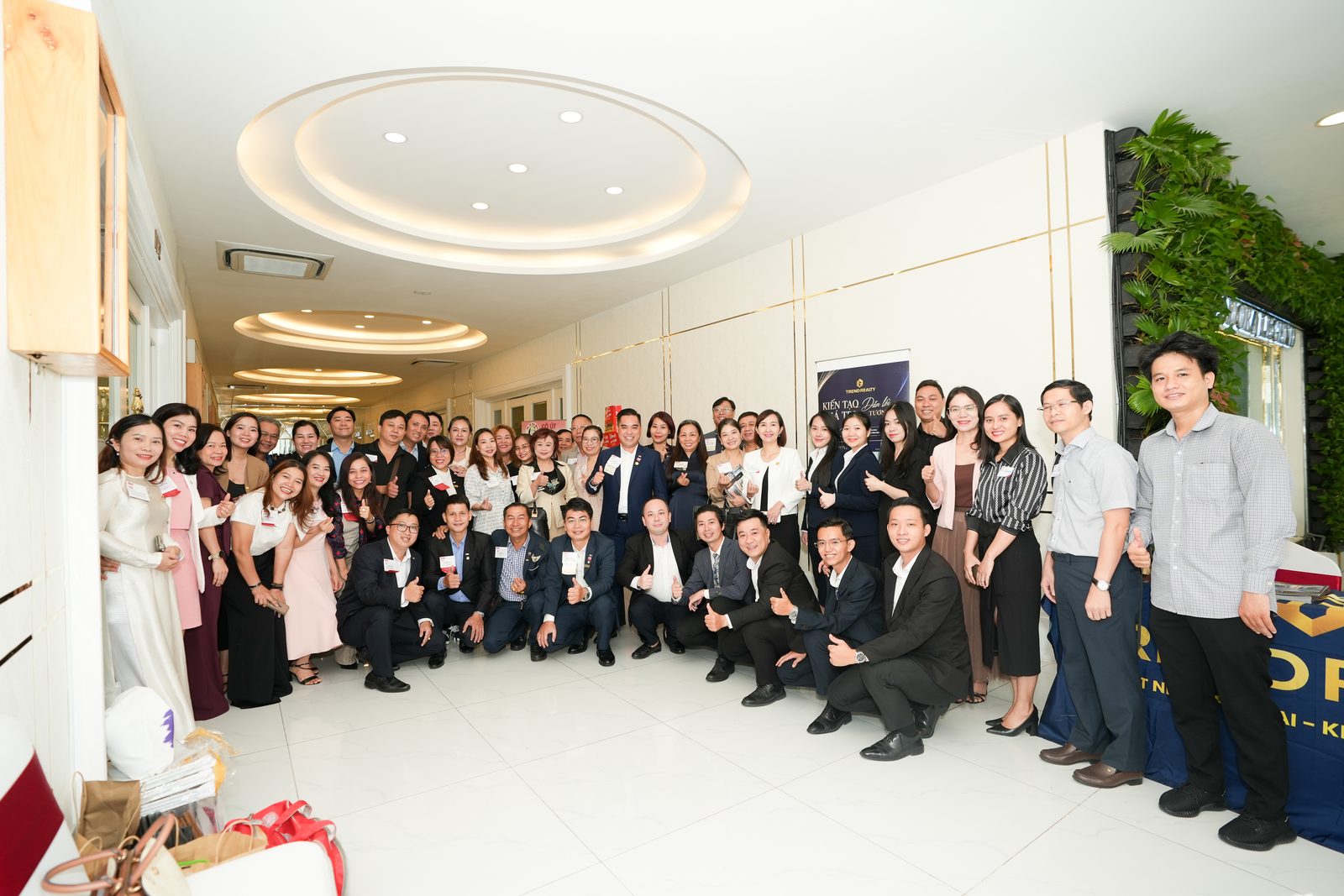
On the morning of Thursday, 13 August 2026, at the Adora Legend Convention Center (32 Hoang Viet St., Tan Son Nhat Ward, Ho Chi Minh City), BNI Substance Chapter (part of BNI HCM West) hosted a Business Networking event welcoming more than 40 business owners and numerous guests. In a warm, professional and collaborative atmosphere, members networked, learned relationship-building skills, and enjoyed a heartfelt company presentation from a fellow member.
Open Networking – The Start of Valuable Connections
Starting at 7:30 a.m., the Open Networking session warmed up the room. Entrepreneurs actively exchanged business cards and gave brief 30-second introductions of their products, services, and networking needs. This is a hallmark of BNI: every handshake can spark a new business opportunity, and every conversation can open the door to a lasting partnership.
Networking Education: “Your Network Is Your Greatest Asset”
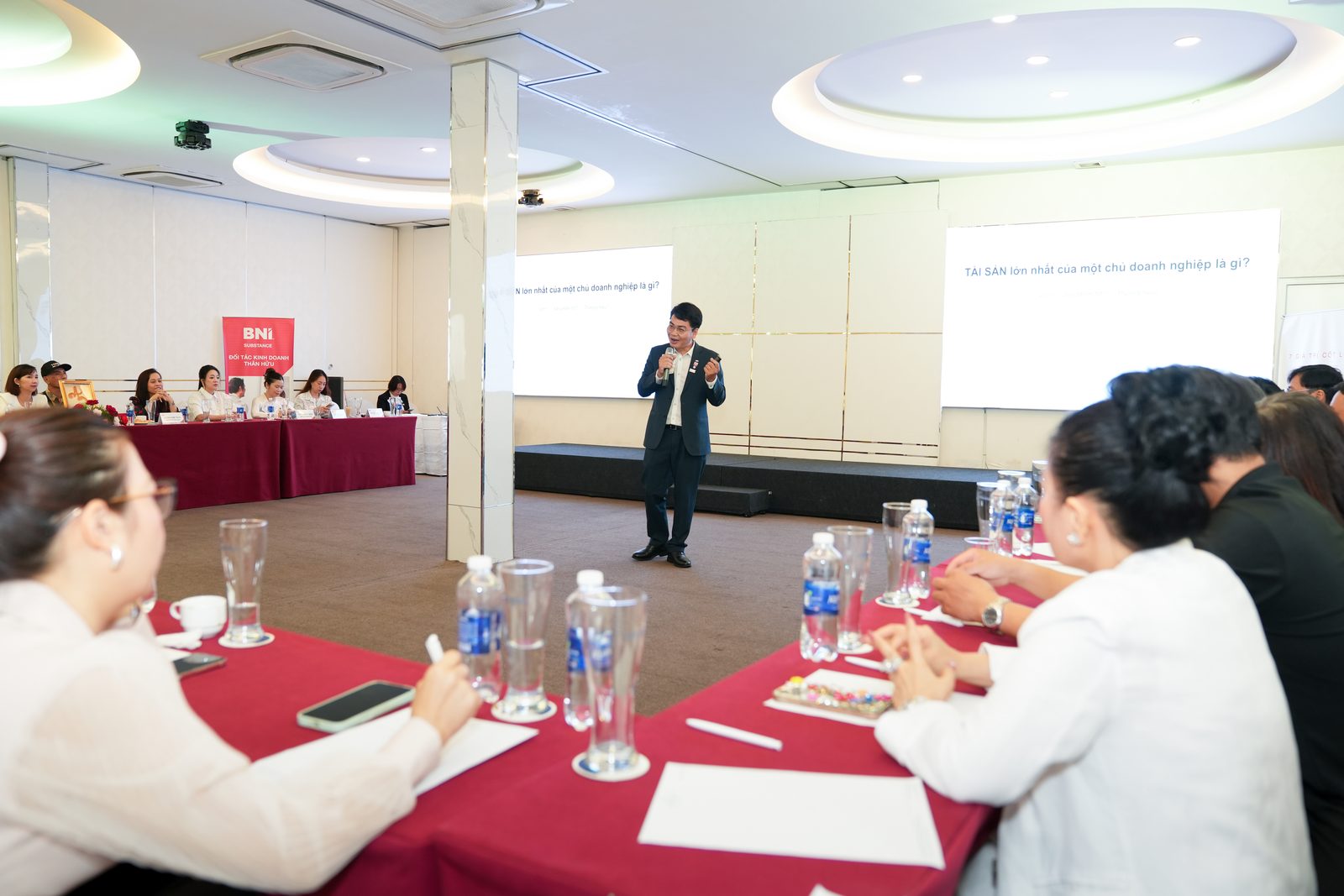
Opening the Networking Education segment, Mr. Nguyen Minh Tan – Chairman of AntKing Group posed a question: what is truly the greatest asset of a business owner – capital, a great product, or a strong brand? His answer: the greatest asset is the NETWORK of people ready to say your name whenever someone needs what you offer. An ordinary network is just a connection; it only becomes a true asset when the people in it understand you, trust you, and are willing to act on your behalf – the very spirit of BNI: Business + System + Commitment + Professionalism + Trust Connection.
He introduced the VCP model – three steps to building a network: Visibility – people know your name, company, and profession; Credibility – people trust your ability and quality; and Referrals – people proactively refer business opportunities to you, with each 1-2-1 meeting serving as a step toward credibility. Quoting Dr. Ivan Misner, founder of BNI: “Your network is your net worth,” he urged members not to try to hand a business card to all 40 people in the room, but instead to choose the right 1-2 people for a deeper conversation this very week.
Feature Presentation: Trend Realty – Real Estate Investment Risk Management
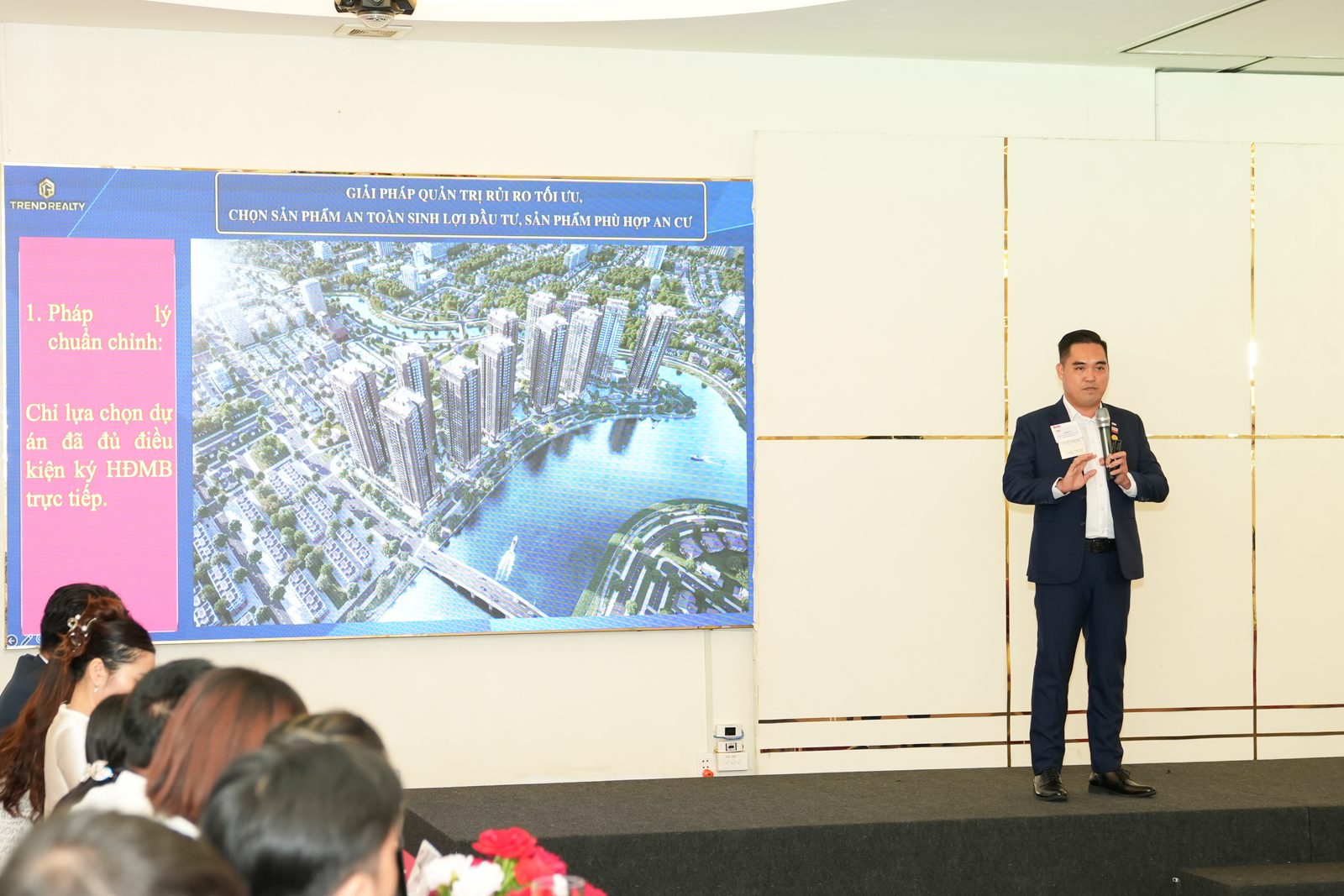
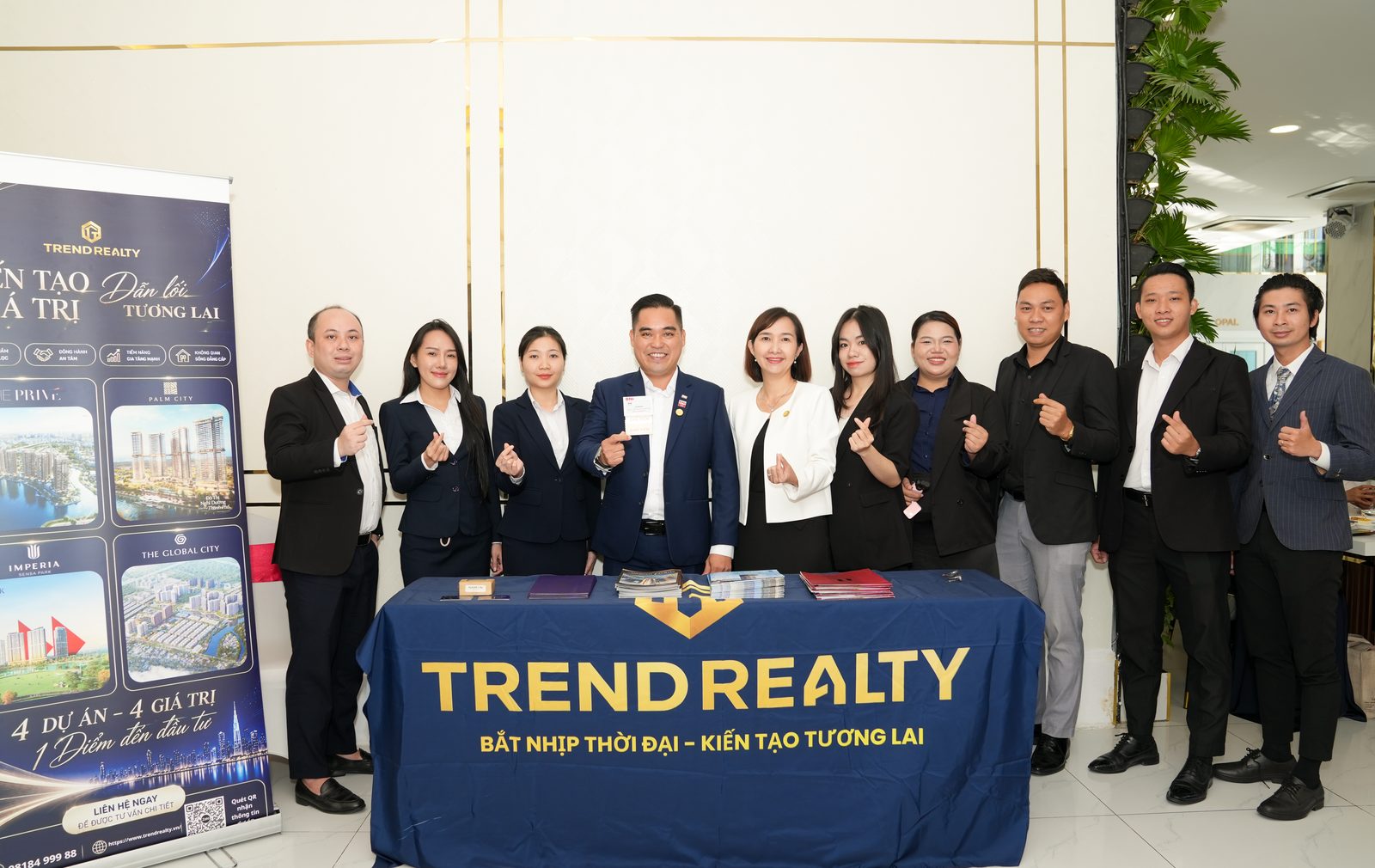
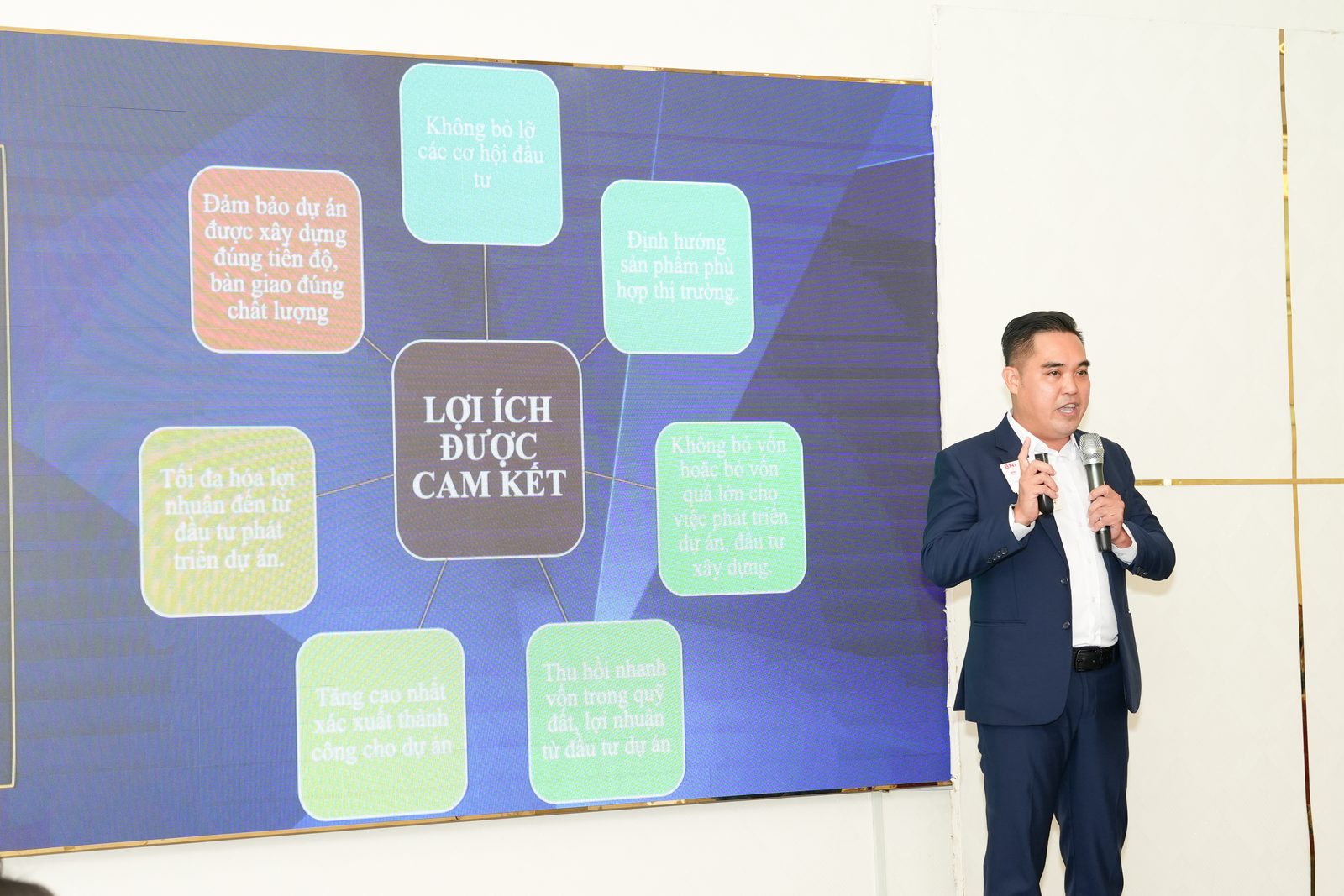
The centerpiece of this week’s Business Networking event was the Feature Presentation by Mr. Le Van Vu – Chapter President and Chairman of Trend Realty, titled “Risk Management in Real Estate Investment.” He explained why real estate remains the optimal asset-accumulation channel compared with gold, stocks, or crypto in the current period, thanks to accelerating public infrastructure investment and the ability to generate real cash flow alongside stable value appreciation across economic cycles. He also dissected six common risks investors face: legal risk, location-and-price pressure, developer capability, pricing distortion, loss of cash-flow control, and unreliable distribution units.
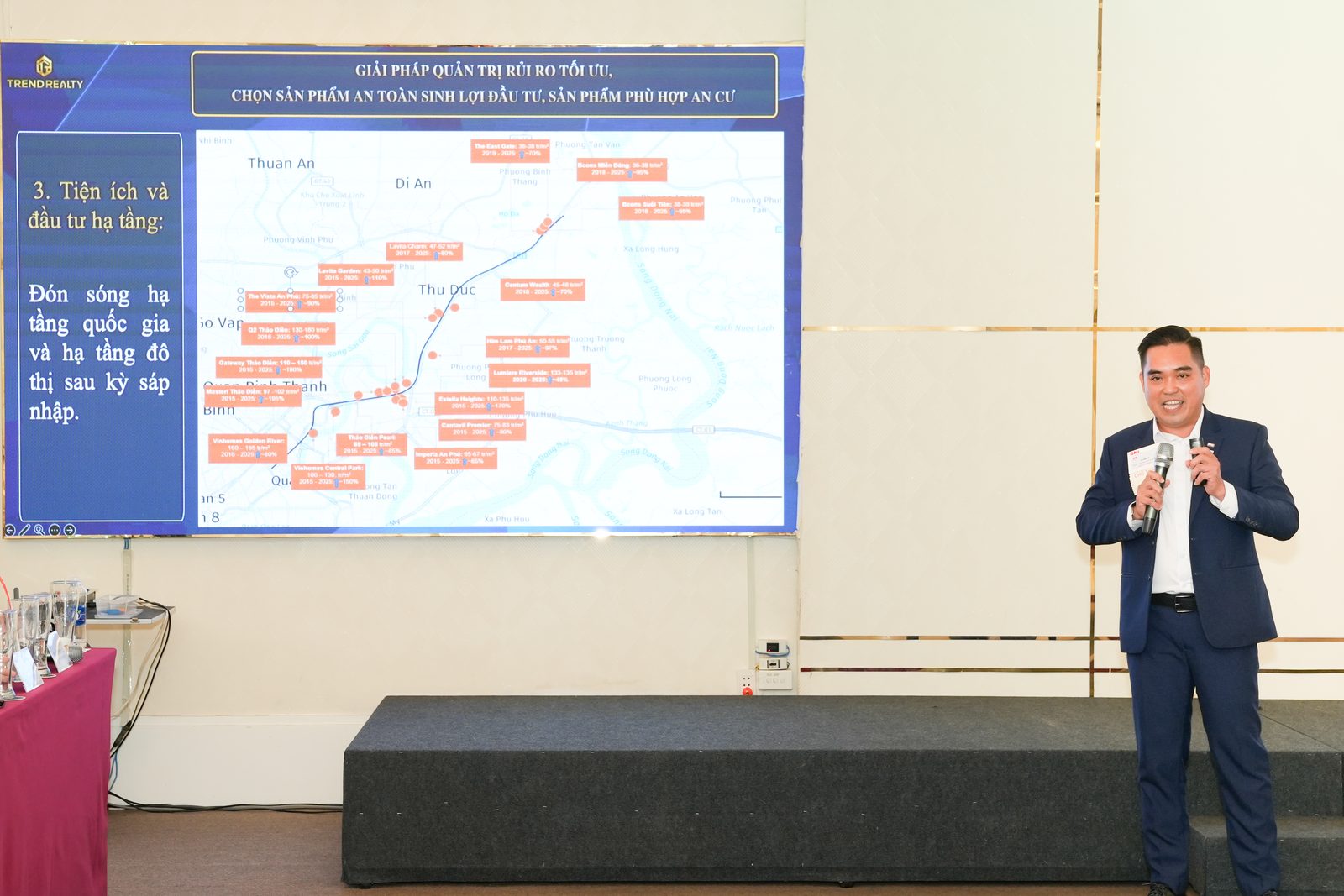
Building on this, Trend Realty presented four groups of optimal risk-management solutions for choosing products that are both safe investments and suitable homes: solid legal footing – only selecting projects eligible for a direct sale-and-purchase agreement; flexible financing – prioritizing light payment schedules with interest support and principal grace periods; capturing infrastructure upside – riding the wave of national and urban infrastructure investment following the recent administrative merger; and choosing a trusted brand – prioritizing developers with strong financial capacity and professional distribution partners. As a professional project developer and real estate distributor, Trend Realty is a strategic partner of major developers including Mitsubishi, Sun Group, Vinhomes, Keppel Land, Blue Marq, and Le Phong, currently distributing legally complete projects such as The Prive, Palm City, Blanca City, and Monrei Saigon.
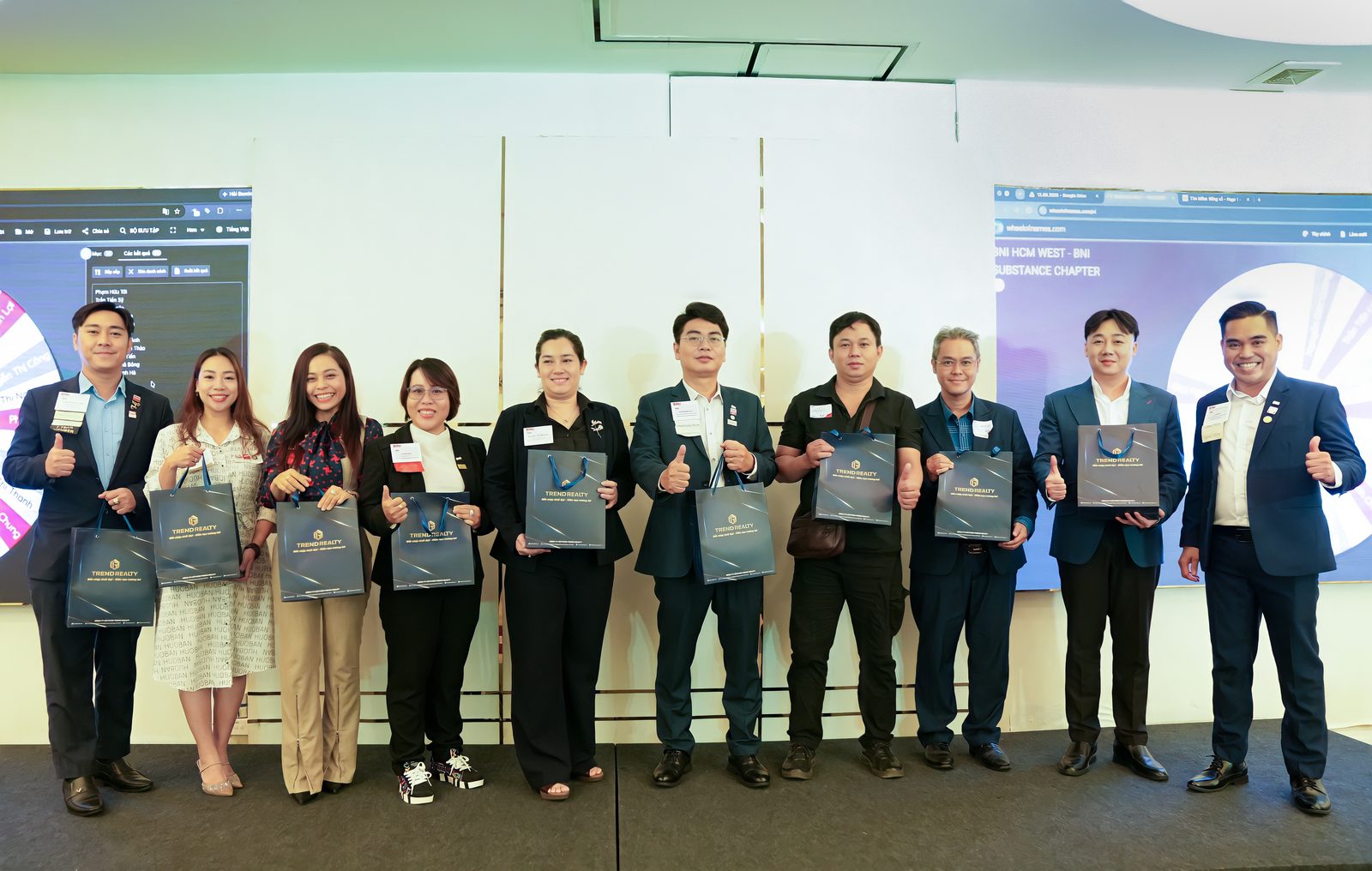
Under the message “Creating Value, Leading the Future,” Trend Realty closed its Feature Presentation with a lively networking and lucky-draw gift session for members and guests.
Connecting, Giving Opportunities, and Spreading Value
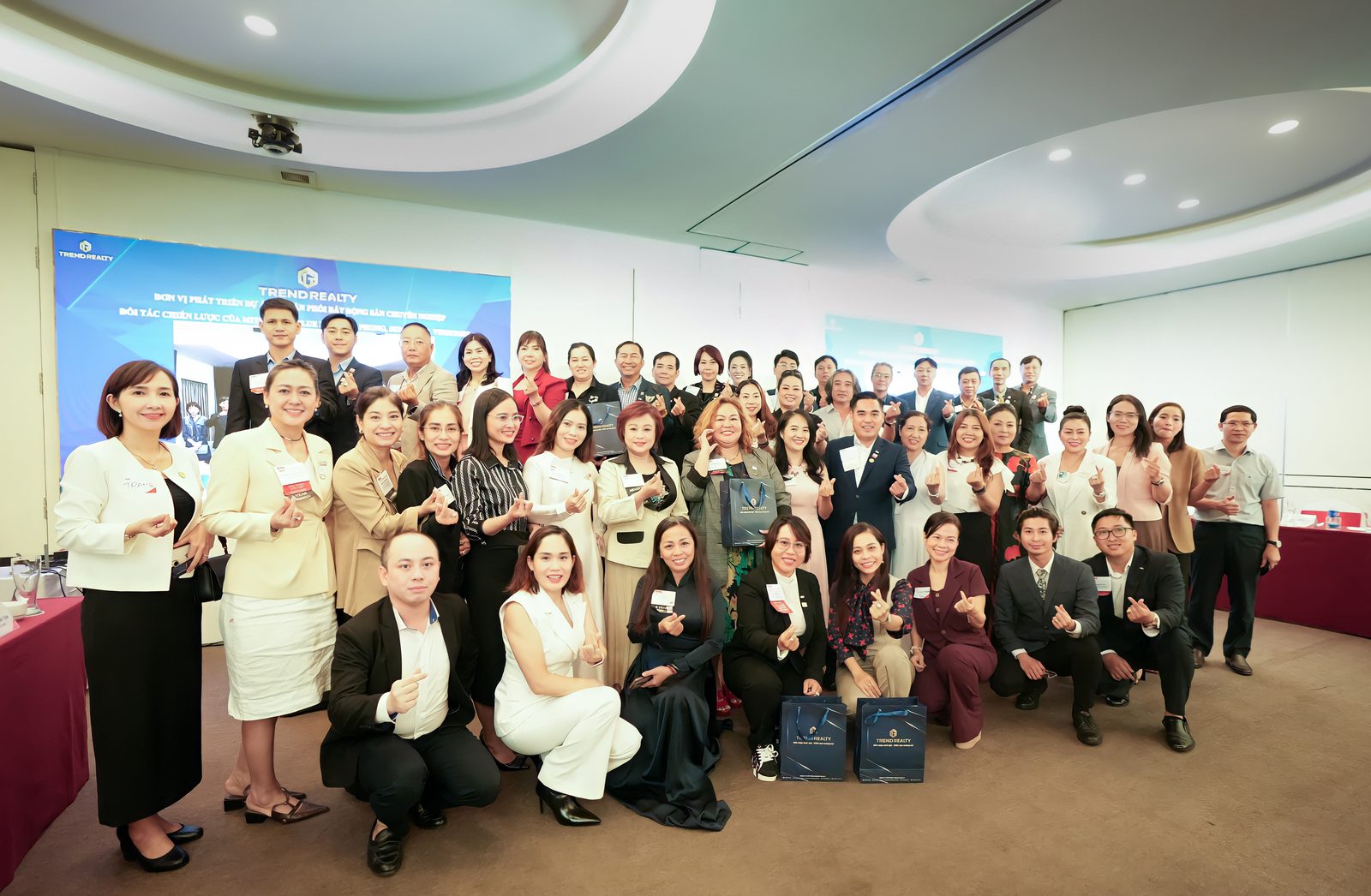
Throughout the morning, BNI’s Givers Gain® spirit was evident in every conversation, every introduction, and every business opportunity shared. More than just a meeting place, the Business Networking event serves as an environment for business owners to learn new skills, broaden their thinking, and find trustworthy partners.
BNI Substance Chapter extends its sincere thanks to both speakers – Mr. Nguyen Minh Tan and Mr. Le Van Vu – and to all members and guests who helped make this a successful networking morning. We look forward to welcoming you at the next Business Networking event.
Trend Realty: https://www.trendrealty.vn/. Register to attend & connect with BNI Substance Chapter: 0989.212.273 (Ms. Minh Thu).
Sign up to receive Invitation tickets